. 2015 Feb;21(2):290-7.
doi: 10.3201/eid2102.141091.

Lagenidium giganteum pathogenicity in mammals

Lagenidium giganteum pathogenicity in mammals

Raquel Vilela et al. Emerg Infect Dis. 2015 Feb.

Abstract

Infections of mammals by species in the phylum Oomycota taxonomically and molecularly similar to known Lagenidium giganteum strains have increased. During 2013-2014, we conducted a phylogenetic study of 21 mammalian Lagenidium isolates; we found that 11 cannot be differentiated from L. giganteum strains that the US Environmental Protection Agency approved for biological control of mosquitoes; these strains were later unregistered and are no longer available. L. giganteum strains pathogenic to mammals formed a strongly supported clade with the biological control isolates, and both types experimentally infected mosquito larvae. However, the strains from mammals grew well at 25°C and 37°C, whereas the biological control strains developed normally at 25°C but poorly at higher temperatures. The emergence of heat-tolerant strains of L. giganteum pathogenic to lower animals and humans is of environmental and public health concern.


Figures
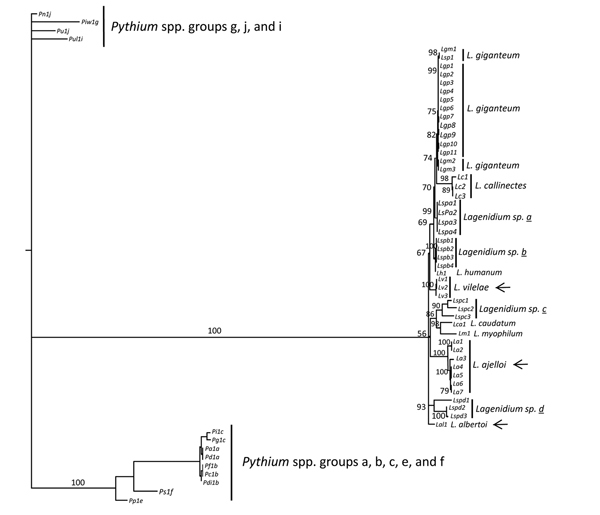
Figure 1
Figure 1
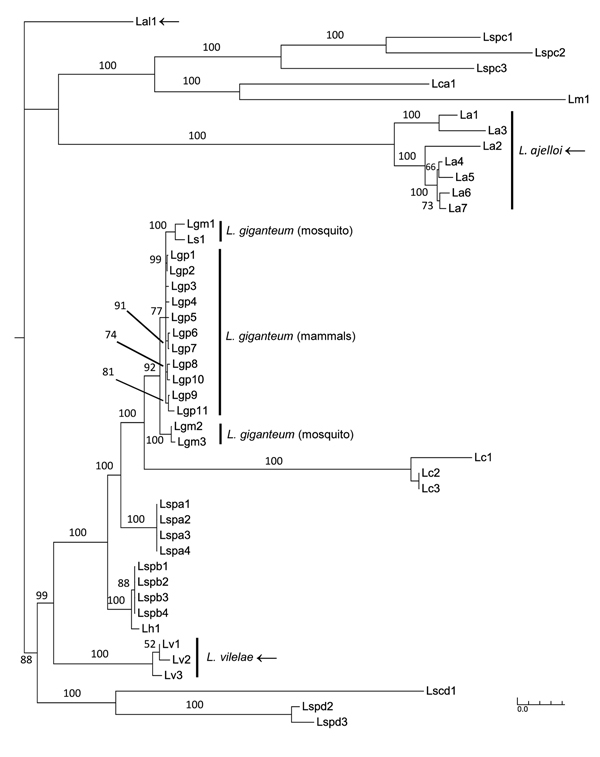
Bayesian phylogenetic analysis of concatenated 4 partial coding gene sequences (cell division cycle 42, cytochrome oxidase II, heat shock protein 90, and tubulin) and the complete internal transcribed spacers 1, 2, and 5.8S of Lagenidium DNA sequences. Thirteen Pythium species DNA sequences were included as the outgroup (groups a–c, e–g, j, and I [16 ]; Table). Support on key branches is the Bayesian probability for that branch followed by the percentage of 1,000 bootstrap resampled datasets containing the branch in neighbor-joining analyses of maximum-likelihood distances followed by the percentage of 1,000 bootstrap resampled datasets containing the branch in parsimony analyses using heuristic searches. In this analysis, the DNA sequences of L. giganteum mosquito control (Lg 1–3) and a Lagenidium sp. recovered from a nematode in Taiwan (Ls1, Lsp1 = HQ395647) clustered with L. giganteum from mammals (Lg 1–10). The pathogen of crab L. callinectes (Lc) was the sister group to the cluster. Three Lagenidium mammalian pathogenic novel species (L. ajelloi = La, L. albertoi = Lal, and L. vilelae = Lv) were placed in 3 distinctive strongly supported clades (arrows). The accession numbers, the abbreviations used to identify each species, and the Lagenidium and Pythium spp. DNA sequences are shown in the Table. ATCC, American Type Culture Collection; CBS, Centraalbureau voor Schimmelcultures.
Figure 2
Figure 2
The Bayesian tree was constructed by concatenated aligned of Lagenidium spp. DNA sequences as in Figure 1 without outgroup to highlight the position of L. giganteum in the tree. L. giganteum from mammals (Lgp 1–11), L. giganteum mosquito control (Lgm 1–3 and Ls1 = HQ395647), and the novel species L. ajelloi = La, L. albertoi = Lal, and L. vilelae = Lv were placed in 4 strongly supported clades (arrows). Scale bar indicates nucleotide substitutions per site.
Figure 3
Figure 3
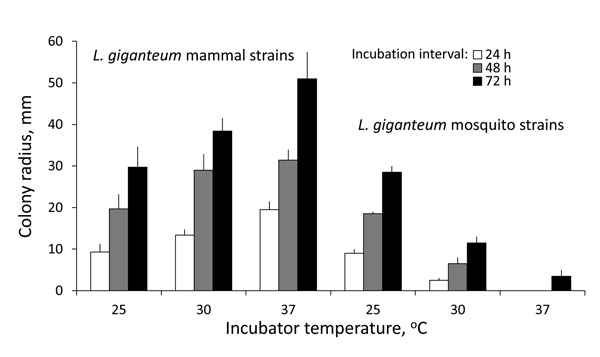
Cardinal temperatures of Lagenidium giganteum types in culture. Growth (mean colony radius and SEM, mm) of L. giganteum mammalian and mosquito strains at 3 temperatures at 24-, 48-, and 72-hour intervals postinoculation onto 2% Sabouraud dextrose agar. Repeated measures analysis of variance showed highly significant differences between strains (F1,33 = 165.0, p<0.0001) and a highly significant interaction of strain and incubation temperature across time intervals (F2,33 = 45.9, p<0.0001).
Figure 4
Figure 4
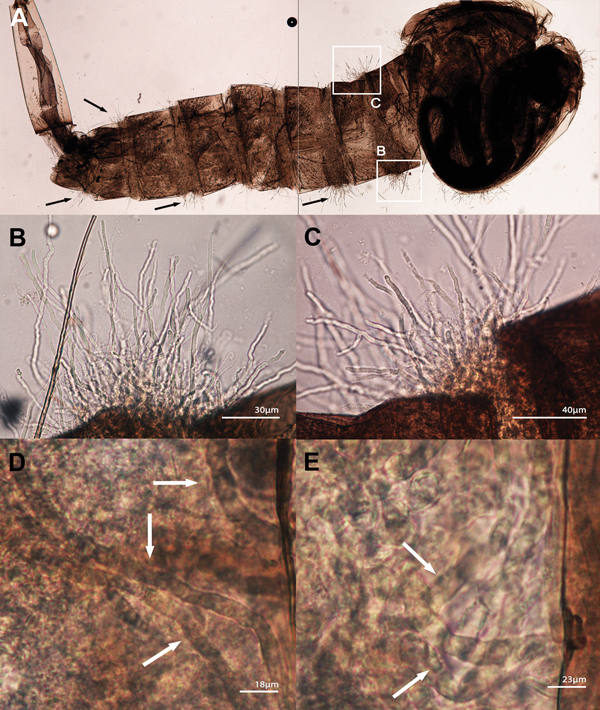
Lagenidium giganteum from mammal experimental infection using Culex pipiens mosquito larvae. A) Composite of 2 photographs showing an instar 3 C. pipiens larvae infected with 1 of the 5 tested strains of L. giganteum recovered from dogs with lagenidiosis (MTLA01, type strain). Note the mycelioid structures emerging from the infected larvae (arrows). B, C) Enlargements of the 2 white boxes in (A) showing details of the mycelioid structures emerging between the segments of the larvae. D, E) Aggressiveness of the invading mycelioid structures (arrows) within the body of C. pipiens larvae.
Figure 5
Figure 5
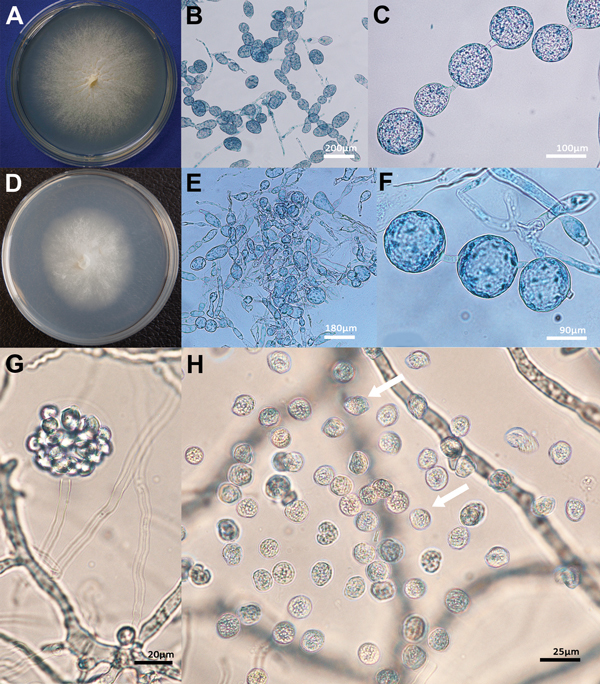
Morphologic features of isolates of Lagenidium giganteum mosquito control agent and L. giganteum mold from mammals. Panel A shows henotypic features in culture of the mammalian pathogen (ATCCMYA-4933, type strain) and panel D shows the biological control (ATCC 36492). The development of spherical and ovoid 40- to 170-μm swelling segments (panels B, C, E, F) was the main feature of both mammalian and biocontrol strains. Panel G shows A tubular body developed from an unseen segmented sporangium form a vesicle enclosing numerous zoospores in a mammalian L. giganteum strain. The kidney-shaped zoospores before release (G) and after release (H, arrows) agree with those in the original description of L. giganteum by Couch (10). ATCC, American Type Culture Collection.

References

    1. De Cock AW, Mendoza L, Padhye AA, Ajello L, Kaufman L. Pythium insidiosum sp. nov., the etiologic agent of pythiosis. J Clin Microbiol. 1987;25:344–9 . - PMC - PubMed
    1. Gaastra W, Lipman LJ, De Cock AW, Exel TK, Pegge RB, Scheurwater J, et al. Pythium insidiosum: an overview. Vet Microbiol. 2010;146:1–16. 10.1016/j.vetmic.2010.07.019 - DOI - PubMed
    1. Grooters AM. Pythiosis, lagenidiosis, and zygomycosis in small animals. Vet Clin North Am Small Anim Pract. 2003;33:695–720. 10.1016/S0195-5616(03)00034-2 - DOI - PubMed
    1. Grooters AM, Hodgin EC, Bauer RW, Detrisac CJ, Znajda NR, Thomas RC. Clinicopathologic findings associated with Lagenidium sp. infection in 6 dogs: initial description of an emerging oomycosis. J Vet Intern Med. 2003;17:637–46. 10.1111/j.1939-1676.2003.tb02494.x - DOI - PubMed
    1. Mendoza L, Vilela R. The mammalian pathogenic oomycetes. Curr Fungal Infect Rep. 2013;7:198–208.

Publication types

Substances