Review
. 2015:4:296-307.
doi: 10.1016/j.redox.2015.01.008. Epub 2015 Jan 14.

NLRP3 inflammasome: from a danger signal sensor to a regulatory node of oxidative stress and inflammatory diseases

Affiliations
Review

NLRP3 inflammasome: from a danger signal sensor to a regulatory node of oxidative stress and inflammatory diseases

Amna Abderrazak et al. Redox Biol. 2015.

Abstract

IL-1β production is critically regulated by cytosolic molecular complexes, termed inflammasomes. Different inflammasome complexes have been described to date. While all inflammasomes recognize certain pathogens, it is the distinctive feature of NLRP3 inflammasome to be activated by many and diverse stimuli making NLRP3 the most versatile, and importantly also the most clinically implicated inflammasome. However, NLRP3 activation has remained the most enigmatic. It is not plausible that the intracellular NLRP3 receptor is able to detect all of its many and diverse triggers through direct interactions; instead, it is discussed that NLRP3 is responding to certain generic cellular stress-signals induced by the multitude of molecules that trigger its activation. An ever increasing number of studies link the sensing of cellular stress signals to a direct pathophysiological role of NLRP3 activation in a wide range of autoinflammatory and autoimmune disorders, and thus provide a novel mechanistic rational, on how molecules trigger and support sterile inflammatory diseases. A vast interest has created to unravel how NLRP3 becomes activated, since mechanistic insight is the prerequisite for a knowledge-based development of therapeutic intervention strategies that specifically target the NLRP3 triggered IL-1β production. In this review, we have updated knowledge on NLRP3 inflammasome assembly and activation and on the pyrin domain in NLRP3 that could represent a drug target to treat sterile inflammatory diseases. We have reported mutations in NLRP3 that were found to be associated with certain diseases. In addition, we have reviewed the functional link between NLRP3 inflammasome, the regulator of cellular redox status Trx/TXNIP complex, endoplasmic reticulum stress and the pathogenesis of diseases such as type 2 diabetes. Finally, we have provided data on NLRP3 inflammasome, as a critical regulator involved in the pathogenesis of obesity and cardiovascular diseases.

Keywords: Cardiovascular diseases; IL-18 (PDB id: Q14116); IL-1β (PDB id: P01584, P10749); NLRP3 inflammasome (PDB id: Q96P20); Obesity.


Figures

Fig. 1
Fig. 1
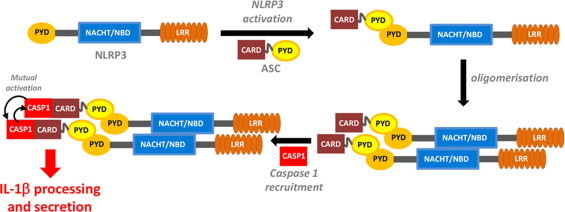
NLRP3 inflammasome assembly. CARD, caspase recruitment domain; LRR, leucine-rich repeat; NACHT/NBD, nucleotide binding domain; PYD, pyrin domain; CAP1, caspase-1.
Fig. 2
Fig. 2
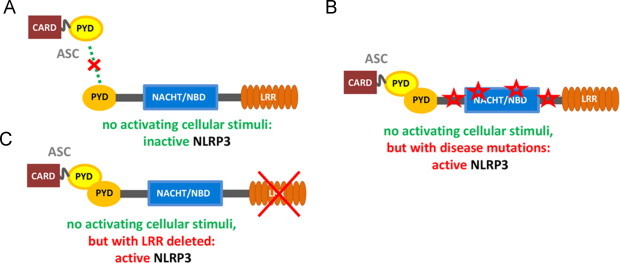
NLRP3 domain structure and its influence on interactions of its pyrin domain. (A) It is unresolved how the pyrin domains shielded from engaging the readily available pyrin domain in ASC in non-activated NLRP3. (B) Disease-associated mutations in NLRP3 were shown to promote pyrin–pyrin domain engagement between NLRP3 and ASC. (C) Biochemical deletion of the LRR-domain in NLRP3 unmasks the pyrin domain and thus facilitates its binding to ASC's pyrin domain.
Fig. 3
Fig. 3
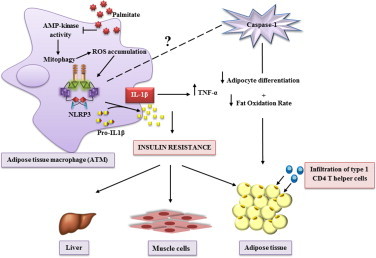
The NLRP3 inflammasome is a key mediator of metabolic inflammation and disorder. In ATM, saturated free fatty acids, but not unsaturated free fatty acids, inhibit regulation of energy storage and cell lipid metabolism by decreasing AMP-activated kinase activity, which normally leads to degradation and recycling of mitochondrial components. When mitophagy is inhibited, the accumulation of dysfunctional mitochondria promotes, (i) mitochondrial generation of ROS and (ii) mitochondrial release of DNA into the cytosol, which combined activate the NLRP3 inflammasome and cleave pro-IL-1β into the active form IL1-1β. This proinflammatory state leads to deterioration of the metabolism. IL1-β enhances insulin-resistance through serine phosphorylation of insulin receptor substrate-1 (IRS-1) that impairs engagement of the insulin receptor (IR) with IRS-1. It also triggers a direct-insulin resistance by promoting expression of TNF-α. Absence of caspase-1 improves adipogenesis and increases fat oxidation rate. Other unknown inflammasome sensors might regulate adipocyte differenciation/maturation and control the cellular energy metabolism through the enzyme caspase-1.
Fig. 4
Fig. 4
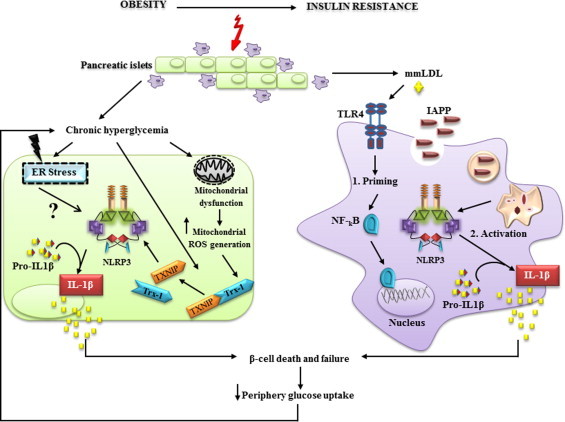
Inflammasome is a central player in the induction of β-cell death and T2DM progression. Chronic exposure of pancreatic β-cells to elevated concentrations of glucose promotes TXNIP expression, endoplasmic reticulum stress and accumulation of dysfunctional mitochondria leading to intracellular ROS accumulation. ROS generation drives NLRP3 activation in a TXNIP-dependent manner. However, ER activation pathway(s) remain poorly understood. IAPP is deposited in pancreas and quickly taken up by macrophages. 1. mmLDL primes cells through TLR4 signaling and 2. IAPP specifically activates NLRP3 inflammasome and pro-IL-1β cleavage. IL1-β signaling induces a local proinflammatory environment through activation of other chemotactic factors and immune cell infiltration that aggravates β-cell failure.

References

    1. Janeway C.A., Jr. The immune system evolved to discriminate infectious nonself from noninfectious self. Immunology Today. 1992;13(1):11–16. 1739426 - PubMed
    1. Matzinger P. The danger model: a renewed sense of self. Science. 2002;296(5566):301–305. 11951032 - PubMed
    1. Martinon F., Tschopp J. NLRs join TLRs as innate sensors of pathogens. Trends in Immunology. 2005;26(8):447–454. 15967716 - PubMed
    1. Martinon F., Burns K., Tschopp J. The inflammasome: a molecular platform triggering activation of inflammatory caspases and processing of proIL-beta. Molecular Cell. 2002;10(2):417–426. 12191486 - PubMed
    1. Dinarello C.A. A clinical perspective of IL-1beta as the gatekeeper of inflammation. European Journal of Immunology. 2011;41(5):1203–1217. 21523780 - PubMed

MeSH terms