. 2015 Jan 23;7(2):219-37.
doi: 10.3390/toxins7020219.

AaeAP1 and AaeAP2: novel antimicrobial peptides from the venom of the scorpion, Androctonus aeneas: structural characterisation, molecular cloning of biosynthetic precursor-encoding cDNAs and engineering of analogues with enhanced antimicrobial and anticancer activities

Affiliations

AaeAP1 and AaeAP2: novel antimicrobial peptides from the venom of the scorpion, Androctonus aeneas: structural characterisation, molecular cloning of biosynthetic precursor-encoding cDNAs and engineering of analogues with enhanced antimicrobial and anticancer activities

Qiang Du et al. Toxins (Basel). .

Abstract

The main functions of the abundant polypeptide toxins present in scorpion venoms are the debilitation of arthropod prey or defence against predators. These effects are achieved mainly through the blocking of an array of ion channel types within the membranes of excitable cells. However, while these ion channel-blocking toxins are tightly-folded by multiple disulphide bridges between cysteine residues, there are additional groups of peptides in the venoms that are devoid of cysteine residues. These non-disulphide bridged peptides are the subject of much research interest, and among these are peptides that exhibit antimicrobial activity. Here, we describe two novel non-disulphide-bridged antimicrobial peptides that are present in the venom of the North African scorpion, Androctonus aeneas. The cDNAs encoding the biosynthetic precursors of both peptides were cloned from a venom-derived cDNA library using 3'- and 5'-RACE strategies. Both translated precursors contained open-reading frames of 74 amino acid residues, each encoding one copy of a putative novel nonadecapeptide, whose primary structures were FLFSLIPSVIAGLVSAIRN and FLFSLIPSAIAGLVSAIRN, respectively. Both peptides were C-terminally amidated. Synthetic versions of each natural peptide displayed broad-spectrum antimicrobial activities, but were devoid of antiproliferative activity against human cancer cell lines. However, synthetic analogues of each peptide, engineered for enhanced cationicity and amphipathicity, exhibited increases in antimicrobial potency and acquired antiproliferative activity against a range of human cancer cell lines. These data clearly illustrate the potential that natural peptide templates provide towards the design of synthetic analogues for therapeutic exploitation.


Figures
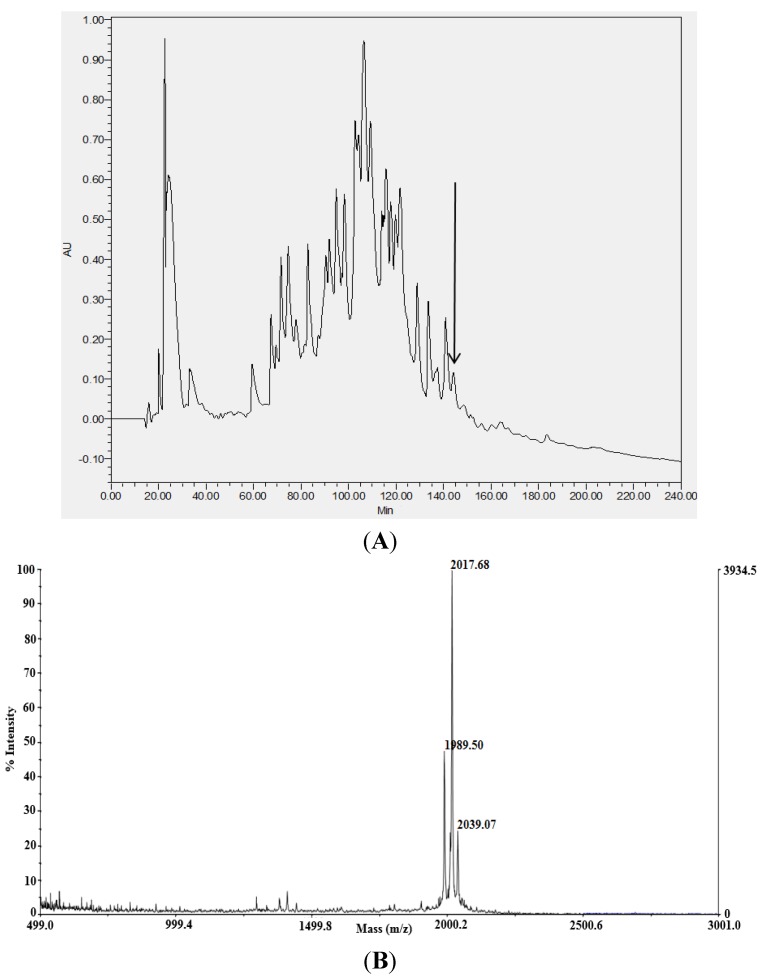
Figure 1
Figure 1
(A) Reverse-phase HPLC chromatogram of lyophilised Androctonus aeneas venom. The arrow indicates the elution position/retention time of the peptide fraction (#145) exhibiting antimicrobial activity. AU = 214 nm, and the gradient was formed from TFA/water (0.05:99.95, v/v) to TFA/water/acetonitrile (0.1:19.95:80.00, v/v/v) in 240 min at a flow rate of 1 mL/min. (B) MALDI-TOF mass spectrum of a sample of Fraction #145 indicating singly-charged [M + H]+ ions at m/z 1989.50 and m/z 2017.68. The ion at m/z 2039.07 is likely to be a sodium adduct ion [M + Na]+ of the peptide at m/z 2017.68.
Figure 2
Figure 2
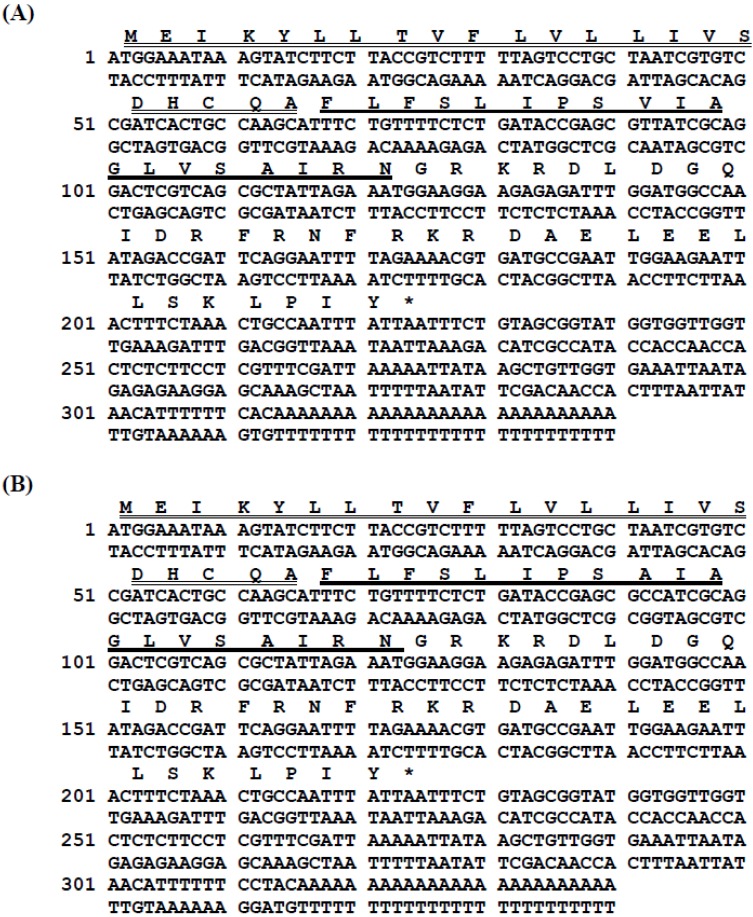
Nucleotide and translated open-reading frame amino acid sequences of cloned cDNAs encoding the biosynthetic precursors of AaeAP1 (A) and AaeAP2 (B). Putative signal peptides are double-underlined; mature peptides are single-underlined; and stop codons are indicated by asterisks.
Figure 3
Figure 3
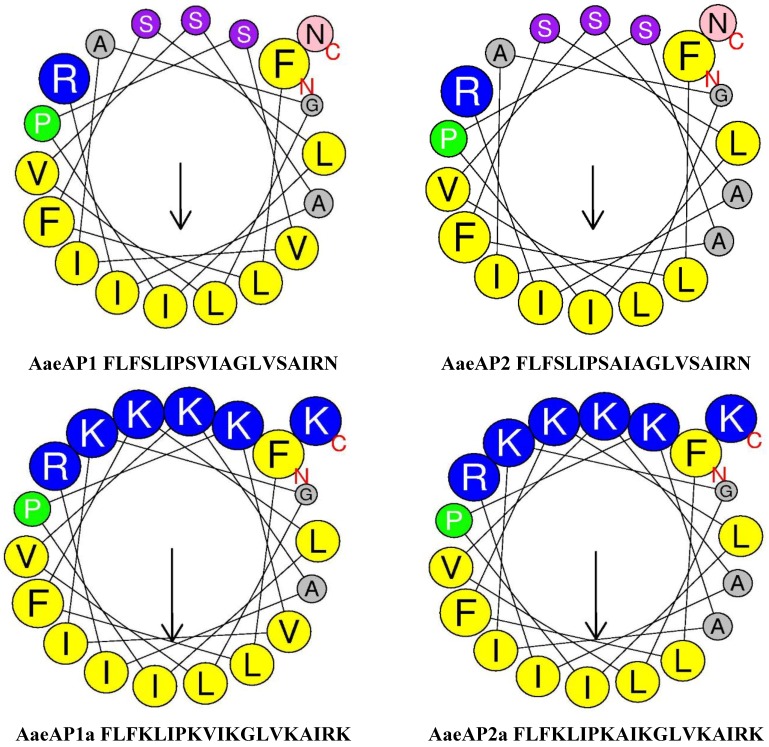
Helical wheel plots of AaeAP1, AaeAP2, AaeAP1a and AaeAP2a. Note the increased amphipathicity and cationicity that have been engineered into the analogues, AaeAP1a and AaeAP2a.
Figure 4
Figure 4
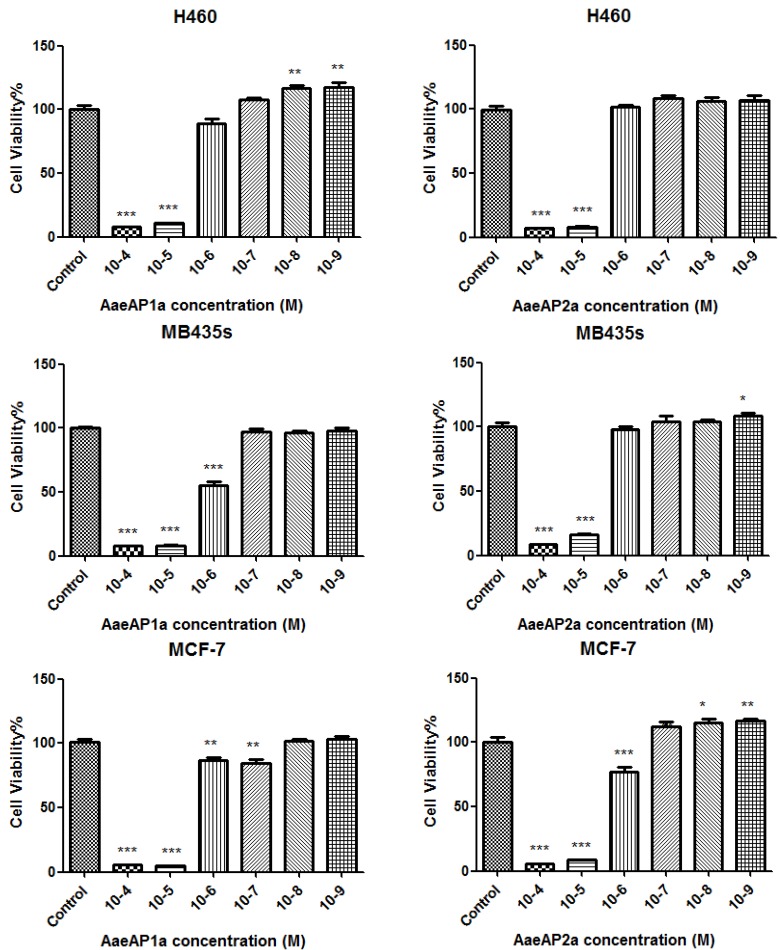
Dose-dependent antiproliferative effects of the analogues, AaeAP1a and AaeAP2a, on the human cancer cell lines, H460, MB435s, MCF-7 and PC3, after 24 h of incubation. The levels of significance are: * p < 0.05; ** p < 0.01; *** p < 0.001. Note that at low concentrations (10−9 M and 10−8 M), AaeAP1a significantly increased the proliferation of H460 cancer cells (p < 0.01). AaeAP2a significantly increased (p < 0.05) the proliferation of MB435s cancer cells at 10−9 M and the proliferation of MCF-7 cancer cells at 10−8 M (p < 0.05) and at 10−9 M (p < 0.01). The growth inhibition of cells at each peptide concentration was calculated as a percentage of the growth observed in controls, which was treated as 100%.
Figure 4
Figure 4
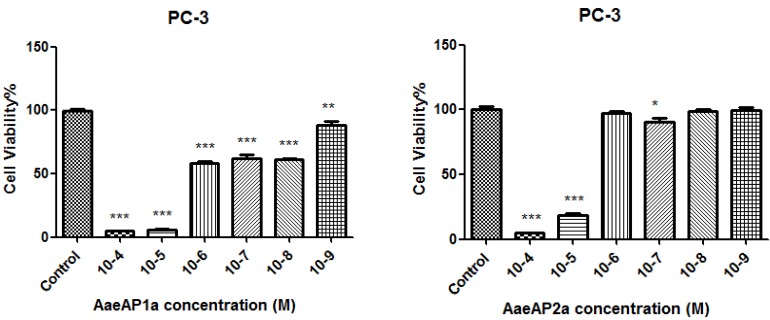
Dose-dependent antiproliferative effects of the analogues, AaeAP1a and AaeAP2a, on the human cancer cell lines, H460, MB435s, MCF-7 and PC3, after 24 h of incubation. The levels of significance are: * p < 0.05; ** p < 0.01; *** p < 0.001. Note that at low concentrations (10−9 M and 10−8 M), AaeAP1a significantly increased the proliferation of H460 cancer cells (p < 0.01). AaeAP2a significantly increased (p < 0.05) the proliferation of MB435s cancer cells at 10−9 M and the proliferation of MCF-7 cancer cells at 10−8 M (p < 0.05) and at 10−9 M (p < 0.01). The growth inhibition of cells at each peptide concentration was calculated as a percentage of the growth observed in controls, which was treated as 100%.

References

    1. Quintero-Hernández V., Jiménez-Vargas J.M., Gurrola G.B., Valdivia H.H., Possani L.D. Scorpion venom components that affect ion-channels function. Toxicon. 2013;76:328–342. doi: 10.1016/j.toxicon.2013.07.012. - DOI - PMC - PubMed
    1. Srinivasan K.N., Gopalakrishnakone P., Tan P.T., Chew K.C., Cheng B., Kini R.M., Koh J.L., Seah S.H., Brusic V. SCORPION, a molecular database of scorpion toxins. Toxicon. 2002;40:23–31. doi: 10.1016/S0041-0101(01)00182-9. - DOI - PubMed
    1. Tan P.T., Veeramani A., Srinivasan K.N., Ranganathan S., Brusic V. SCORPION2: A database for structure-function analysis of scorpion toxins. Toxicon. 2006;47:356–363. doi: 10.1016/j.toxicon.2005.12.001. - DOI - PubMed
    1. Rodríguez de la Vega R.C., Schwartz E.F., Possani L.D. Mining on scorpion venom biodiversity. Toxicon. 2010;56:1155–1161. doi: 10.1016/j.toxicon.2009.11.010. - DOI - PubMed
    1. Hille B. Ion Channels of Excitable Membranes. 3rd ed. Sinauer Associates, Inc.; Sunderland, MA, USA: 2001.

MeSH terms

LinkOut - more resources