


The emerging role of peptidyl-prolyl isomerase chaperones in tau oligomerization, amyloid processing, and Alzheimer's disease
- PMID: 25628064
- PMCID: PMC4361273
- DOI: 10.1111/jnc.13033
The emerging role of peptidyl-prolyl isomerase chaperones in tau oligomerization, amyloid processing, and Alzheimer's disease
Abstract
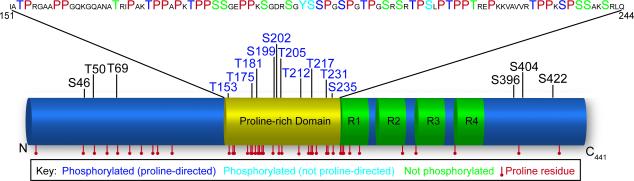
Peptidyl-prolyl cis/trans isomerases (PPIases), a unique family of molecular chaperones, regulate protein folding at proline residues. These residues are abundant within intrinsically disordered proteins, like the microtubule-associated protein tau. Tau has been shown to become hyperphosphorylated and accumulate as one of the two main pathological hallmarks in Alzheimer's disease, the other being amyloid beta (Ab). PPIases, including Pin1, FK506-binding protein (FKBP) 52, FKBP51, and FKBP12, have been shown to interact with and regulate tau biology. This interaction is particularly important given the numerous proline-directed phosphorylation sites found on tau and the role phosphorylation has been found to play in pathogenesis. This regulation then affects downstream aggregation and oligomerization of tau. However, many PPIases have yet to be explored for their effects on tau biology, despite the high likelihood of interaction based on proline content. Moreover, Pin1, FKBP12, FKBP52, cyclophilin (Cyp) A, CypB, and CypD have been shown to also regulate Ab production or the toxicity associated with Ab pathology. Therefore, PPIases directly and indirectly regulate pathogenic protein multimerization in Alzheimer's disease and represent a family rich in targets for modulating the accumulation and toxicity.
Keywords: Alzheimer's disease; PPIase; amyloid β; chaperone; immunophilin; tau.
© 2015 International Society for Neurochemistry.
Figures
References
-
- Ahn J, Murphy M, Kratowicz S, Wang A, Levine AJ, George DL. Down-regulation of the stathmin/Op18 and FKBP25 genes following p53 induction. Oncogene. 1999;18:5954–5958. - PubMed
-
- Augustinack JC, Schneider A, Mandelkow EM, Hyman BT. Specific tau phosphorylation sites correlate with severity of neuronal cytopathology in Alzheimer's disease. Acta neuropathologica. 2002;103:26–35. - PubMed
-
- Bai X, Ma D, Liu A, Shen X, Wang QJ, Liu Y, Jiang Y. Rheb activates mTOR by antagonizing its endogenous inhibitor, FKBP38. Science. 2007;318:977–980. - PubMed
Publication types
MeSH terms
Substances
Grants and funding
LinkOut - more resources
Full Text Sources
Other Literature Sources
Medical
Molecular Biology Databases
Miscellaneous
