


Bruxism: a literature review
Abstract
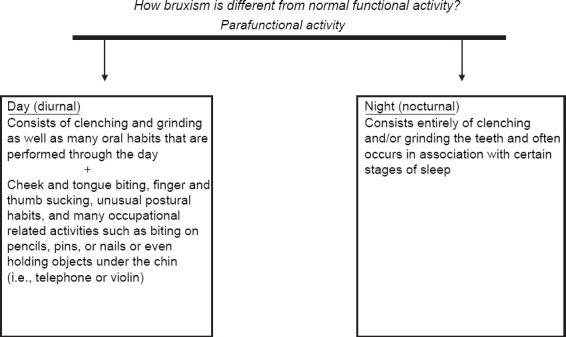
Parafunctional activities associated with the stomatognathic system include lip and cheek chewing, nail biting, and teeth clenching. Bruxism can be classified as awake or sleep bruxism. Patients with sleep bruxism are more likely to experience jaw pain and limitation of movement, than people who do not experience sleep bruxism. Faulty occlusion is one of the most common causes of bruxism that further leads to temporomandibular joint pain. Bruxism has been described in various ways by different authors. This article gives a review of the literature on bruxism since its first description.
Keywords: Bruxism; clenching; parafunctional activity; temporomandibular disorders.
Conflict of interest statement
References
-
- Widmalm SE. Michigan: Orthotech, University of Michigan; 2003. Bite Splints in General Dental Practice.
-
- Lobbezoo F, Hamburger HL, Naeije M. Etiology of bruxism. In: Paesani DA, editor. Bruxism- Theory and Practice. London: Quintessence; 2010. pp. 53–65.
-
- Carlsson GE, Magnusson T. Chicago: Quintessence; 1999. Management of Temporomandibular Disorders in the General Dental Practice.
-
- American Academy of Orofacial Pain. Chicago: Quintessence; 1996. Guidelines for Assesments, Diagnosis and Management.
-
- American Academy of Sleep Medicine. Chicago: AASM; 2001. International Classification of Sleep Disorders: Diagnostic and Coding Manual.
Publication types
LinkOut - more resources
Full Text Sources