Review
. 2015 Jan 13:5:774.
doi: 10.3389/fpls.2014.00774. eCollection 2014.

The family of LSU-like proteins

Affiliations
Review

The family of LSU-like proteins

Agnieszka Sirko et al. Front Plant Sci. .

Abstract

The plant response to sulfur deficiency includes extensive metabolic changes which can be monitored at various levels (transcriptome, proteome, metabolome) even before the first visible symptoms of sulfur starvation appear. Four members of the plant-specific LSU (response to Low SUlfur) gene family occur in Arabidopsis thaliana (LSU1-4). Variable numbers of LSU genes occur in other plant species but they were studied only in Arabidopsis and tobacco. Three out of four of the Arabidopsis LSU genes are induced by sulfur deficiency. The LSU-like genes in tobacco were characterized as UP9 (UPregulated by sulfur deficit 9). LSU-like proteins do not have characteristic domains that provide clues to their function. Despite having only moderate primary sequence conservation they share several common features including small size, a coiled-coil secondary structure and short conserved motifs in specific positions. Although the precise function of LSU-like proteins is still unknown there is some evidence that members of the LSU family are involved in plant responses to environmental challenges, such as sulfur deficiency, and possibly in plant immune responses. Various bioinformatic approaches have identified LSU-like proteins as important hubs for integration of signals from environmental stimuli. In this paper we review a variety of published data on LSU gene expression, the properties of lsu mutants and features of LSU-like proteins in the hope of shedding some light on their possible role in plant metabolism.

Keywords: Arabidopsis; OAS; SALK mutants; UP9; coiled coil; ethylene; gene expression; tobacco.


Figures
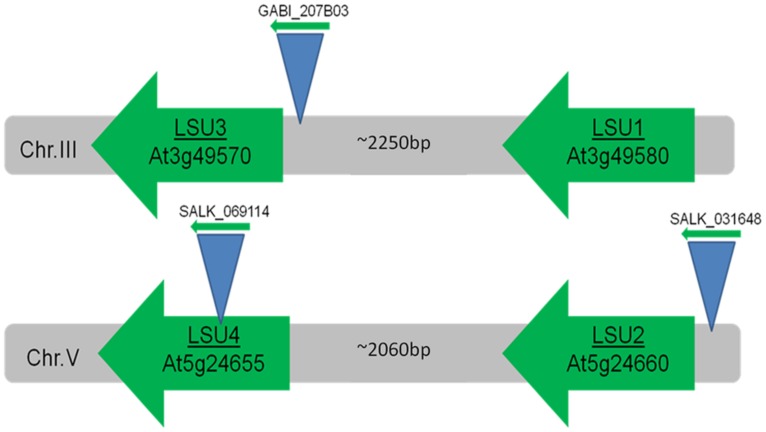
FIGURE 1
FIGURE 1
Localization of ‘response to Low Sulfur’ (LSU) genes in the Arabidopsis genome. Number of base pairs (bp) between LSU open reading frames is indicated. Positions of T-DNA inserts are shown schematically.
FIGURE 2
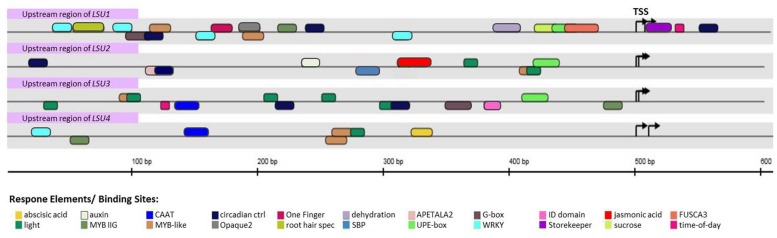
FIGURE 2
Depiction of transcription factor (TF) binding sites found in the upstream regions of LSU1-4. The sequences were scanned for matches to TFs binding sites using MatInspector, part of the Genomatix Software Suite (www.genomatix.de). A match is represented by a round-ended rectangle. Matches with the positive and negative strands are depicted above or below the sequence line, respectively. The arrow symbol on the sequence stands for a transcription start site (TSS); note that there are several putative TSSs for each LSU.
FIGURE 3
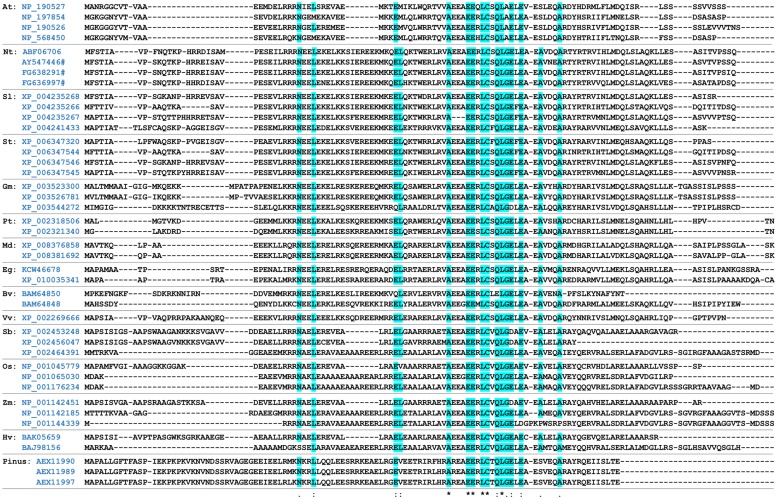
FIGURE 3
Alignment of the selected LSU-like proteins. The evolutionary conserved amino acids identified by the MAFT alignment software [http://mafft.cbrc.jp] are highlighted. The accession numbers of the protein sequences are provided. # denotes the accession number to the corresponding nucleotide sequence; At, Arabidopsis thaliana; Nt, Nicotiana tabacum; Sl, Solanum lycopersicum; St, Solanum tuberosum; Gm, Glycine max; Pt, Populus trichocarpa; Md, Malus domesticus; Eg, Eucalyptus grandis; Bv, Beta vulgaris; Vv, Vitis vinifera; Sb, Sorghum bicolor; Os, Oryza sativa; Zm, Zea mays; Hv, Hordeum vulgare; Pinus, Pinus taeda.
FIGURE 4
FIGURE 4
Venn diagram of potential LSU1 and LSU2 interacting partners (Arabidopsis Interactome Mapping Consortium, 2011).
FIGURE 5
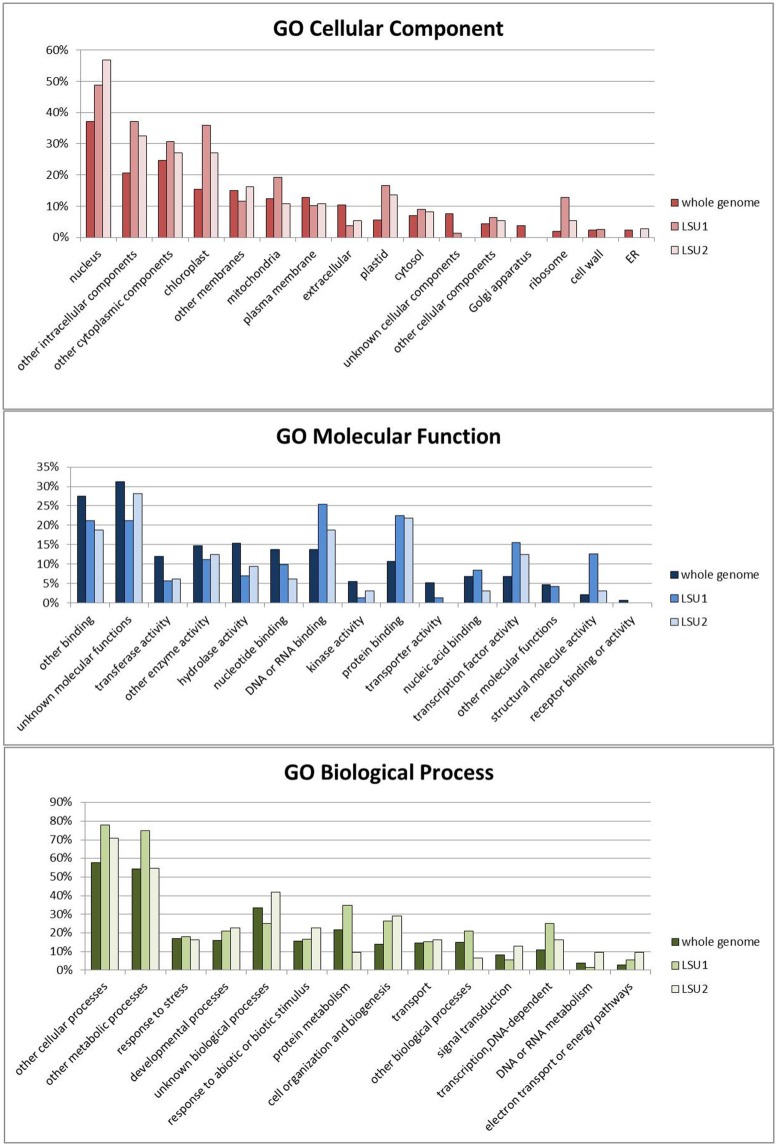
FIGURE 5
Functional categorization of the potential LSU1 and LSU2 interacting partners for GO Cellular Component, GO Molecular Function and GO Biological Process. The analysis was done using the Gene ontology tools available at TAIR [http://www.arabidopsis.org].

References

    1. Adie B., Chico J. M., Rubio-Somoza I., Solano R. (2007). Modulation of plant defenses by ethylene. J. Plant Growth Regul. 26 160–177 10.1007/s00344-007-0012-6 - DOI
    1. Arabidopsis Interactome Mapping Consortium. (2011). Evidence for network evolution in an Arabidopsis interactome map. Science 333 601–607 10.1126/science.1203877 - DOI - PMC - PubMed
    1. Ascencio-Ibanez J. T., Sozzani R., Lee T. J., Chu T. M., Wolfinger R. D., Cella R., et al. (2008). Global analysis of Arabidopsis gene expression uncovers a complex array of changes impacting pathogen response and cell cycle during geminivirus infection. Plant Physiol. 148 436–454 10.1104/pp.108.121038 - DOI - PMC - PubMed
    1. Caldana C., Degenkolbe T., Cuadros-Inostroza A., Klie S., Sulpice R., Leisse A., et al. (2011). High-density kinetic analysis of the metabolomic and transcriptomic response of Arabidopsis to eight environmental conditions. Plant J. 67 869–884 10.1111/j.1365-313X.2011.04640.x - DOI - PubMed
    1. Davletova S., Schlauch K., Coutu J., Mittler R. (2005). The zinc-finger protein Zat12 plays a central role in reactive oxygen and abiotic stress signaling in Arabidopsis. Plant Physiol. 139 847–856 10.1104/pp.105.068254 - DOI - PMC - PubMed