Review
. 2015 Jan 13:5:473.
doi: 10.3389/fgene.2014.00473. eCollection 2014.

Condensin-mediated chromosome organization and gene regulation

Affiliations
Review

Condensin-mediated chromosome organization and gene regulation

Alyssa C Lau et al. Front Genet. .

Abstract

In many organisms sexual fate is determined by a chromosome-based method which entails a difference in sex chromosome-linked gene dosage. Consequently, a gene regulatory mechanism called dosage compensation equalizes X-linked gene expression between the sexes. Dosage compensation initiates as cells transition from pluripotency to differentiation. In Caenorhabditis elegans, dosage compensation is achieved by the dosage compensation complex (DCC) binding to both X chromosomes in hermaphrodites to downregulate gene expression by twofold. The DCC contains a subcomplex (condensin I(DC)) similar to the evolutionarily conserved condensin complexes which play a fundamental role in chromosome dynamics during mitosis. Therefore, mechanisms related to mitotic chromosome condensation are hypothesized to mediate dosage compensation. Consistent with this hypothesis, monomethylation of histone H4 lysine 20 is increased, whereas acetylation of histone H4 lysine 16 is decreased, both on mitotic chromosomes and on interphase dosage compensated X chromosomes in worms. These observations suggest that interphase dosage compensated X chromosomes maintain some characteristics associated with condensed mitotic chromosome. This chromosome state is stably propagated from one cell generation to the next. In this review we will speculate on how the biochemical activities of condensin can achieve both mitotic chromosome compaction and gene repression.

Keywords: Caenorhabditis elegans; chromatin; chromosome condensation; condensin; dosage compensation; epigenetics; gene expression; interphase chromosome.


Figures
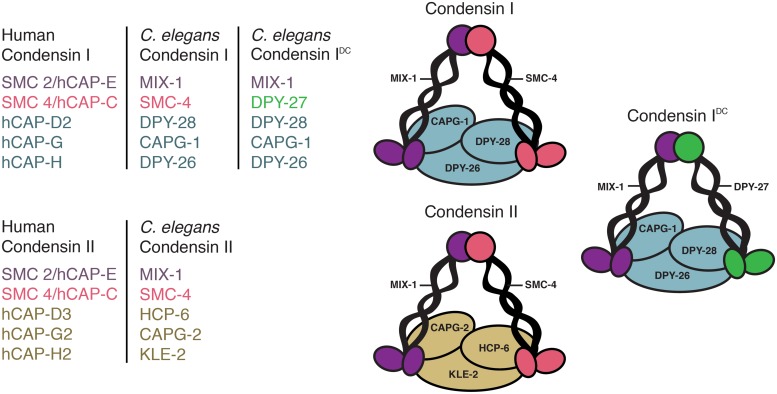
FIGURE 1
FIGURE 1
Three condensin complexes. Caenorhabditis elegans condensin subunits and their human homologs. Condensins I and II share the same pair of MIX-1 and SMC-4 subunits and have three unique chromosome-associated polypeptide (CAP) proteins. Condensin I contains DPY-28, CAPG-1, and DPY-26, while condensin II contains HCP-6, CAPG-2, and KLE-2. In addition, C. elegans has a condensin I-like complex (condensin IDC) that functions in dosage compensation. Condensin IDC differs from the canonical condensin I by only one subunit: DPY-27 replaces SMC-4.
FIGURE 2
FIGURE 2
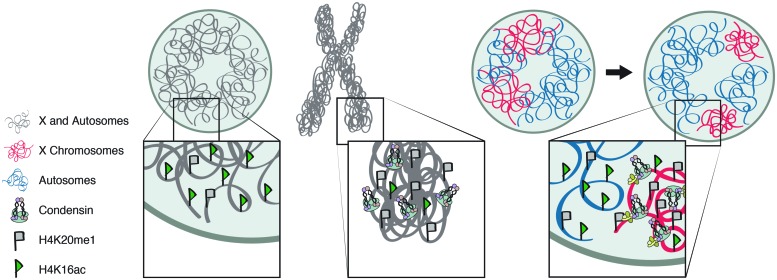
Condensin and chromatin mediated chromosome compaction. Similar distributions of histone modifications and condensin in condensed mitotic chromosomes and interphase dosage compensated X chromosomes. Compaction is accompanied by enrichment of H4K20me1 and depletion of H4K16ac in both mitotic chromosome condensation and interphase dosage compensated X chromosomes.
FIGURE 3
FIGURE 3
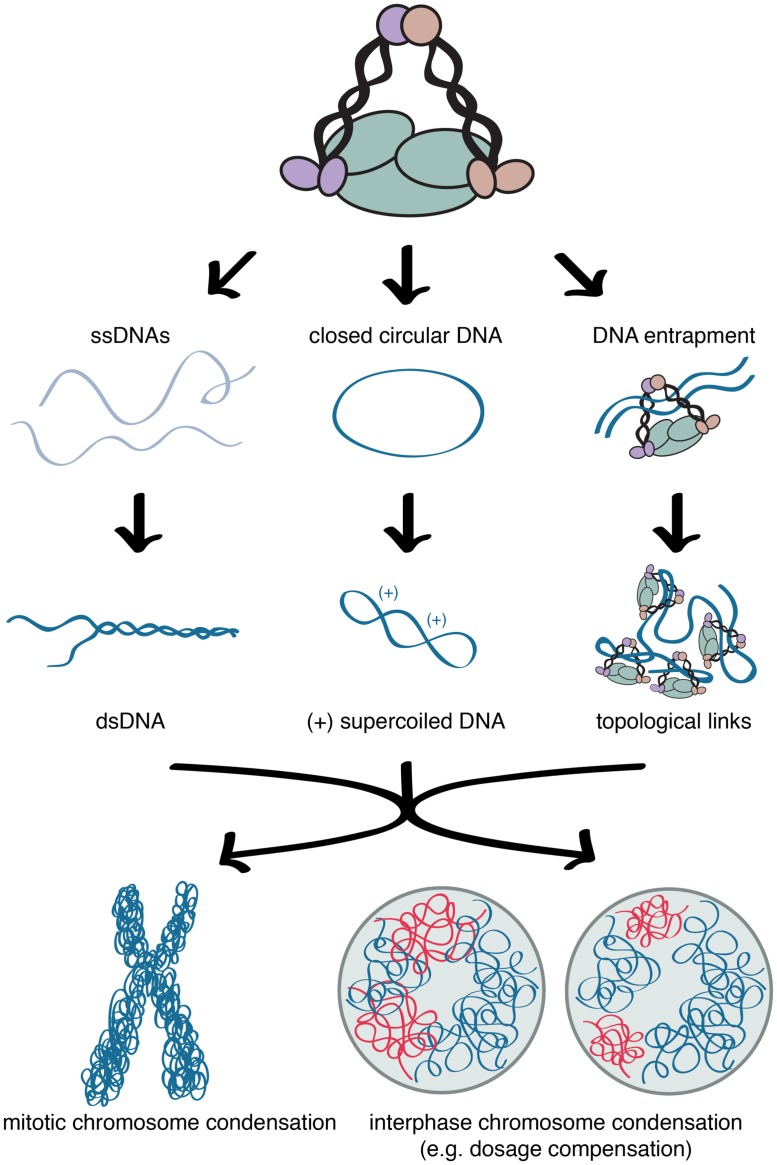
Molecular mechanisms of condensin activity. The proposed mechanisms by which condensin generates and maintains chromosome condensation in interphase and mitosis. Condensin’s structural maintenance of chromosomes (SMC) proteins can reanneal complementary ssDNAs into dsDNAs, in preparation for subsequent coiling steps. Condensin can also introduce ATP-dependent positive supercoils into DNA in vitro. Alternatively, or in addition, condensin is proposed to entrap the chromatin fibers in its ring-like structure.

References

    1. Barakat T. S., Gribnau J. (2012). X chromosome inactivation in the cycle of life. Development 139 2085–2089 10.1242/dev.069328 - DOI - PubMed
    1. Bauer C. R., Hartl T. A., Bosco G. (2012). Condensin II promotes the formation of chromosome territories by inducing axial compaction of polyploid interphase chromosomes. PLoS Genet. 8:e1002873 10.1371/journal.pgen.1002873 - DOI - PMC - PubMed
    1. Baxter J., Sen N., Martinez V. L., De Carandini M. E., Schvartzman J. B., Diffley J. F., et al. (2011). Positive supercoiling of mitotic DNA drives decatenation by topoisomerase II in eukaryotes. Science 331 1328–1332 10.1126/science.1201538 - DOI - PubMed
    1. Buster D. W., Daniel S. G., Nguyen H. Q., Windler S. L., Skwarek L. C., Peterson M., et al. (2013). SCFSlimb ubiquitin ligase suppresses condensin II-mediated nuclear reorganization by degrading Cap-H2. J. Cell Biol. 201 49–63 10.1083/jcb.201207183 - DOI - PMC - PubMed
    1. Chan R. C., Severson A. F., Meyer B. J. (2004). Condensin restructures chromosomes in preparation for meiotic divisions. J. Cell Biol. 167 613–625 10.1083/jcb.200408061 - DOI - PMC - PubMed

LinkOut - more resources