


Acupuncture for spasticity after stroke: a systematic review and meta-analysis of randomized controlled trials
- PMID: 25628750
- PMCID: PMC4299539
- DOI: 10.1155/2015/870398
Acupuncture for spasticity after stroke: a systematic review and meta-analysis of randomized controlled trials
Erratum in
-
Corrigendum to "Acupuncture for Spasticity after Stroke: A Systematic Review and Meta-Analysis of Randomized Controlled Trials".Evid Based Complement Alternat Med. 2017;2017:7324857. doi: 10.1155/2017/7324857. Epub 2017 Apr 5. Evid Based Complement Alternat Med. 2017. PMID: 28479927 Free PMC article.
Abstract
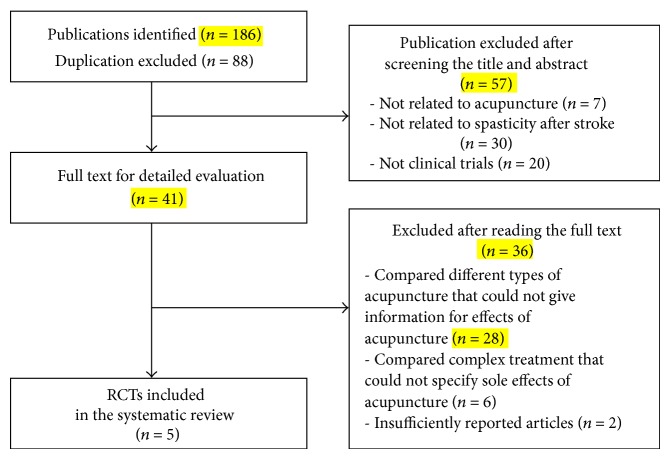
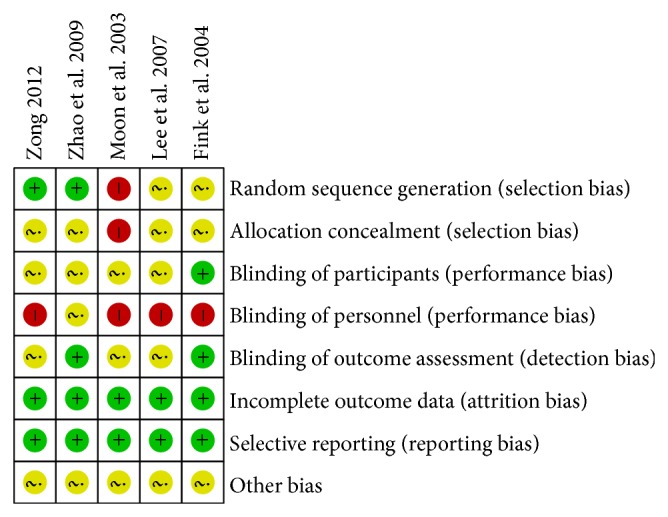
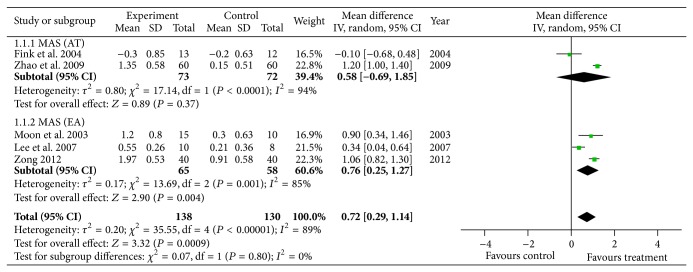
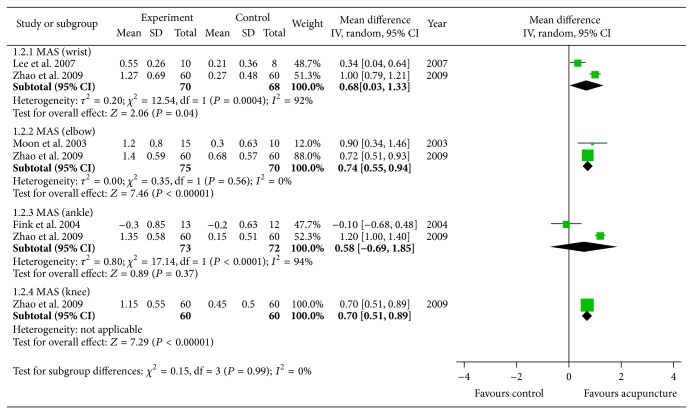
The aim of this systematic review was to determine how effective acupuncture or electroacupuncture (acupuncture with electrical stimulation) is in treating poststroke patients with spasticity. We searched publications in Medline, EMBASE, and the Cochrane Library in English, 19 accredited journals in Korean, and the China Integrated Knowledge Resources Database in Chinese through to July 30, 2013. We included randomized controlled trials (RCTs) with no language restrictions that compared the effects of acupuncture or electroacupuncture with usual care or placebo acupuncture. The two investigators assessed the risk of bias and statistical analyses were performed. Three RCTs in English, 1 in Korean, and 1 in Chinese were included. Assessments were performed primarily with the Modified Ashworth Scale (MAS). Meta-analysis showed that acupuncture or electroacupuncture significantly decreased spasticity after stroke. A subgroup analysis showed that acupuncture significantly decreased wrist, knee, and elbow spasticity in poststroke patients. Heterogeneity could be explained by the differences in control, acupoints, and the duration after stroke occurrence. In conclusion, acupuncture could be effective in decreasing spasticity after stroke, but long-term studies are needed to determine the longevity of treatment effects.
Figures
References
-
- Lee S. H., Wong Y. O., Wong Y. O., Che C. T. Acupuncture in managing of spasticity of post stroke survivor: a systematic review. Stroke. 2012;43:p. A3506.
-
- Zorowitz R. D., Gillard P. J., Brainin M. Poststroke spasticity: sequelae and burden on stroke survivors and caregivers. Neurology. 2013;80(3) supplement 2:S45–S52. - PubMed
Publication types
LinkOut - more resources
Full Text Sources
Other Literature Sources
