


Gastrointestinal stromal tumors of the esophagus: evaluation of a pooled case series regarding clinicopathological features and clinical outcome
- PMID: 25628942
- PMCID: PMC4300707
Gastrointestinal stromal tumors of the esophagus: evaluation of a pooled case series regarding clinicopathological features and clinical outcome
Abstract
Background and objectives: To elucidate diagnostic criteria, clinicopathological features and clinical outcome in patients with esophageal gastrointestinal stromal tumors (GIST), representing an extremely rare subform of GIST with an estimated incidence of about 0.1 to 0.3 per million people.
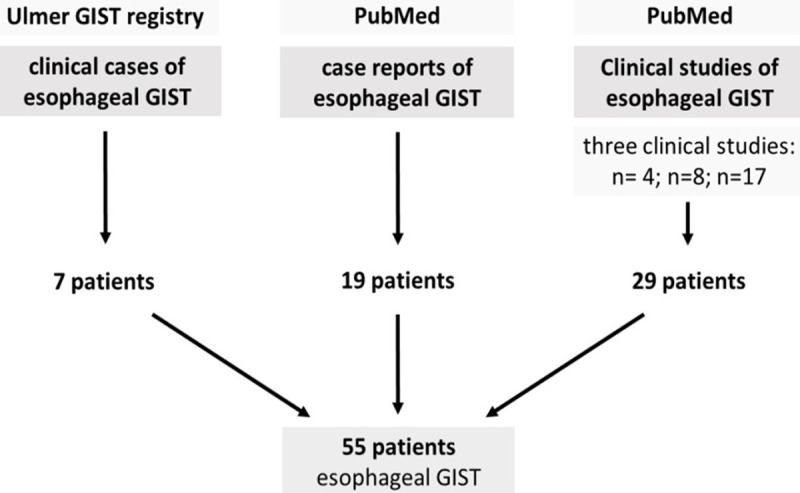
Patients and methods: Esophageal GIST cases from the Ulmer GIST registry consisting of 1077 cases were pooled with case reports and case series of esophageal GIST extracted from MEDLINE. Data were compared with those from 683 cases with gastric GIST from the Ulmer GIST registry.
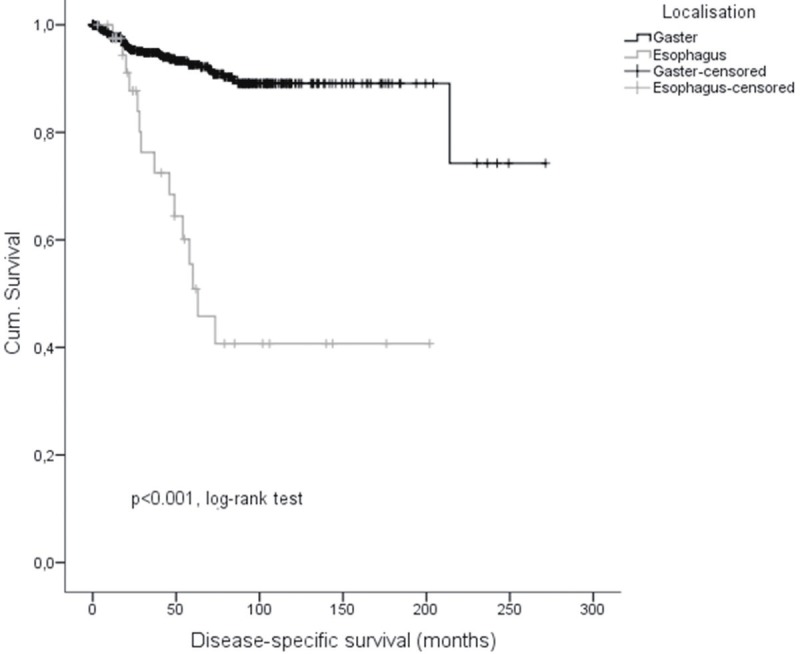
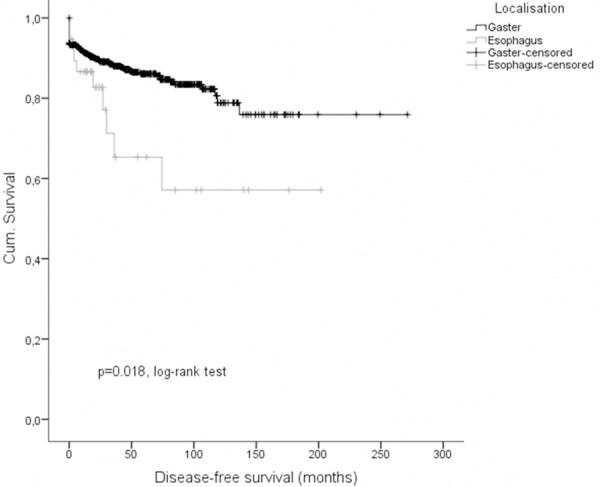
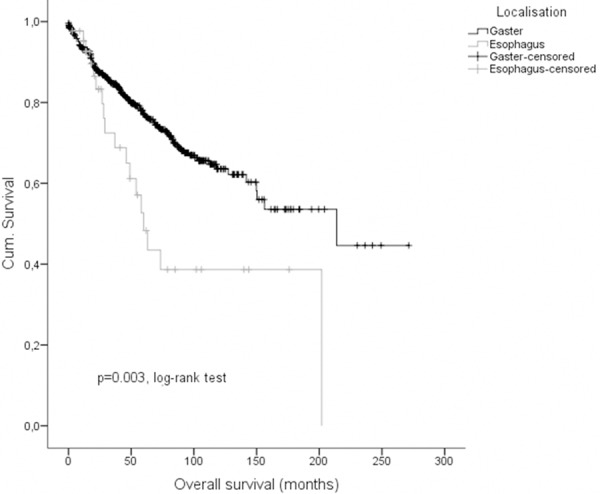
Results: In comparison to gastric GIST, esophageal GIST (n = 55) occurred significantly more frequent in men (p = 0.035) as well as in patients younger than 60 at diagnosis (p < 0.001). Primary tumor sizes were significantly larger (p < 0.001), thereby resulting more frequently in a high-risk classification (OR = 4.53, CI 95% 2.41-8.52, p < 0.001). The 5-year rates of disease-specific survival (DSS), disease-free survival (DFS), and overall survival (OS) were 50.9%, 65.3% and 48.3%, respectively. The prognosis of esophageal GIST was less favorable compared with gastric GIST (DSS: p < 0.001, HR = 0.158, 95% CI: 0.087-0.288; DFS: p = 0.023, HR 0.466, 95% CI: 0.241-0.901; OS p = 0.003, HR = 0.481, 95% CI: 0.294-0.785; univariate Cox model) after a median follow-up time of 28 months (range 1.9 to 202). Mutational analysis for KIT showed more frequently wild-type status in esophageal GIST (OR = 10.13, CI 95% 3.02-33.96, p < 0.001).
Conclusions: Esophageal GIST differ significantly from gastric GIST in respect to clinicopathological features and clinical outcome. To optimize treatment options further prospective data on patients with esophageal GIST are urgently warranted.
Keywords: GIST; esophagus; gastrointestinal stromal tumor; mutation analysis; outcome; prognosis.
Figures
References
-
- Monges G, Bisot-Locard S, Blay JY, Bouvier AM, Urbieta M, Coindre JM, Scoazec JY. The estimated incidence of gastrointestinal stromal tumors in France. Results of PROGIST study conducted among pathologists. Bull Cancer. 2010;97:E16–22. - PubMed
-
- Nilsson B, Bumming P, Meis-Kindblom JM, Oden A, Dortok A, Gustavsson B, Sablinska K, Kindblom LG. Gastrointestinal stromal tumors: the incidence, prevalence, clinical course, and prognostication in the preimatinib mesylate era--a population-based study in western Sweden. Cancer. 2005;103:821–829. - PubMed
-
- Steigen SE, Bjerkehagen B, Haugland HK, Nordrum IS, Loberg EM, Isaksen V, Eide TJ, Nielsen TO. Diagnostic and prognostic markers for gastrointestinal stromal tumors in Norway. Mod Pathol. 2008;21:46–53. - PubMed
-
- Tran T, Davila JA, El-Serag HB. The epidemiology of malignant gastrointestinal stromal tumors: an analysis of 1,458 cases from 1992 to 2000. Am J Gastroenterol. 2005;100:162–168. - PubMed
-
- Tryggvason G, Kristmundsson T, Orvar K, Jonasson JG, Magnusson MK, Gislason HG. Clinical study on gastrointestinal stromal tumors (GIST) in Iceland, 1990-2003. Dig Dis Sci. 2007;52:2249–2253. - PubMed
LinkOut - more resources
Full Text Sources