


Cost Effectiveness of Malaria Interventions from Preelimination through Elimination: a Study in Iran
- PMID: 25629064
- PMCID: PMC4289510
Cost Effectiveness of Malaria Interventions from Preelimination through Elimination: a Study in Iran
Abstract
Background: Malaria still is considered as a public health problem in Iran. The aim of the National Malaria Control Department is to reach the elimination by 2024. By decreasing the number of malaria cases in preelimination phase the cost effectiveness of malaria interventions decreases considerably. This study estimated the cost effectiveness of various strategies to combat malaria in preelimination and elimination phases in Iran.
Methods: running costs of the interventions at each level of intervention was estimated by using evidence and expert opinions. The effect of each intervention was estimated using the documentary evidence available and expert opinions. Using a point estimate and distribution of each variable the sensitivity was evaluated with the Monte Carlo method.
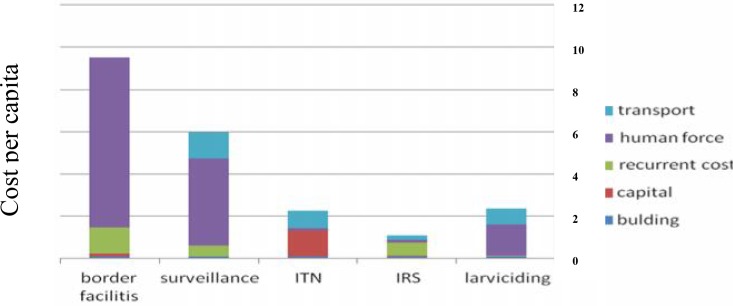
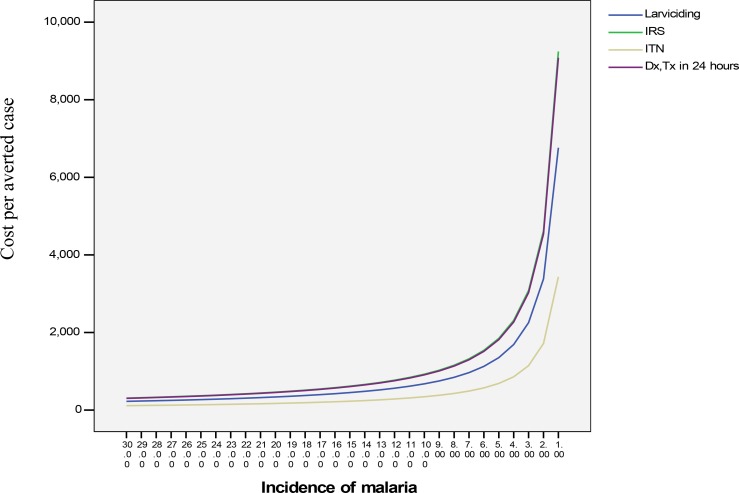
Results: The most cost-effective interventions were insecticide treated net (ITN), larviciding, surveillance for diagnosis and treatment of patients less than 24 hours, and indoor residual spraying (IRS) respectively, No related evidence found for the effectiveness of the border facilities.
Conclusion: This study showed that interventions in the elimination phase of malaria have low cost effectiveness in Iran like many other countries. However ITN is the most cost effective intervention among the available interventions.
Keywords: IRS; ITN; Iran; Malaria; cost effectiveness; prevention and control.
Figures
References
-
- Carrara VI, Sirilak S, Thonglairuam J, Rojanawatsirivet C, Proux S, Gilbos V, Ashley EA, McGready R, Krudsood S, Leemingsawat S. Deployment of early diagnosis and mefloquine-artesunate treatment of falciparum malaria in Thailand: the Tak Malaria Initiative. PLoS Medicine. 2006;3:856–864. - PMC - PubMed
-
- Conteh L, Sharp BL, Streat E, Barreto A, Konar S. The cost and cost effectiveness of malaria vector control by residual insecticide house spraying in southern Mozambique: a rural and urban analysis. Trop Med Int Health. 2004;9:125–132. - PubMed
-
- Edrissian GH. Malaria in Iran: Past and present situation. Iran J Parasitol. 2006;1(1):1–14.
-
- Elimination WHOM. A Field Manual for Low and Moderate Endemic Countries. Geneva: World Health Organization; 2007.
-
- Goodman C, Coleman P, Mills A, Research GF. Economic analysis of malaria control in sub-Saharan Africa. Global Forum for Health Research Geneva; Switzerland: 2000.
LinkOut - more resources
Full Text Sources