. 2015 May;10(5):806-814.
doi: 10.1097/JTO.0000000000000486.

Tumor Spread through Air Spaces is an Important Pattern of Invasion and Impacts the Frequency and Location of Recurrences after Limited Resection for Small Stage I Lung Adenocarcinomas

Affiliations

Tumor Spread through Air Spaces is an Important Pattern of Invasion and Impacts the Frequency and Location of Recurrences after Limited Resection for Small Stage I Lung Adenocarcinomas

Kyuichi Kadota et al. J Thorac Oncol. 2015 May.

Abstract

Introduction: Tumor invasion in lung adenocarcinoma is defined as infiltration of stroma, blood vessels, or pleura. Based on observation of tumor spread through air spaces (STAS), we considered whether this could represent new patterns of invasion and investigated whether it correlated with locoregional versus distant recurrence according to limited resection versus lobectomy.

Methods: We reviewed resected small (less than or equal to 2 cm) stage I lung adenocarcinomas (n = 411; 1995-2006). Tumor STAS was defined as tumor cells-micropapillary structures, solid nests, or single cells-spreading within air spaces in the lung parenchyma beyond the edge of the main tumor. Competing risks methods were used to estimate risk of disease recurrence and its associations with clinicopathological risk factors.

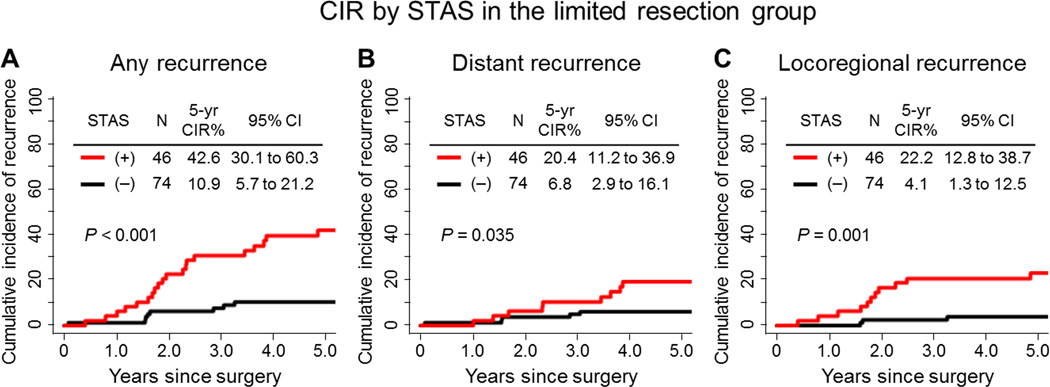
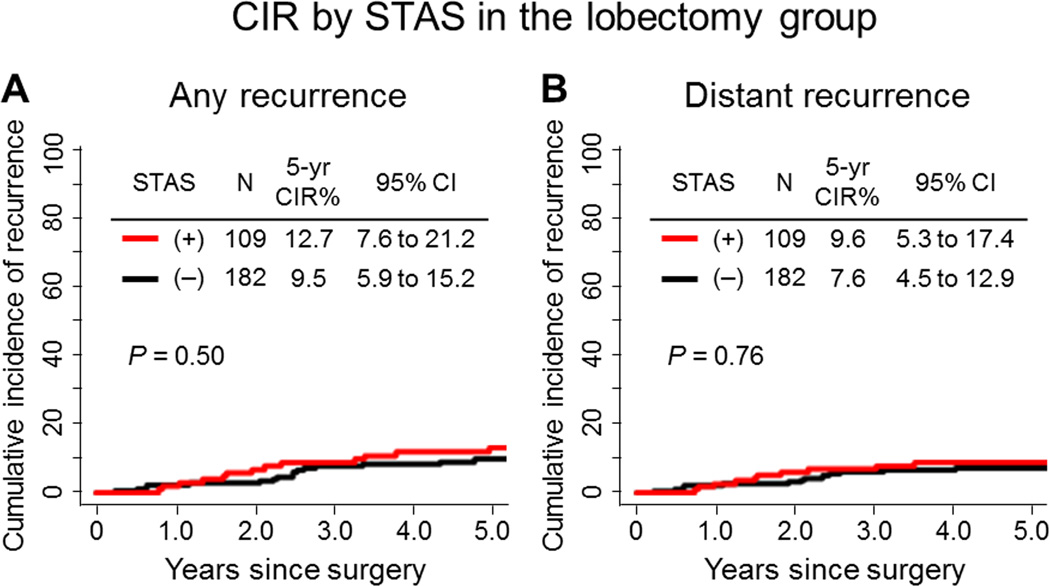
Results: STAS was observed in 155 cases (38%). In the limited resection group (n = 120), the risk of any recurrence was significantly higher in patients with STAS-positive tumors than that of patients with STAS-negative tumors (5-year cumulative incidence of recurrence, 42.6% versus 10.9%; P < 0.001); the presence of STAS correlated with higher risk of distant (P = 0.035) and locoregional recurrence (P = 0.001). However, in the lobectomy group (n = 291), the presence of STAS was not associated with either any (P = 0.50) or distant recurrence (P = 0.76). In a multivariate analysis, the presence of tumor STAS remained independently associated with the risk of developing recurrence (hazard ratio, 3.08; P = 0.014).

Conclusion: The presence of STAS is a significant risk factor of recurrence in small lung adenocarcinomas treated with limited resection. These findings support our proposal that STAS should formally be recognized as a pattern of invasion in lung adenocarcinoma.


Conflict of interest statement

AUTHORS’ DISCLOSURES OF POTENTIAL CONFLICTS OF INTEREST

The authors indicated no potential conflicts of interest.

Figures
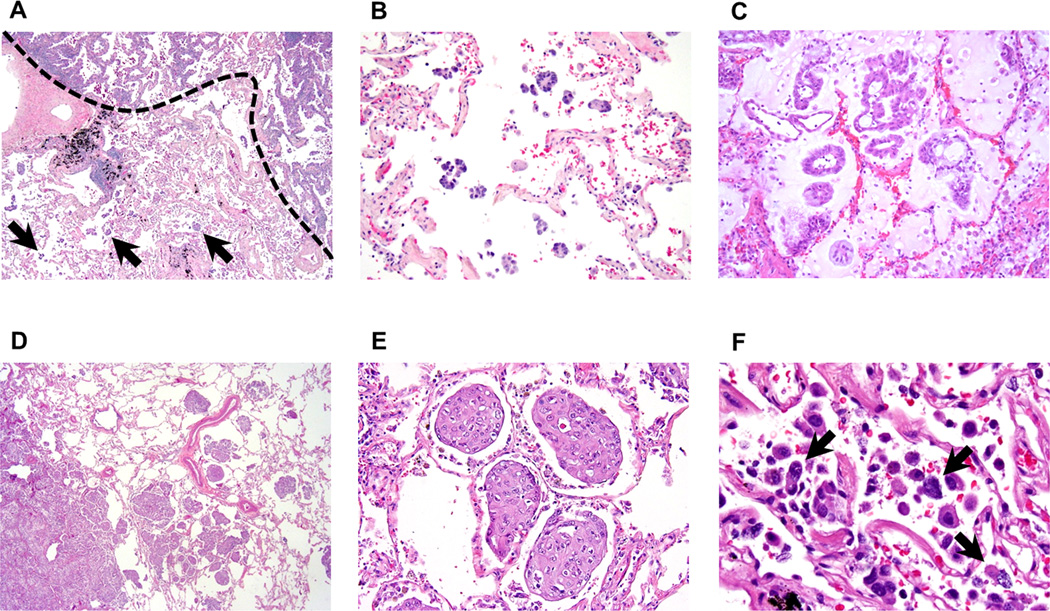
Figure 1
Figure 1. Morphologic features of tumor spread through air spaces (STAS) pattern (original magnification: ×20 in A and D; ×200 in B, C and E; ×400 in F)
(A) Micropapillary pattern STAS (arrows) identified within air spaces in the lung parenchyma beyond the edge (a dotted line) of the main tumor. (B) Micropapillary pattern STAS consisting of papillary structures without central fibrovascular cores. (C) Micropapillary pattern STAS forming ring-like structures within air spaces. (D) Solid pattern STAS identified within air spaces in the lung parenchyma beyond the edge of the main tumor. (E) Solid type STAS consisting of solid collections of tumor cells filling air spaces. (F) Single cell pattern STAS consisting of scattered discohesive single cells (arrows).
Figure 2
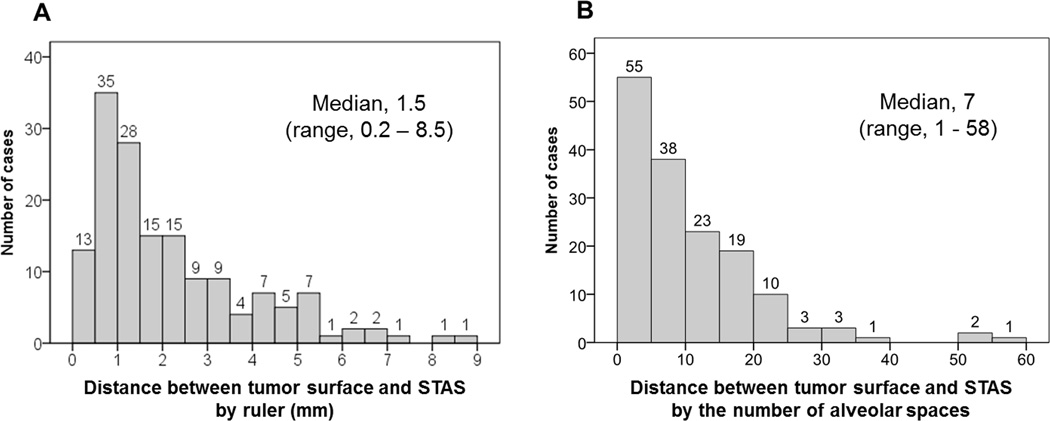
Figure 2. Distance of tumor spread through air spaces (STAS) from edge of main tumor
(A) Distance between tumor surface and farthest STAS away from the tumor edge was measured by a ruler with a median of 1.5 mm (range 0.2–8.5 mm), and (B) according to number of alveolar spaces with a median of 7 (range 1–58).
Figure 3
Figure 3. Cumulative incidence of recurrence (CIR) by spread through air spaces (STAS) in the limited resection group
(A) CIR for any recurrence of patients with STAS-positive tumors was significantly higher than for patients with STAS-negative tumors (5-year CIR, 42.6% vs. 10.9%; P<0.001). (B) CIR for distant recurrence of patients with STAS-positive tumors was significantly higher than for patients with STAS-negative tumors (5-year CIR, 20.4% vs. 6.8%; P=0.035). (C) CIR for locoregional recurrence of patients with STAS-positive tumors was significantly higher than for patients with STAS-negative tumors (5-year CIR, 22.2% vs. 4.1%; P=0.001).
Figure 4
Figure 4. Cumulative incidence of recurrence (CIR) by spread through air spaces (STAS) in the lobectomy group
(A) Presence of tumor STAS was not associated with risk of any recurrence compared with absence of STAS (5-year CIR, 12.7% vs. 9.5%; P=0.50). (B) Presence of tumor STAS was not associated with risk of distant recurrence compared with absence of STAS (5-year CIR, 9.6% vs. 7.6%; P=0.76).

References

    1. Travis WD, Brambilla E, Noguchi M, et al. International Association for the Study of Lung Cancer/American Thoracic Society/European Respiratory Society international multidisciplinary classification of lung adenocarcinoma. J Thorac Oncol. 2011;6(2):244–285. - PMC - PubMed
    1. Kadota K, Suzuki K, Kachala SS, et al. A grading system combining architectural features and mitotic count predicts recurrence in stage I lung adenocarcinoma. Mod Pathol. 2012;25(8):1117–1127. - PMC - PubMed
    1. Kadota K, Villena-Vargas J, Yoshizawa A, et al. Prognostic significance of adenocarcinoma in situ, minimally invasive adenocarcinoma, and nonmucinous lepidic predominant invasive adenocarcinoma of the lung in patients with stage I disease. Am J Surg Pathol. 2014;38(4):448–460. - PMC - PubMed
    1. Kadota K, Yeh YC, Sima CS, et al. The cribriform pattern identifies a subset of acinar predominant tumors with poor prognosis in patients with stage I lung adenocarcinoma: a conceptual proposal to classify cribriform predominant tumors as a distinct histologic subtype. Mod Pathol. 2014;27(5):690–700. - PMC - PubMed
    1. Kadota K, Yeh Y-C, D’Angelo SP, et al. Associations between mutations and histologic patterns of mucin in lung adenocarcinoma: Invasive mucinous pattern and extracellular mucin are associated with KRAS mutation. Am J Surg Pathol. 2014;38(8):1118–1127. - PMC - PubMed

Publication types