


A cluster-randomized trial determining the efficacy of caterpillar cereal as a locally available and sustainable complementary food to prevent stunting and anaemia
- PMID: 25631295
- PMCID: PMC10271482
- DOI: 10.1017/S1368980014003334
A cluster-randomized trial determining the efficacy of caterpillar cereal as a locally available and sustainable complementary food to prevent stunting and anaemia
Abstract
Objective: We conducted a cluster-randomized controlled trial to assess the efficacy of a cereal made from caterpillars, a micronutrient-rich, locally available alternative animal-source food, on reducing stunting and anaemia in infants in the Democratic Republic of Congo.
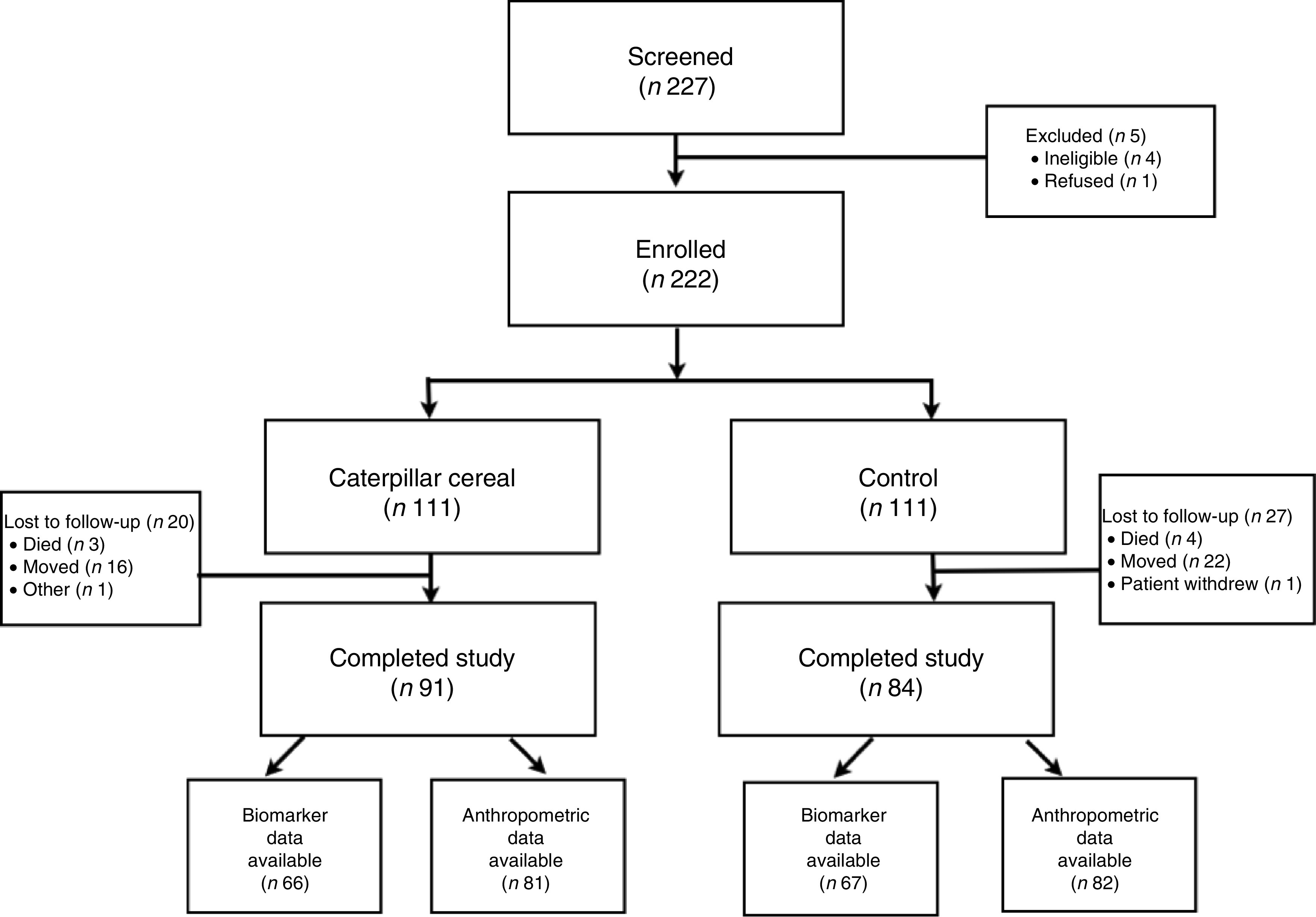
Design: Six-month-old infants were cluster randomized to receive either caterpillar cereal daily until 18 months of age or the usual diet. At 18 months of age, anthropometric measurements and biological samples were collected.
Setting: The rural Equateur Province in the Democratic Republic of Congo.
Subjects: One hundred and seventy-five infants followed from 6 to 18 months of age.
Results: Stunting was common at 6 months (35%) and the prevalence increased until 18 months (69%). There was no difference in stunting prevalence at 18 months between the intervention and control groups (67% v. 71%, P = 0.69). Infants in the cereal group had higher Hb concentration than infants in the control group (10.7 v. 10.1 g/dl, P = 0.03) and fewer were anaemic (26 v. 50%, P = 0.006), although there was no difference in estimates of body Fe stores (6.7 v. 7.2 mg/kg body weight, P = 0.44).
Conclusions: Supplementation of complementary foods with caterpillar cereal did not reduce the prevalence of stunting at 18 months of age. However, infants who consumed caterpillar cereal had higher Hb concentration and fewer were anaemic, suggesting that caterpillar cereal might have some beneficial effect. The high prevalence of stunting at 6 months and the lack of response to this micronutrient-rich supplement suggest that factors other than dietary deficiencies also contribute to stunting.
Trial registration: ClinicalTrials.gov NCT01282788.
Keywords: Anaemia; Complementary feeding; Stunting.
Figures
References
-
- Bhutta ZA, Das JK, Rizvi A et al. (2013) Evidence-based interventions for improvement of maternal and child nutrition: what can be done and at what cost? Lancet 382, 452–477. - PubMed
-
- Black RE, Victora CG, Walker SP et al. (2013) Maternal and child undernutrition and overweight in low-income and middle-income countries. Lancet 382, 427–451. - PubMed
-
- Black RE, Allen LH, Bhutta ZA et al. (2008) Maternal and child undernutrition: global and regional exposures and health consequences. Lancet 371, 243–260. - PubMed
-
- Bhutta ZA, Ahmed T, Black RE et al. (2008) What works? Interventions for maternal and child undernutrition and survival. Lancet 371, 417–440. - PubMed
Publication types
MeSH terms
Substances
Associated data
LinkOut - more resources
Full Text Sources
Medical
