. 2015 May;32(5):1237-41.
doi: 10.1093/molbev/msv014. Epub 2015 Jan 27.

No genome-wide protein sequence convergence for echolocation

Affiliations

No genome-wide protein sequence convergence for echolocation

Zhengting Zou et al. Mol Biol Evol. 2015 May.

Abstract

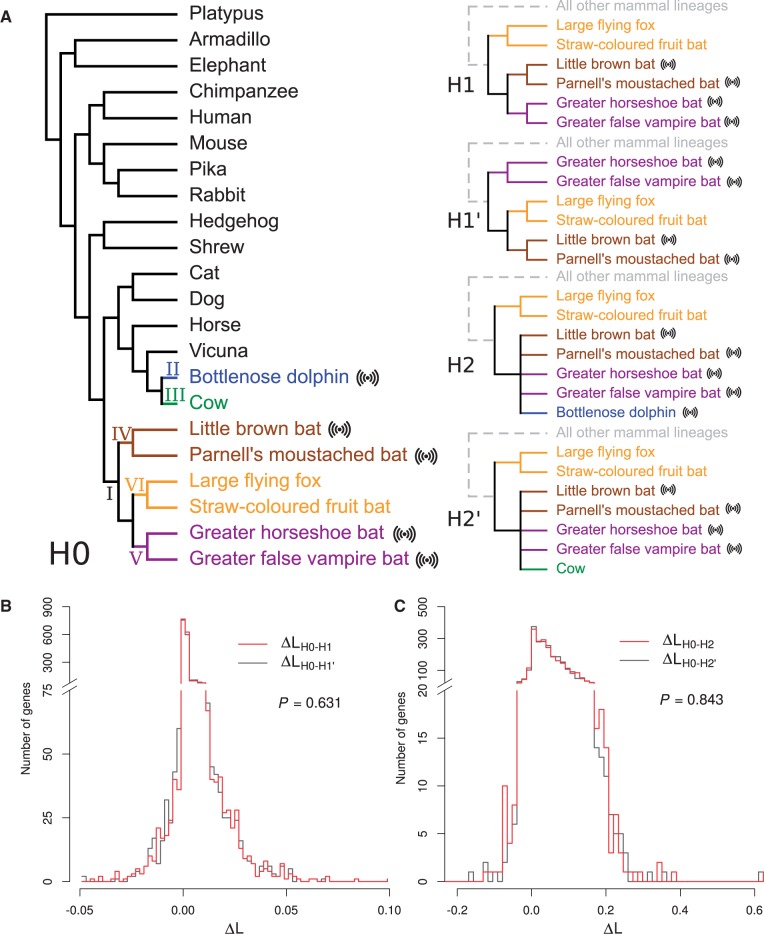
Toothed whales and two groups of bats independently acquired echolocation, the ability to locate and identify objects by reflected sound. Echolocation requires physiologically complex and coordinated vocal, auditory, and neural functions, but the molecular basis of the capacity for echolocation is not well understood. A recent study suggested that convergent amino acid substitutions widespread in the proteins of echolocators underlay the convergent origins of mammalian echolocation. Here, we show that genomic signatures of molecular convergence between echolocating lineages are generally no stronger than those between echolocating and comparable nonecholocating lineages. The same is true for the group of 29 hearing-related proteins claimed to be enriched with molecular convergence. Reexamining the previous selection test reveals several flaws and invalidates the asserted evidence for adaptive convergence. Together, these findings indicate that the reported genomic signatures of convergence largely reflect the background level of sequence convergence unrelated to the origins of echolocation.

Keywords: bat; convergent evolution; dolphin; neutral evolution.


Figures

F<sc>ig</sc>. 1.
Fig. 1.
No genome-wide signatures of protein sequence convergence associated with echolocation. (A) Hypotheses and corresponding tree topologies. H0, species tree; H1, clustering of the two groups of echolocating bats; H1′, clustering of echolocating Yangochiroptera bats and nonecholocating Yinpterochiroptera bats; H2, clustering of echolocating bats and dolphin; H2′, clustering of echolocating bats and cow. In H1, H1′, H2, and H2′, the tree topology for “all other mammalian lineages” is the same as in the species tree. Echolocating species are indicated with an echo symbol. The six branches where convergent sites are counted in table 1 are marked by I–VI. (B) Frequency distributions of ΔLH0-H1 and ΔLH0-H1' among the 2,326 proteins are not significantly different. ΔL refers to the per site logarithm of the likelihood ratio between two hypotheses for a protein. (C) Frequency distributions of ΔLH0-H2 and ΔLH0-H2' among the 2,326 proteins are not significantly different. In (B) and (C), the P-values are from Kolmogorov–Smirnov tests.

References

    1. Bazykin GA, Kondrashov FA, Brudno M, Poliakov A, Dubchak I, Kondrashov AS. Extensive parallelism in protein evolution. Biol Direct. 2007;2:20. - PMC - PubMed
    1. Castoe TA, de Koning AP, Kim HM, Gu W, Noonan BP, Naylor G, Jiang ZJ, Parkinson CL, Pollock DD. Evidence for an ancient adaptive episode of convergent molecular evolution. Proc Natl Acad Sci U S A. 2009;106:8986–8991. - PMC - PubMed
    1. Davies KT, Cotton JA, Kirwan JD, Teeling EC, Rossiter SJ. Parallel signatures of sequence evolution among hearing genes in echolocating mammals: an emerging model of genetic convergence. Heredity. 2012;108:480–489. - PMC - PubMed
    1. Li G, Wang J, Rossiter SJ, Jones G, Cotton JA, Zhang S. The hearing gene Prestin reunites echolocating bats. Proc Natl Acad Sci U S A. 2008;105:13959–13964. - PMC - PubMed
    1. Li Y, Liu Z, Shi P, Zhang J. The hearing gene Prestin unites echolocating bats and whales. Curr Biol. 2010;20:R55–R56. - PMC - PubMed

Publication types

LinkOut - more resources