


Socioeconomic Characteristics Are Major Contributors to Ethnic Differences in Health Status in Obstructive Lung Disease: An Analysis of the National Health and Nutrition Examination Survey 2007-2010
- PMID: 25633478
- PMCID: PMC4493871
- DOI: 10.1378/chest.14-1814
Socioeconomic Characteristics Are Major Contributors to Ethnic Differences in Health Status in Obstructive Lung Disease: An Analysis of the National Health and Nutrition Examination Survey 2007-2010
Erratum in
-
Correction to Reference in: Socioeconomic Characteristics Are Major Contributors to Ethnic Differences in Health Status in Obstructive Lung Disease: An Analysis of the National Health and Nutrition Examination Survey 2007-2010.Chest. 2015 Sep;148(3):842. doi: 10.1016/S0012-3692(15)50666-1. Chest. 2015. PMID: 26324135 Free PMC article. No abstract available.
Abstract
Background: Understanding ethnic differences in health status (HS) could help in designing culturally appropriate interventions. We hypothesized that racial and ethnic differences exist in HS between non-Hispanic whites and Mexican Americans with obstructive lung disease (OLD) and that these differences are mediated by socioeconomic factors.
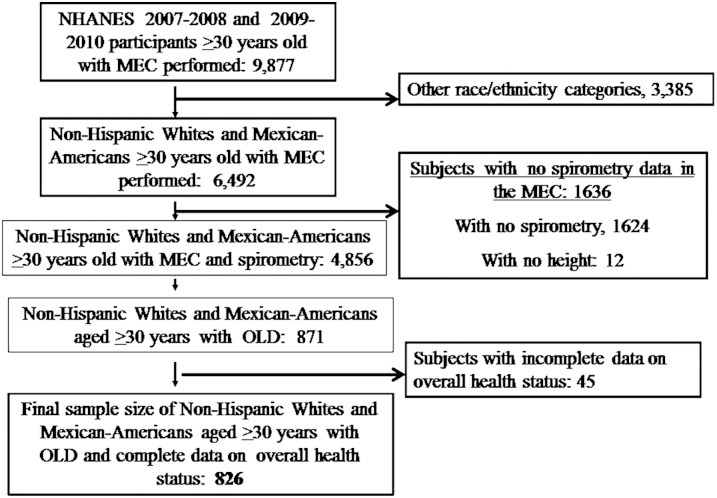
Methods: We analyzed 826 US adults aged ≥ 30 years self-identified as Mexican American or non-Hispanic white with spirometry-confirmed OLD (FEV₁/FVC < 0.7) who participated in the National Health and Nutrition Examination Survey 2007-2010. We assessed associations between Mexican American ethnicity and self-reported HS using logistic regression models adjusted for demographics, smoking status, number of comorbidities, limitations for work, and lung function and tested the contribution of education and health-care access to ethnic differences in HS.
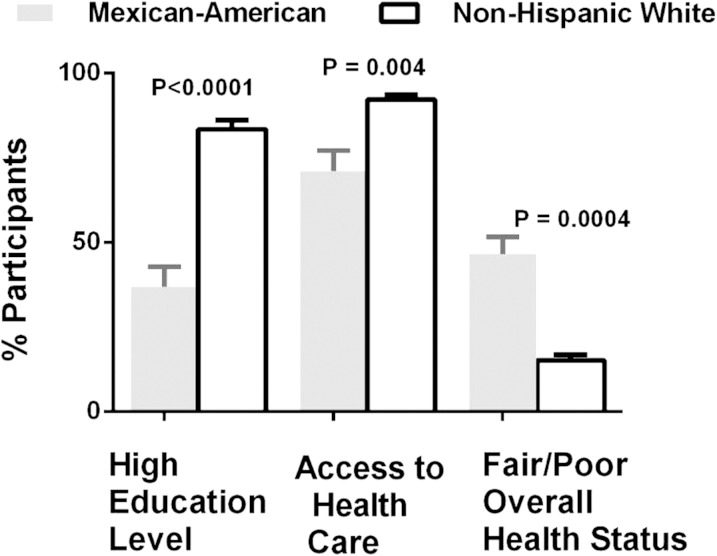
Results: Among Mexican Americans with OLD, worse (fair or poor) HS was more prevalent than among non-Hispanic whites (weighted percentage [SE], 46.6% [5.0] vs 15.2% [1.6]; P < .001). In bivariate analysis, socioeconomic characteristics were associated with lower odds of reporting poor HS (high school graduation: OR, 0.24 [95% CI, 0.10-0.40]; access to health care: OR, 0.50 [95% CI, 0.30-0.80]). In fully adjusted models, a strong association was found between Mexican American ethnicity (vs non-Hispanic white) and fair or poor HS (OR, 7.52; 95% CI, 4.43-12.78; P < .001). Higher education and access to health care contributed to lowering the Mexican American ethnicity odds of fair or poor HS by 47% and 16%, respectively, and together, they contributed 55% to reducing the differences in HS with non-Hispanic whites.
Conclusions: Mexican Americans with OLD report poorer overall HS than non-Hispanic whites, and education and access to health care are large contributors to the difference.
Figures
References
-
- Ford ES, Mannino DM, Wheaton AG, Giles WH, Presley-Cantrell L, Croft JB. Trends in the prevalence of obstructive and restrictive lung function among adults in the United States: findings from the National Health and Nutrition Examination surveys from 1988-1994 to 2007-2010. Chest. 2013;143(5):1395-1406. - PMC - PubMed
-
- Jones P, Lareau S, Mahler DA. Measuring the effects of COPD on the patient. Respir Med. 2005;99(suppl B):S11-S18. - PubMed
-
- Jones PW, Brusselle G, Dal Negro RW, et al. Health-related quality of life in patients by COPD severity within primary care in Europe. Respir Med. 2011;105(1):57-66. - PubMed
Publication types
MeSH terms
Grants and funding
LinkOut - more resources
Full Text Sources
Other Literature Sources
Medical
Molecular Biology Databases
