Nanocrystals of Cesium Lead Halide Perovskites (CsPbX₃, X = Cl, Br, and I): Novel Optoelectronic Materials Showing Bright Emission with Wide Color Gamut
- PMID: 25633588
- PMCID: PMC4462997
- DOI: 10.1021/nl5048779
Nanocrystals of Cesium Lead Halide Perovskites (CsPbX₃, X = Cl, Br, and I): Novel Optoelectronic Materials Showing Bright Emission with Wide Color Gamut
Abstract
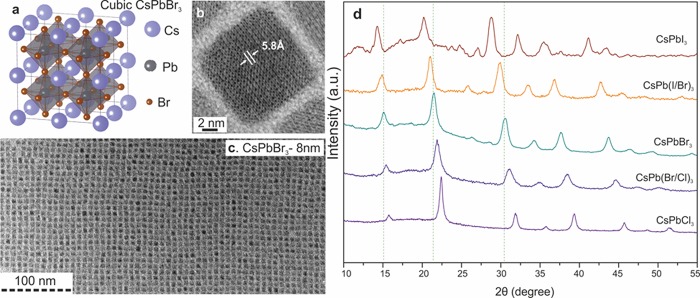
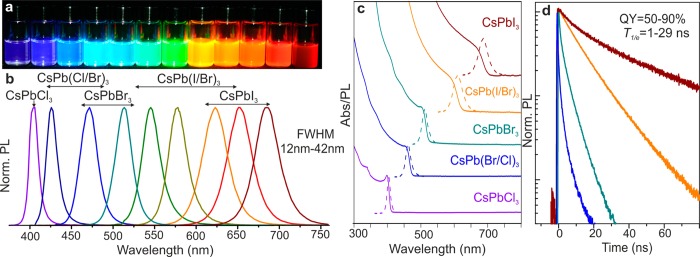
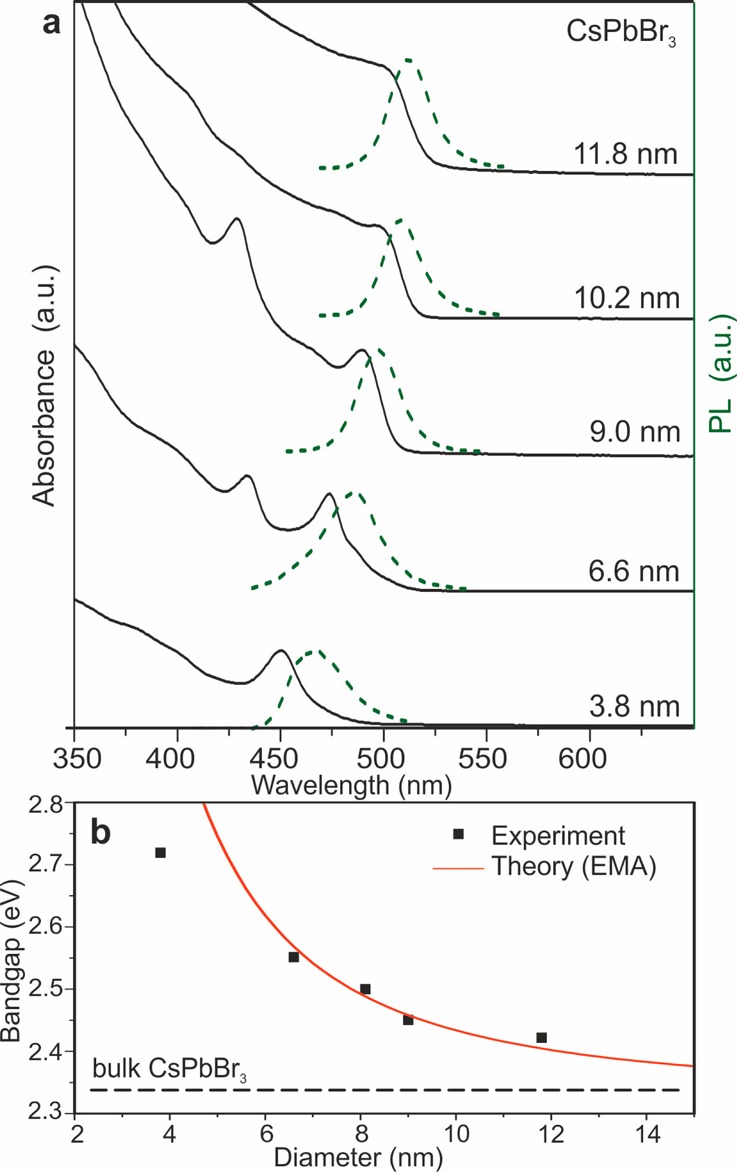
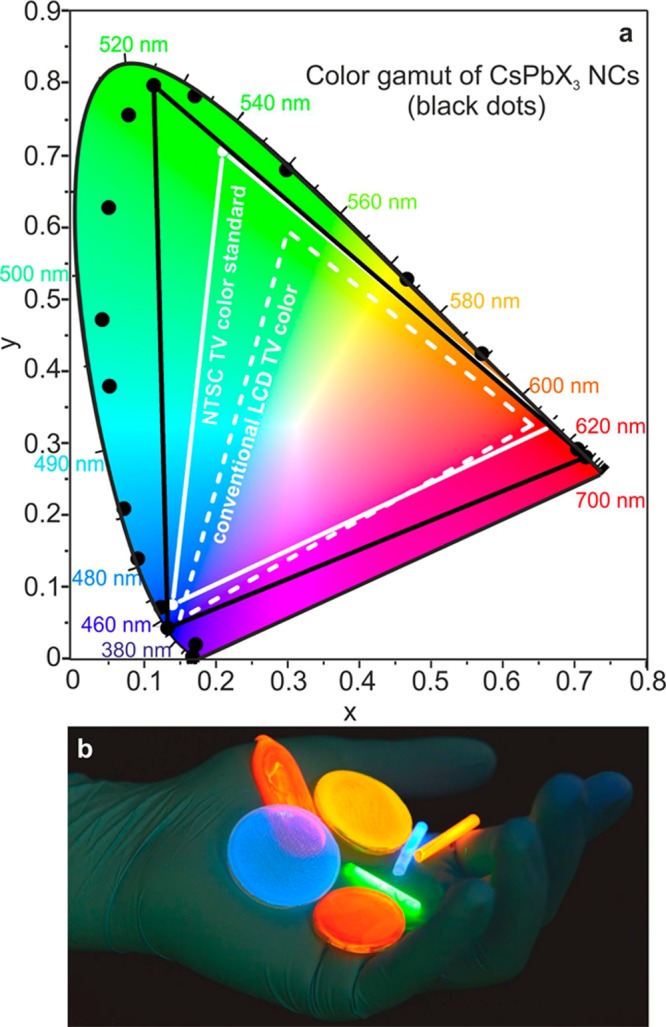
Metal halides perovskites, such as hybrid organic-inorganic CH3NH3PbI3, are newcomer optoelectronic materials that have attracted enormous attention as solution-deposited absorbing layers in solar cells with power conversion efficiencies reaching 20%. Herein we demonstrate a new avenue for halide perovskites by designing highly luminescent perovskite-based colloidal quantum dot materials. We have synthesized monodisperse colloidal nanocubes (4-15 nm edge lengths) of fully inorganic cesium lead halide perovskites (CsPbX3, X = Cl, Br, and I or mixed halide systems Cl/Br and Br/I) using inexpensive commercial precursors. Through compositional modulations and quantum size-effects, the bandgap energies and emission spectra are readily tunable over the entire visible spectral region of 410-700 nm. The photoluminescence of CsPbX3 nanocrystals is characterized by narrow emission line-widths of 12-42 nm, wide color gamut covering up to 140% of the NTSC color standard, high quantum yields of up to 90%, and radiative lifetimes in the range of 1-29 ns. The compelling combination of enhanced optical properties and chemical robustness makes CsPbX3 nanocrystals appealing for optoelectronic applications, particularly for blue and green spectral regions (410-530 nm), where typical metal chalcogenide-based quantum dots suffer from photodegradation.
Keywords: Perovskites; halides; nanocrystals; optoelectronics; quantum dots.
Figures
References
-
- Talapin D. V.; Lee J.-S.; Kovalenko M. V.; Shevchenko E. V. Chem. Rev. 2009, 110, 389–458. - PubMed
-
- Lan X.; Masala S.; Sargent E. H. Nat. Mater. 2014, 13, 233–240. - PubMed
-
- Hetsch F.; Zhao N.; Kershaw S. V.; Rogach A. L. Mater. Today 2013, 16, 312–325.
-
- Shirasaki Y.; Supran G. J.; Bawendi M. G.; Bulovic V. Nat. Photonics 2013, 7, 13–23.
Publication types
Grants and funding
LinkOut - more resources
Full Text Sources
Other Literature Sources
Miscellaneous