. 2015 Mar:80:175-85.
doi: 10.1016/j.yjmcc.2015.01.006. Epub 2015 Jan 26.

Reciprocal interactions between mitral valve endothelial and interstitial cells reduce endothelial-to-mesenchymal transition and myofibroblastic activation

Affiliations

Reciprocal interactions between mitral valve endothelial and interstitial cells reduce endothelial-to-mesenchymal transition and myofibroblastic activation

Kayle Shapero et al. J Mol Cell Cardiol. 2015 Mar.

Abstract

Thickening of mitral leaflets, endothelial-to-mesenchymal transition (EndMT), and activated myofibroblast-like interstitial cells have been observed in ischemic mitral valve regurgitation. We set out to determine if interactions between mitral valve endothelial cells (VECs) and interstitial cells (VICs) might affect these alterations. We used in vitro co-culture in Transwell™ inserts to test the hypothesis that VICs secrete factors that inhibit EndMT and conversely, that VECs secrete factors that mitigate the activation of VICs to a myofibroblast-like, activated phenotype. Primary cultures and clonal populations of ovine mitral VICs and VECs were used. Western blot, quantitative reverse transcriptase PCR (qPCR) and functional assays were used to assess changes in cell phenotype and behavior. VICs or conditioned media from VICs inhibited transforming growth factor β (TGFβ)-induced EndMT in VECs, as indicated by reduced expression of EndMT markers α-smooth muscle actin (α-SMA), Slug, Snai1 and MMP-2 and maintained the ability of VECs to mediate leukocyte adhesion, an important endothelial function. VECs or conditioned media from VECs reversed the spontaneous cell culture-induced change in VICs to an activated phenotype, as indicated by reduced expression of α-SMA and type I collagen, increased expression chondromodulin-1 (Chm1), and reduced contractile activity. These results demonstrate that mitral VECs and VICs secrete soluble factors that can reduce VIC activation and inhibit TGFβ-driven EndMT, respectively. These findings suggest that the endothelium of the mitral valve is critical for the maintenance of a quiescent VIC phenotype and that, in turn, VICs prevent EndMT. We speculate that the disturbance of the ongoing reciprocal interactions between VECs and VICs in vivo may contribute to the thickened and fibrotic leaflets observed in ischemic mitral regurgitation, and in other types of valve disease.

Keywords: Endothelial cells; Endothelial-to-mesenchymal transition; Mitral valve; Valve interstitial cells.


Figures

Figure 1
Figure 1
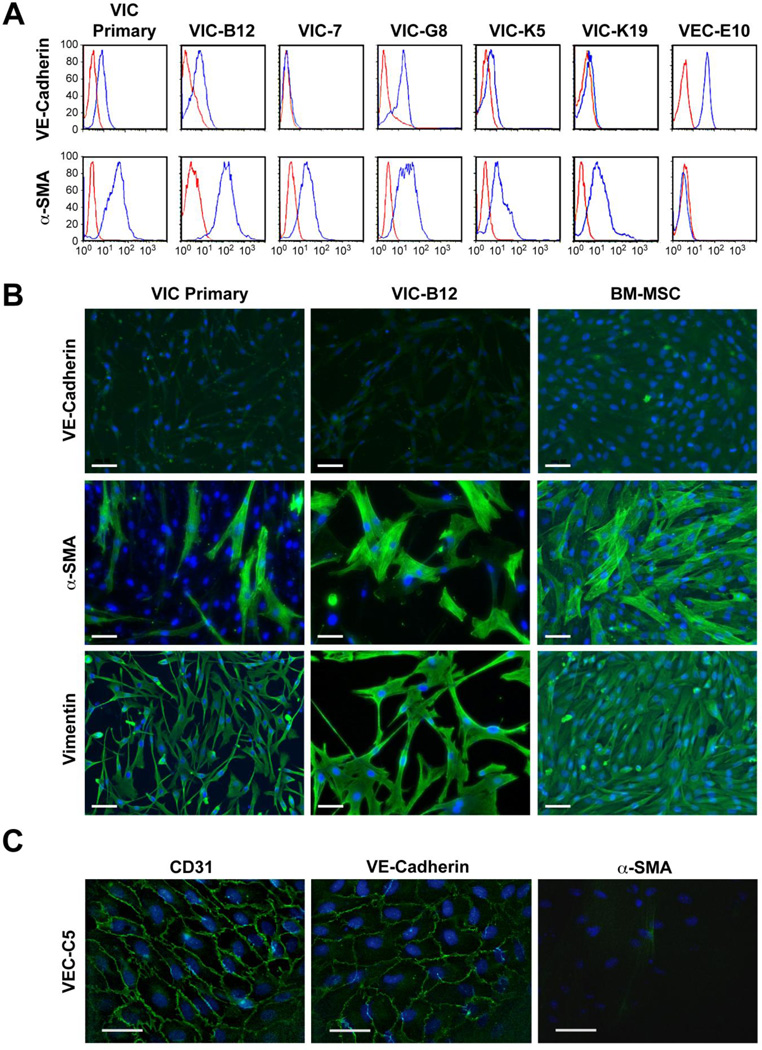
Phenotype of mitral valve interstitial cells (VIC) A. Flow cytometry of VIC with anti-VE-cadherin (top row) and anti-α-SMA (bottom row) (blue lines). Red line indicates cells incubated with isotype-matched control IgG. B. Immunofluorescence staining for VE-cadherin (top row), α-SMA (middle row) and vimentin (bottom row); nuclei stained blue with DAPI. Scale bar, 50 µM. C. Mitral VEC immunostained for CD31 (left panel), VE-cadherin (middle panel) and α-SMA (right panel); nuclei stained blue with DAPI. Scale bar, 20 µM.
Figure 2
Figure 2
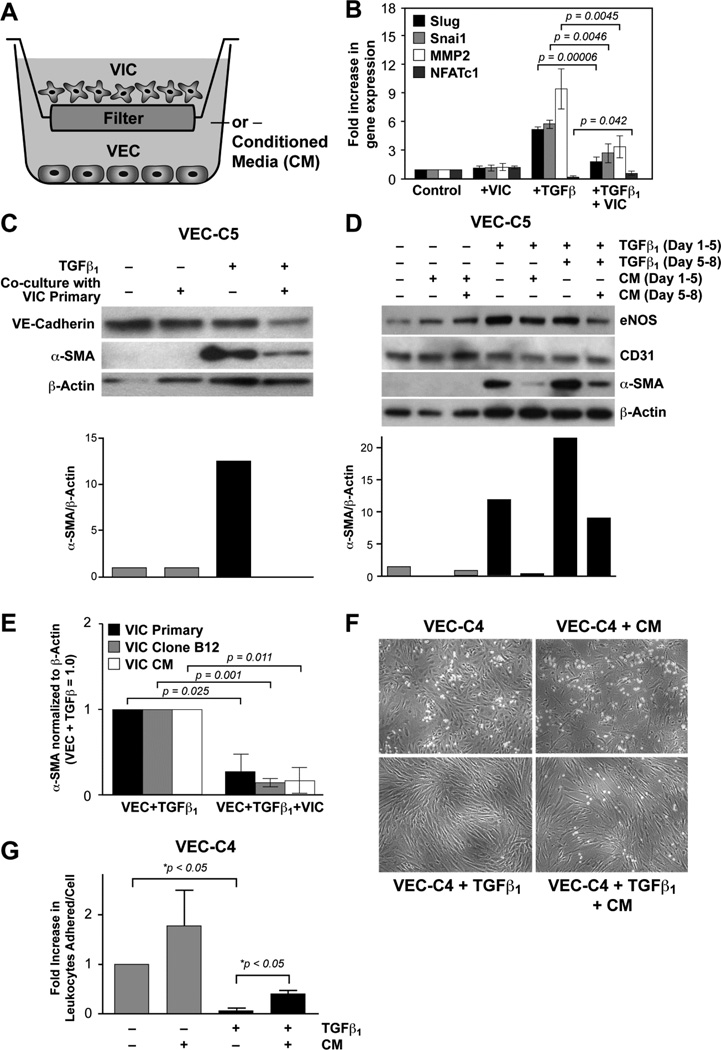
VIC inhibit TGFβ1-induced EndMT in VEC A. Schematic of mitral VIC-VEC co-culture. B. qPCR of EndMT markers Slug, Snai1, MMP1 and NFATc1 in untreated mitral VEC (control), mitral VEC co-cultured with VIC (+VIC), mitral VEC treated with TGFβ1 for 4 days (+TGFβ1) and mitral VEC treated with TGFβ1 and co-cultured with VIC (+TGFβ1 + VIC). Values were analyzed by two-tailed t-tests assuming unequal variance, with p value <0.05 considered significant. C. Western blot of VEC-C5 that had been co-cultured with VIC primary cells. Bar graph shows the levels of αSMA normalized to β-actin in each lane determined by image analysis of the western blot. D. Western blot of VEC-C5 co-cultured without (gray bars) or with TGFβ1 (black bars) from day 1–8 and with CM from VIC primary day 5–8. eNOS and CD31 serve as endothelial markers. Levels of αSMA normalized to β-actin in each lane were determined by image analysis. E. Levels of αSMA in VECs treated with TGFβ1 +/− co-culture with VIC primary cells (black bars), VIC clone B12 (gray bars) or VIC clone B12 CM (white bars), n=3 for each. Values were analyzed by two tailed t-tests assuming unequal variance, with p value < 0.05 considered significant. F–G. HL-60 leukocyte adhesion assay. VEC-C4 cells were treated with VIC CM, TGFβ1 or TGFβ1 + CM for 5 days prior to 5 hour treatment with TNF-α to induce expression of leukocyte adhesion molecules. HL-60 cells were allowed to adhere to the VEC monolayer for 45 minutes before washing with PBS. Bound HL-60 cells were photographed and counted. Data is expressed as mean +/− standard deviation. Statistical significance was determined using the one tailed Student’s t-test, assuming unequal variance, with p value <0.05 considered significant.
Figure 3
Figure 3
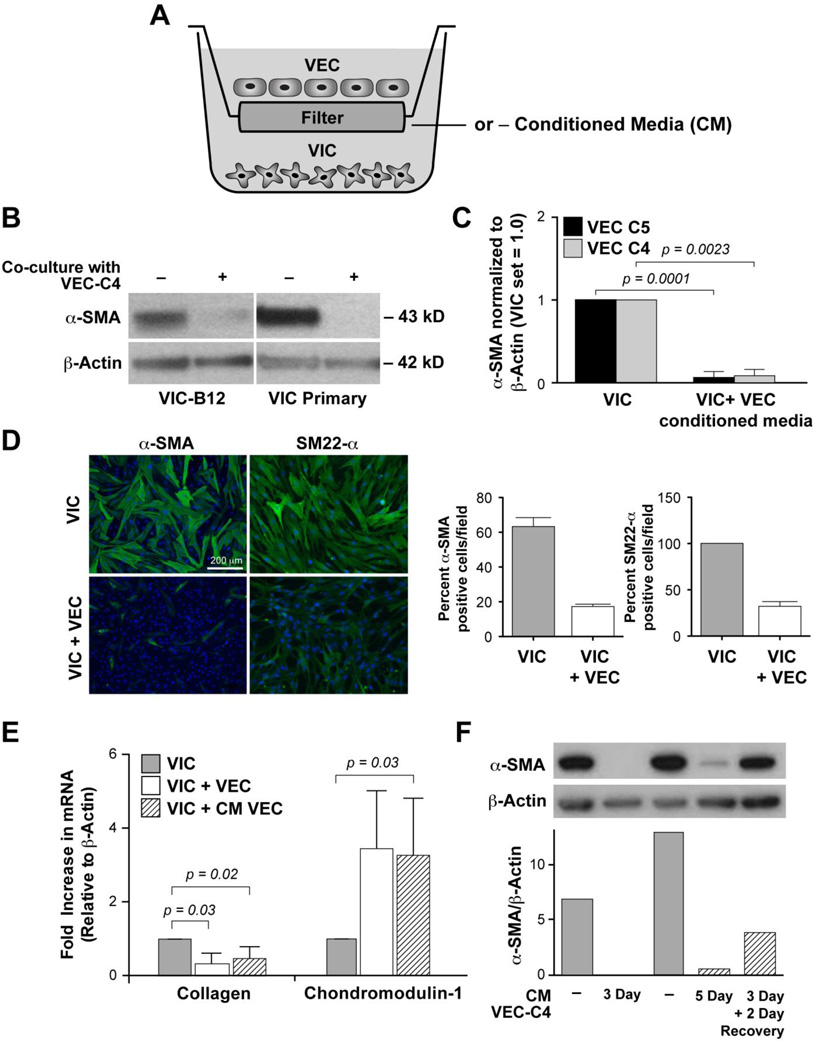
VEC reduce the activated VIC phenotype. A. Schematic of VEC-VIC co-culture. B. Western blot of lysates from VIC-B12 and VIC Primary co-cultured with VEC-C4. C. Levels of αSMA in VIC were normalized to β-actin and set 1.0 and compared to levels in VIC co-cultured with CM from VEC clone C5 (black bars) or VEC clone C4 (gray bars), n=3 for each. Values were analyzed by two tailed t-tests assuming unequal variance, with p value < 0.05 considered significant. D. Immunofluorescence staining for α-SMA and SM22-α (green) in VIC and VIC co-cultured with VEC. Nuclei are stained with blue with DAPI. Scale bar = 200 um. Bar graphs show quantification of positive cells/field. Five randomly selected fields at 20× magnification were quantified and expressed as average percent positive cells/field. E. qPCR for type I collagen and Chm1 in VIC that had been cultured alone (gray bar), indirectly with VEC (white bar) or with CM from VEC (hatched bar). Values were analyzed by one-tailed t-tests assuming unequal variance; a p value <0.05 is considered significant. F. Western blot of VIC cultured with CM from VEC-C4 as shown. Bar graph below the blots shows quantification α-SMA normalized to β-actin.
Figure 4
Figure 4
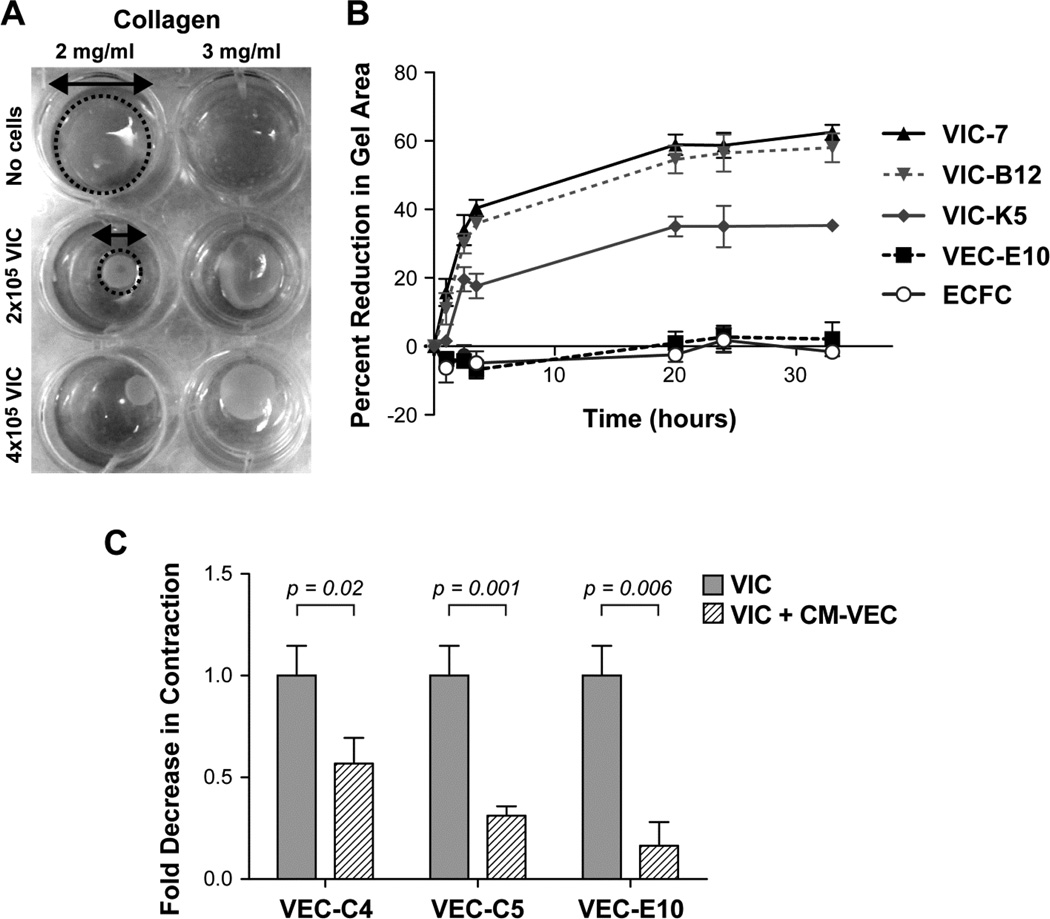
VIC contractility assay A. Optimization of VIC collagen gel contraction assay. B. Three different VIC clones contracted collagen gels over time; VEC and ECFC did not. C. VIC were cultured alone (gray bar) or with CM from VEC for 5 days (hatched bar), plated on collagen gels for one hour, and percent reduction in gel area measured. Means ± standard deviation were analyzed by two-tailed t-tests assuming unequal variance; a p value <0.05 is considered significant.
Figure 5
Figure 5
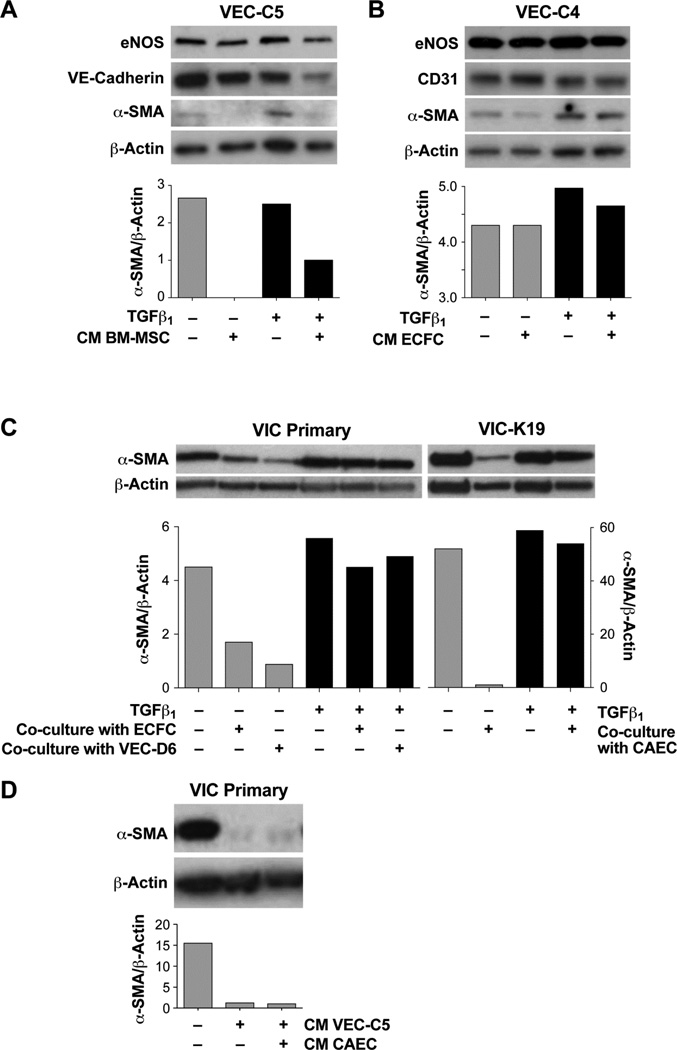
A. Western blot of VEC-C5 co-cultured with CM from BM-MSC in the absence (gray bars) or presence of TGFβ1. B. Western blot of VEC-C4 cultured with CM from ECFC in the absence (gray bars) or presence of TGFβ1. C. Western blot of VIC Primary (left) and VIC-K19 (right) co-cultured with ECFC, VEC-D6 or with CAEC as shown. Cells were treated without (gray bars) or with TGFβ1 for 5 days. D. Western blot of VIC primary cultured with CM from VEC-C5 or from CAEC. Bar graph shows α-SMA band intensities normalized to β-actin.

Comment in

  • To 'cell' and back!
    Lincoln J. Lincoln J. J Mol Cell Cardiol. 2015 Apr;81:94-5. doi: 10.1016/j.yjmcc.2015.02.001. Epub 2015 Feb 12. J Mol Cell Cardiol. 2015. PMID: 25681583 No abstract available.

References

    1. Grande-Allen KJ, et al. Mitral valve stiffening in end-stage heart failure: evidence of an organic contribution to functional mitral regurgitation. The Journal of thoracic and cardiovascular surgery. 2005;130(3):783–790. - PubMed
    1. Grande-Allen KJ, et al. Apparently normal mitral valves in patients with heart failure demonstrate biochemical and structural derangements: an extracellular matrix and echocardiographic study. Journal of the American College of Cardiology. 2005;45(1):54–61. - PubMed
    1. Dal-Bianco JP, et al. Active adaptation of the tethered mitral valve: insights into a compensatory mechanism for functional mitral regurgitation. Circulation. 2009;120(4):334–342. - PMC - PubMed
    1. Aikawa E, et al. Human semilunar cardiac valve remodeling by activated cells from fetus to adult: implications for postnatal adaptation, pathology, and tissue engineering. Circulation. 2006;113(10):1344–1352. - PubMed
    1. Liu AC, Joag VR, Gotlieb AI. The emerging role of valve interstitial cell phenotypes in regulating heart valve pathobiology. Am J Pathol. 2007;171(5):1407–1418. - PMC - PubMed

Publication types

Substances