


Antibiotics, bacteria, and antibiotic resistance genes: aerial transport from cattle feed yards via particulate matter
- PMID: 25633846
- PMCID: PMC4383574
- DOI: 10.1289/ehp.1408555
Antibiotics, bacteria, and antibiotic resistance genes: aerial transport from cattle feed yards via particulate matter
Abstract
Background: Emergence and spread of antibiotic resistance has become a global health threat and is often linked with overuse and misuse of clinical and veterinary chemotherapeutic agents. Modern industrial-scale animal feeding operations rely extensively on veterinary pharmaceuticals, including antibiotics, to augment animal growth. Following excretion, antibiotics are transported through the environment via runoff, leaching, and land application of manure; however, airborne transport from feed yards has not been characterized.
Objectives: The goal of this study was to determine the extent to which antibiotics, antibiotic resistance genes (ARG), and ruminant-associated microbes are aerially dispersed via particulate matter (PM) derived from large-scale beef cattle feed yards.
Methods: PM was collected downwind and upwind of 10 beef cattle feed yards. After extraction from PM, five veterinary antibiotics were quantified via high-performance liquid chromatography with tandem mass spectrometry, ARG were quantified via targeted quantitative polymerase chain reaction, and microbial community diversity was analyzed via 16S rRNA amplification and sequencing.
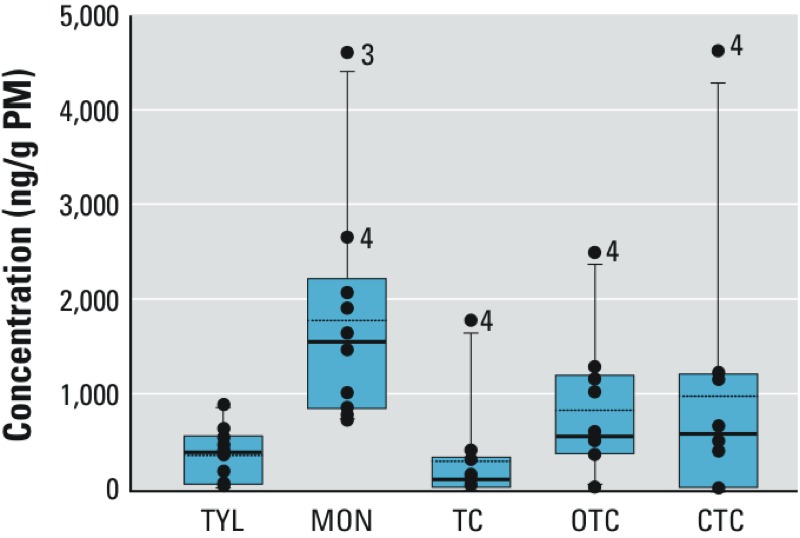
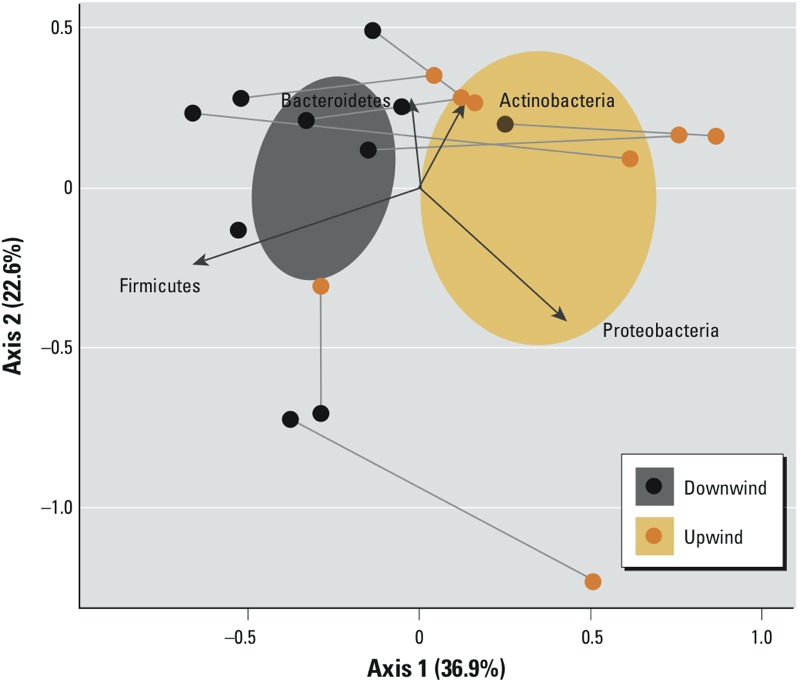
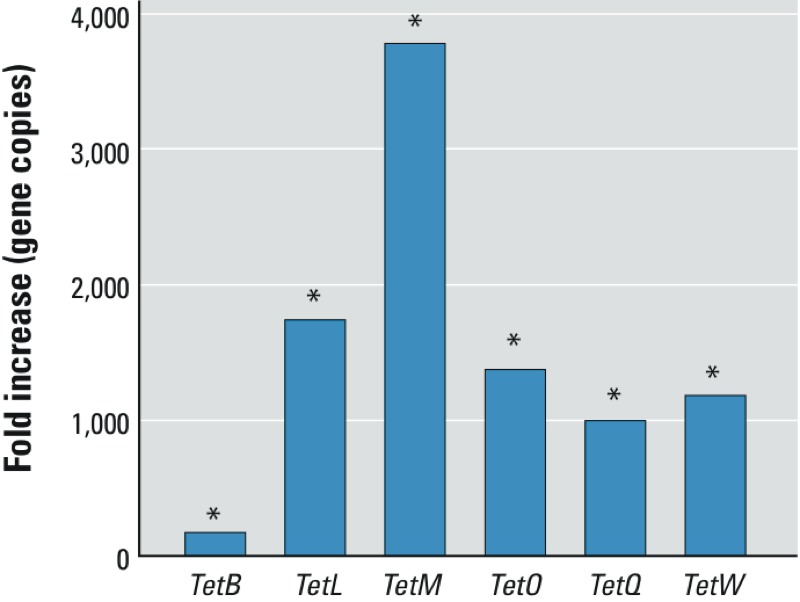
Results: Airborne PM derived from feed yards facilitated dispersal of several veterinary antibiotics, as well as microbial communities containing ARG. Concentrations of several antibiotics in airborne PM immediately downwind of feed yards ranged from 0.5 to 4.6 μg/g of PM. Microbial communities of PM collected downwind of feed yards were enriched with ruminant-associated taxa and were distinct when compared to upwind PM assemblages. Furthermore, genes encoding resistance to tetracycline antibiotics were significantly more abundant in PM collected downwind of feed yards as compared to upwind.
Conclusions: Wind-dispersed PM from feed yards harbors antibiotics, bacteria, and ARGs.
Conflict of interest statement
J.D.H. and S.B.C. are both employed by Research and Testing Laboratory (Lubbock, TX). The authors declare they have no actual or potential competing financial interests.
Figures
Comment in
-
Dust emissions from cattle feed yards: a source of antibiotic resistance?Environ Health Perspect. 2015 Apr;123(4):A96. doi: 10.1289/ehp.123-A96. Environ Health Perspect. 2015. PMID: 25830727 Free PMC article. No abstract available.
References
-
- Anderson MJ, Willis TJ. Canonical analysis of principal coordinates: a useful method of constrained ordination for ecology. Ecology. 2003;84:511–525.
-
- Aust MO, Godlinski F, Travis GR, Hao X, McAllister TA, Leinweber P, et al. Distribution of sulfamethazine, chlortetracycline and tylosin in manure and soil of Canadian feedlots after subtherapeutic use in cattle. Environ Pollut. 2008;156:1243–1251. - PubMed
-
- Bonifacio HF, Maghirang RG, Auvermann BW, Razote EB, Murphy JP, Harner JP., III Particulate matter emission rates from beef cattle feedlots in Kansas—reverse dispersion modeling. J Air Waste Manag Assoc. 2012;62:350–361. - PubMed
-
- Boxall ABA, Johnson P, Smith EJ, Sinclair CJ, Stutt E, Levy LS. Uptake of veterinary medicines from soils into plants. J Agric Food Chem. 2006;54:2288–2297. - PubMed
-
- Chee-Sanford JC, Mackie RI, Koike S, Krapac IG, Lin YF, Yannarell AC, et al. Fate and transport of antibiotic residues and antibiotic resistance genes following land application of manure waste. J Environ Qual. 2009;38:1086–1108. - PubMed
Publication types
MeSH terms
Substances
LinkOut - more resources
Full Text Sources
Other Literature Sources
Medical