A cybrid cell model for the assessment of the link between mitochondrial deficits and sporadic Parkinson's disease
- PMID: 25634293
- PMCID: PMC4612525
- DOI: 10.1007/978-1-4939-2288-8_31
A cybrid cell model for the assessment of the link between mitochondrial deficits and sporadic Parkinson's disease
Abstract
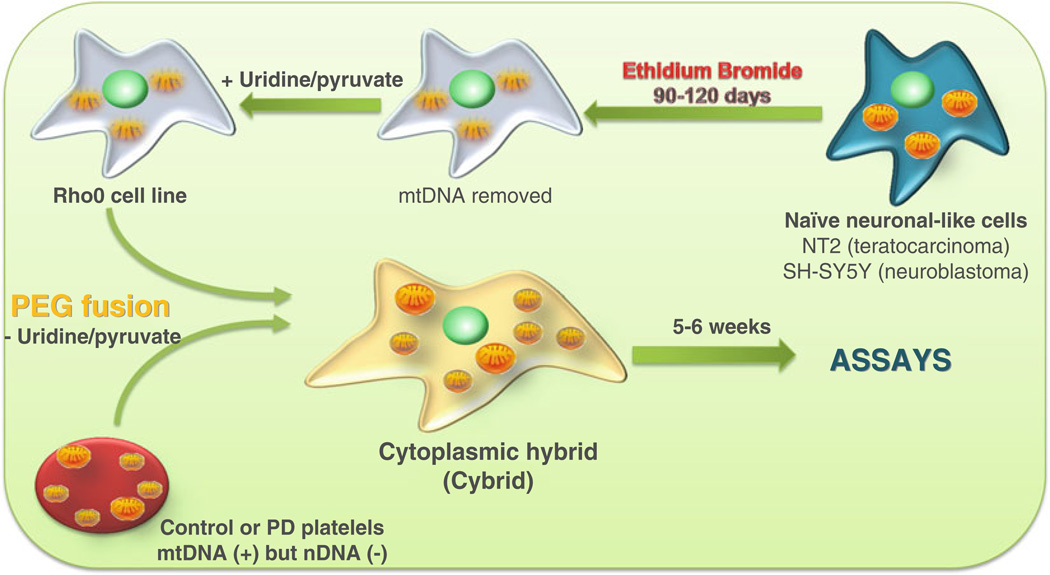
Parkinson's disease (PD) is a multifactorial and clinically complex age-related movement disorder. The cause of its most common form (sporadic PD, sPD) is unknown, but one prominent causal factor is mitochondrial dysfunction. Although several genetic- and toxin-based models have been developed along the last decades to mimic the pathological cascade of PD, cellular models that reliably recapitulate the pathological features of the neurons that degenerate in PD are scarce.We describe here the generation of cytoplasmic hybrid cells (or cybrids) as a cellular model of sPD. This approach consists on the fusion of platelets harboring mtDNA from sPD patients with cells in which the endogenous mtDNA has been depleted (Rho0 cells).The sPD cybrid model has been successful in recapitulating most of the hallmarks of sPD, constituting now a validated model for addressing the link between mitochondrial dysfunction and sPD pathology.
Figures

References
-
- Schapira AH. Mitochondrial dysfunction in Parkinson’s disease. Cell Death Differ. 2007;14(7):1261–1266. - PubMed
-
- Thomas B, Beal MF. Parkinson’s disease. Hum Mol Genet. 2007;16:R183–R194. 16/R2/R183 [pii] - PubMed
-
- Esteves AR, Domingues AF, Ferreira IL, Januario C, Swerdlow RH, Oliveira CR, Cardoso SM. Mitochondrial function in Parkinson’s disease cybrids containing an nt2 neuron-like nuclear background. Mitochondrion. 2008;8(3):219–228. - PubMed
-
- Ghosh SS, Swerdlow RH, Miller SW, Sheeman B, Parker WD, Jr, Davis RE. Use of cytoplasmic hybrid cell lines for elucidating the role of mitochondrial dysfunction in Alzheimer’s disease and Parkinson’s disease. Ann N Y Acad Sci. 1999;893:176–191. - PubMed
-
- Swerdlow RH, Parks JK, Miller SW, Tuttle JB, Trimmer PA, Sheehan JP, Bennett JP, Jr, Davis RE, Parker WD., Jr Origin and functional consequences of the complex I defect in Parkinson’s disease. Ann Neurol. 1996;40(4):663–671. - PubMed
MeSH terms
Grants and funding
LinkOut - more resources
Full Text Sources
Other Literature Sources
Medical