


Decreased Cancer Mortality-to-Incidence Ratios with Increased Accessibility of Federally Qualified Health Centers
- PMID: 25634545
- PMCID: PMC4490935
- DOI: 10.1007/s10900-014-9978-8
Decreased Cancer Mortality-to-Incidence Ratios with Increased Accessibility of Federally Qualified Health Centers
Abstract
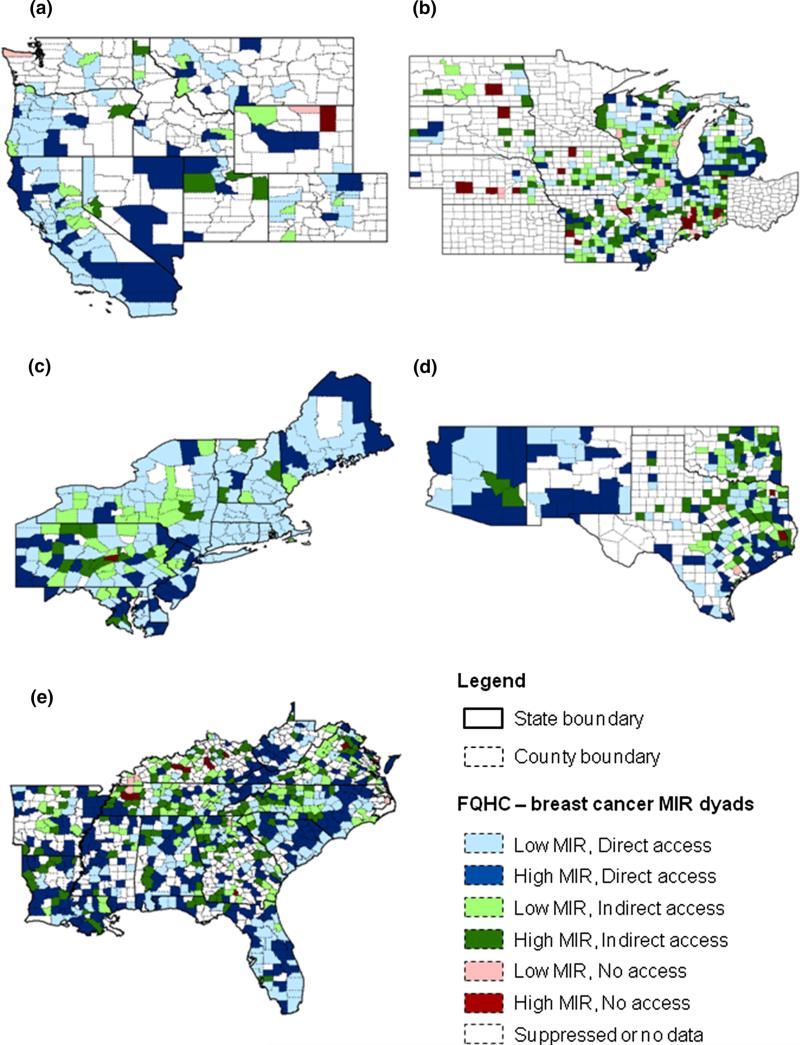
Federally qualified health centers (FQHCs) offer primary and preventive healthcare, including cancer screening, for the nation's most vulnerable population. The purpose of this study was to explore the relationship between access to FQHCs and cancer mortality-to-incidence ratios (MIRs). One-way analysis of variance was conducted to compare the mean MIRs for breast, cervical, prostate, and colorectal cancers for each U.S. county for 2006-2010 by access to FQHCs (direct access, in-county FQHC; indirect access, adjacent-county FQHC; no access, no FQHC either in the county or in adjacent counties). ArcMap 10.1 software was used to map cancer MIRs and FQHC access levels. The mean MIRs for breast, cervical, and prostate cancer differed significantly across FQHC access levels (p < 0.05). In urban and healthcare professional shortage areas, mean MIRs decreased as FQHC access increased. A trend of lower breast and prostate cancer MIRs in direct access to FQHCs was found for all racial groups, but this trend was significant for whites only. States with a large proportion of rural and medically underserved areas had high mean MIRs, with correspondingly more direct FQHC access. Expanding FQHCs to more underserved areas and concentrations of disparity populations may have an important role in reducing cancer morbidity and mortality, as well as racial-ethnic disparities, in the United States.
Figures
References
-
- Siegel R, Ma J, Zou Z, Jemal A. Cancer statistics, 2014. CA: A Cancer Journal for Clinicians. 2014;64(1):9–29. - PubMed
-
- Tabár L, Vitak B, Chen TH, et al. Swedish two-county trial: Impact of mammographic screening on breast cancer mortality during 3 decades. Radiology. 2011;260(3):658–663. - PubMed
-
- Saslow D, Solomon D, Lawson HW, et al. American Cancer Society, American Society for Colposcopy and Cervical Pathology, and American Society for Clinical Pathology screening guidelines for the prevention and early detection of cervical cancer. CA: A Cancer Journal for Clinicians. 2012;62(3):147–172. - PMC - PubMed
Publication types
MeSH terms
Grants and funding
LinkOut - more resources
Full Text Sources
Other Literature Sources
