


Mutations of GJB2 encoding connexin 26 contribute to non-syndromic moderate and severe hearing loss in Pakistan
- PMID: 25636251
- PMCID: PMC4475449
- DOI: 10.1007/s00405-015-3523-y
Mutations of GJB2 encoding connexin 26 contribute to non-syndromic moderate and severe hearing loss in Pakistan
Abstract
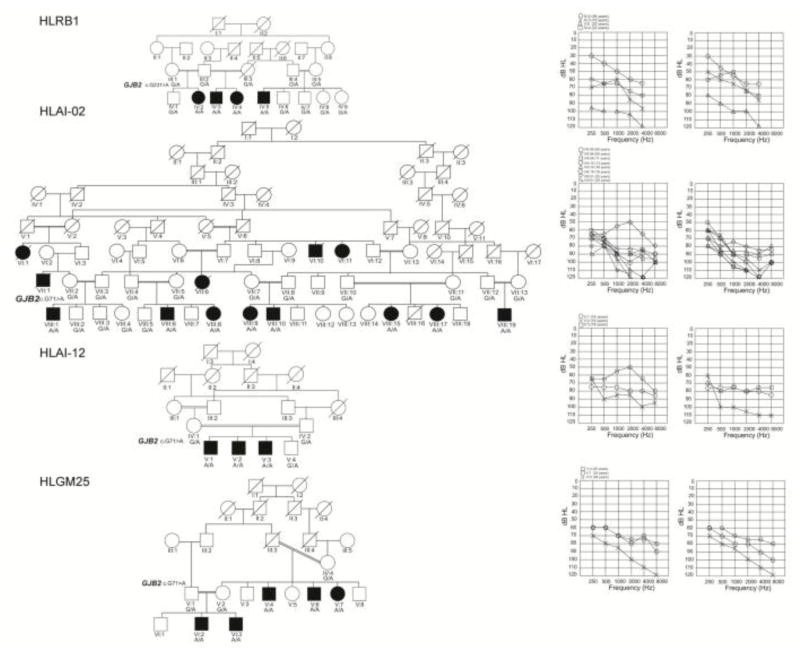
Mutations of GJB2 which encode connexin 26, contribute to 6-7 % of profound deafness in Pakistan. We investigated the involvement of GJB2 mutations in a cohort of 84 pedigrees and 86 sporadic individuals with moderate or severe hearing loss. Individuals in eight consanguineous families and four sporadic cases (9.52 and 4.65 %, respectively) were homozygous or compound heterozygous for p.W24X or p.W77X mutations in GJB2. These two variants are also among the most common mutations known to cause profound deafness in South Asia. The association of identical mutations with both profound and less severe phenotype of hearing loss suggests that alleles of other genes modify the phenotype due to these GJB2 nonsense mutations. Our study demonstrates that GJB2 mutations are an important contributor to aetiology of moderate to severe hearing loss in Pakistan.
Conflict of interest statement
The authors declare no conflict of interest.
Figures
References
-
- Thonnissen E, Rabionet R, Arbones ML, Estivill X, Willecke K, Ott T. Human connexin26 (GJB2) deafness mutations affect the function of gap junction channels at different levels of protein expression. Hum Genet. 2002;111 (2):190–197. - PubMed
-
- Kenneson A, Van Naarden Braun K, Boyle C. GJB2 (connexin 26) variants and nonsyndromic sensorineural hearing loss: a HuGE review. Genet Med. 2002;4 (4):258–274. - PubMed
-
- Denoyelle F, Marlin S, Weil D, Moatti L, Chauvin P, Garabedian EN, Petit C. Clinical features of the prevalent form of childhood deafness, DFNB1, due to a connexin-26 gene defect: implications for genetic counselling. Lancet. 1999;353 (9161):1298–1303. - PubMed
-
- Estivill X, Fortina P, Surrey S, Rabionet R, Melchionda S, D’Agruma L, Mansfield E, Rappaport E, Govea N, Mila M, Zelante L, Gasparini P. Connexin-26 mutations in sporadic and inherited sensorineural deafness. Lancet. 1998;351 (9100):394–398. - PubMed
-
- Gasparini P, Rabionet R, Barbujani G, Melchionda S, Petersen M, Brondum-Nielsen K, Metspalu A, Oitmaa E, Pisano M, Fortina P, Zelante L, Estivill X. High carrier frequency of the 35delG deafness mutation in European populations. Genetic Analysis Consortium of GJB2 35delG. Eur J Hum Genet. 2000;8 (1):19–23. - PubMed
Publication types
MeSH terms
Substances
Grants and funding
LinkOut - more resources
Full Text Sources
Other Literature Sources
