


doi: 10.1007/s11017-015-9321-0.
Psychiatric comorbidity: fact or artifact?
Affiliations
- PMID: 25636962
- PMCID: PMC4320768
- DOI: 10.1007/s11017-015-9321-0
Item in Clipboard
Psychiatric comorbidity: fact or artifact?
Theor Med Bioeth.
2015 Feb.
Abstract
The frequent occurrence of comorbidity has brought about an extensive theoretical debate in psychiatry. Why are the rates of psychiatric comorbidity so high and what are their implications for the ontological and epistemological status of comorbid psychiatric diseases? Current explanations focus either on classification choices or on causal ties between disorders. Based on empirical and philosophical arguments, we propose a conventionalist interpretation of psychiatric comorbidity instead. We argue that a conventionalist approach fits well with research and clinical practice and resolves two problems for psychiatric diseases: experimenter's regress and arbitrariness.
Figures
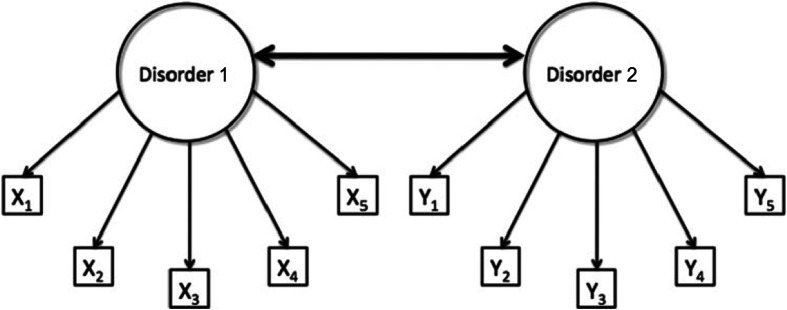
A model of comorbidity between disorders 1 and 2, under the standard assumptions of latent variable modeling. The circles represent the disorders (i.e., latent variables) and the rectangles represent the observable core symptoms of those disorders (i.e., X1–X5 for disorder 1, and Y1–Y5 for disorder 2). In this model, comorbidity is viewed as a correlation between the latent variables, visualized by the thick bidirectional edge between disorders 1 and 2 (Figure from Cramer et al. [21] with minor adjustments; reprinted with permission)
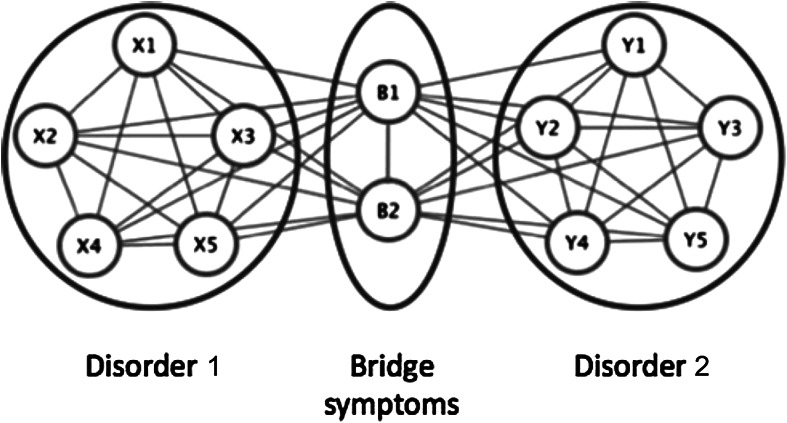
Comorbidity under a network approach. Disorder 1 consists of bidirectionally related symptoms X1–X5, and disorder 2 consists of symptoms Y1–Y5. Symptoms B1 and B2 are bridge symptoms that overlap between disorders 1 and 2. In this model, comorbidity arises as a result of direct relations between the bridge symptoms of two disorders (Figure from Cramer et al. [21] with minor adjustments; reprinted with permission)
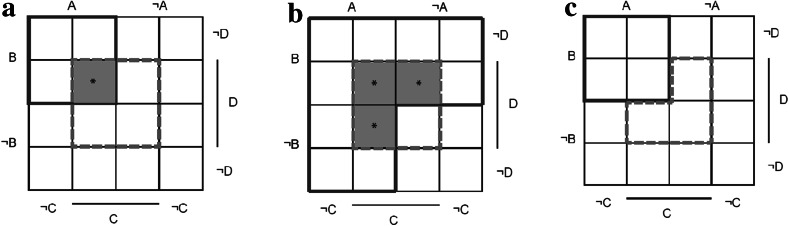
Different disease models and their potential for comorbidity. D1
solid line; D2
dashed line; *potential comorbid symptom combinations. a Two monothetic disease models (D
1: A ∩ B; D
2: C ∩ D). b
D
1 as a polythetic model (D
1: A ∪ B; D
2: C ∩ D). c
D
2 includes exclusionary rules (D
1: A ∩ B; D
2: ¬A ∩ ¬B ∩ C ∩ D)
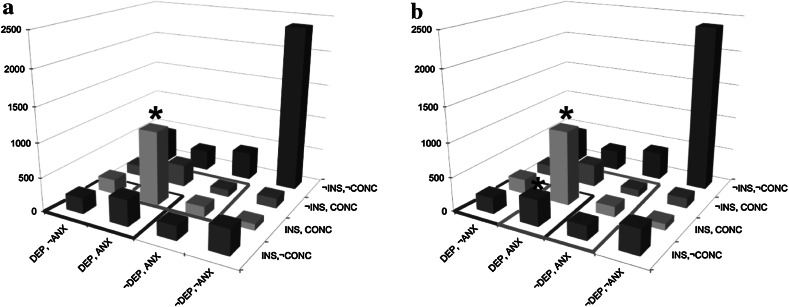
Histogram with responses on “Have you ever suffered from…?” Answers: ANX: anxiety, worrisome period of at least 1 month; DEP: depressed mood for at least 2 weeks; INS: insomnia for at least 2 weeks; CONC: concentration problems for at least 2 weeks (* marks comorbidity with rates of 43.1 % in a to 53.9 % in b)
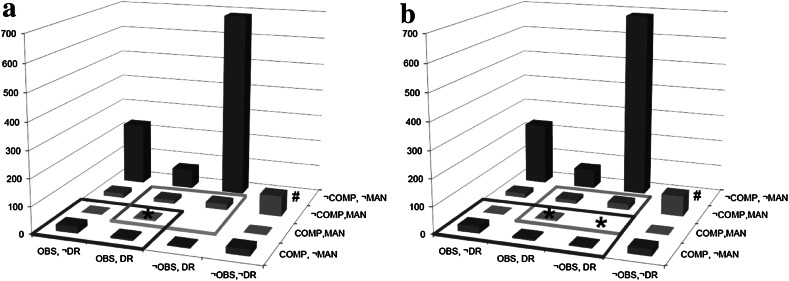
Histogram with responses on “Have you ever suffered from…?” Answers: OBS obsessions, COMP compulsions, MAN manic mood for at least 2 days; DR drug use. (* marks comorbidity with rates of 6.9 % in a to 6.5 % in b) (The column representing the n = 5,889 individuals without symptoms has been omitted to improve the visibility of the individuals suffering from one or more symptoms)
References
-
- American Psychiatric Association . Diagnostic and statistical manual of mental disorders. 5. Washington, DC: American Psychiatric Publishing; 2013.
Publication types
MeSH terms
LinkOut - more resources
Full Text Sources
Other Literature Sources
Medical
