


Comparison of two isometric handgrip protocols on sympathetic arousal in women
- PMID: 25637170
- PMCID: PMC4340716
- DOI: 10.1016/j.physbeh.2015.01.031
Comparison of two isometric handgrip protocols on sympathetic arousal in women
Abstract
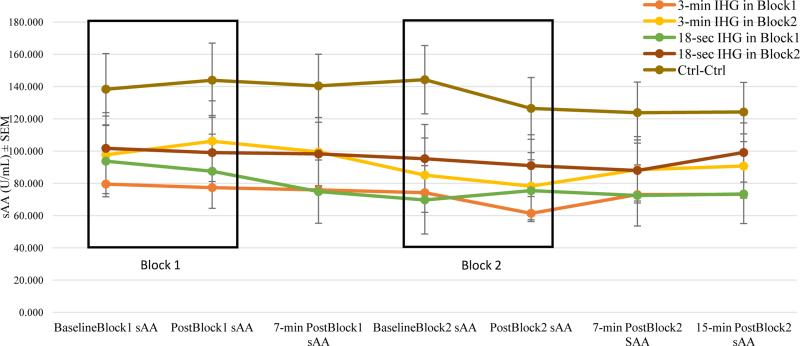
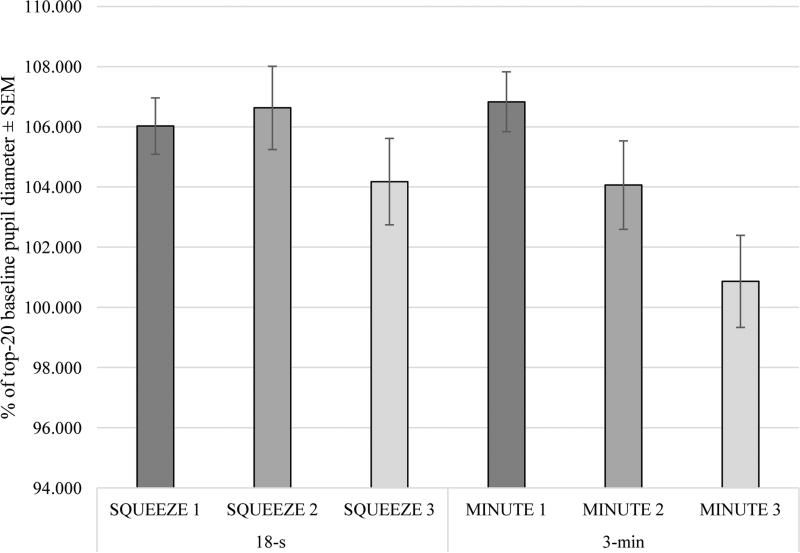
Isometric handgrip is commonly used in stress research because the task reliably increases sympathetic arousal. Various handgrip protocols have been used; they vary in handgrip strength, duration of grip, and the number of cycles of handgrip and rest. However, most protocols require the calibration of a maximum voluntary contraction (MVC) prior to the handgrip task, which is not always convenient (i.e., in a functional magnetic resonance imaging study). Here, we wanted to test whether two handgrip protocols with different strength, duration and cycle protocols would reliably elicit sympathetic arousal in the absence of calibrating an MVC. Sixty-two healthy naturally cycling women and women on hormonal contraception participated in one of the two isometric handgrip protocols using a hand therapy ball of medium resistance. Women completed one of the following handgrip protocols: 1) 30% of a perceived maximum voluntary contraction for 3 min or 2) 3 cycles of maximum voluntary contraction for 18s with a one minute rest in between. All handgrip blocks were counterbalanced with a control condition. Sympathetic arousal was measured throughout the session via pupil diameter changes and salivary alpha-amylase. Results indicate that in the absence of calibrating an MVC, the handgrip tasks elicited different changes in sympathetic arousal. Pupil dilation responses increased significantly in the handgrip versus control blocks only in participants in the 18-s protocol. Additionally, more participants exhibited a salivary alpha-amylase response to the handgrip block in the 18-s condition compared to the 3-min condition. Thus, these results suggest that neuroimaging and behavioral studies with isometric handgrip should be able to successfully induce sympathetic nervous activity with the 18-s paradigm, regardless of the handgrip device and the ability to calibrate an MVC.
Keywords: Handgrip; Norepinephrine; Pupil dilation; Sympathetic arousal; Women.
Published by Elsevier Inc.
Figures


References
-
- Mitchell JH, Wildenthal K. Static (isometric) exercise and the heart: physiological and clinical considerations. Annual review of medicine. 1974;25(1):369–381. - PubMed
-
- Christensen NJ, Galbo H. Sympathetic nervous activity during exercise. Annual Review of Physiology. 1983;45(1):139–153. - PubMed
-
- McAllister R., Jr Effect of adrenergic receptor blockade on the responses to isometric handgrip: studies in normal and hypertensive subjects. Journal of cardiovascular pharmacology. 1979;1(2):253–264. - PubMed
-
- Jones PP, et al. Gender does not influence sympathetic neural reactivity to stress in healthy humans. American Journal of Physiology-Heart and Circulatory Physiology. 1996;39(1):H350. - PubMed
Publication types
MeSH terms
Substances
Grants and funding
LinkOut - more resources
Full Text Sources
Other Literature Sources
