


The association between reduction in inflammation and changes in lipoprotein levels and HDL cholesterol efflux capacity in rheumatoid arthritis
- PMID: 25637346
- PMCID: PMC4345878
- DOI: 10.1161/JAHA.114.001588
The association between reduction in inflammation and changes in lipoprotein levels and HDL cholesterol efflux capacity in rheumatoid arthritis
Abstract
Background: Potent anti-inflammatory rheumatoid arthritis (RA) treatments are associated with reduced cardiovascular risk as well as increases in low-density lipoprotein (LDL) cholesterol. This apparent paradox may be explained by favorable changes in other lipid measurements. The objective of this study was to determine the longitudinal association between changes in inflammation with advanced lipoprotein measurements and high-density lipoprotein (HDL) cholesterol efflux capacity.
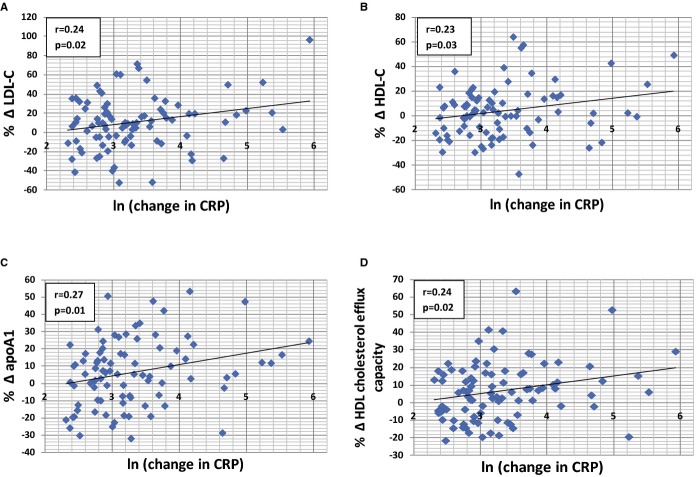
Methods and results: We conducted this study in a longitudinal RA cohort from a large academic center, including subjects with high-sensitivity C-reactive protein (hs-CRP) reduction ≥10 mg/L at 2 time points 1 year apart. Subjects receiving statins during the study period or preceding 6 months were excluded. We compared total cholesterol, LDL cholesterol, HDL cholesterol, apolipoprotein B, and apolipoprotein A1 levels and HDL cholesterol efflux capacity at baseline and 1-year follow-up by using the paired t test. We also assessed the correlations between reductions in hs-CRP with percentage change in lipid parameters. We studied 90 RA subjects (mean age 57 years, 89% female), all of whom were receiving disease-modifying antirheumatic drugs. We observed a 7.2% increase in LDL cholesterol levels (P=0.02) and improvement in efflux capacity by 5.7% (P=0.002) between baseline and follow-up, with a median hs-CRP reduction of 23.5 mg/L. We observed significant correlations between reductions in hs-CRP with increases in apolipoprotein A1 (r=0.27, P=0.01) and HDL cholesterol efflux capacity (r=0.24, P=0.02).
Conclusion: Among RA subjects experiencing reductions in hs-CRP, we observed increased LDL cholesterol levels and concomitant improvements in HDL cholesterol efflux capacity. These findings provide further insight into lipid modulation and the beneficial effect of reduction in inflammation on lipids in vivo.
Keywords: inflammation; lipids; rheumatoid arthritis.
© 2015 The Authors. Published on behalf of the American Heart Association, Inc., by Wiley Blackwell.
Figures
References
-
- Avina‐Zubieta JA, Thomas J, Sadatsafavi M, Lehman AJ, Lacaille D. Risk of incident cardiovascular events in patients with rheumatoid arthritis: a meta‐analysis of observational studies. Ann Rheum Dis. 2012; 71:1524-1529. - PubMed
-
- Solomon DH, Karlson EW, Rimm EB, Cannuscio CC, Mandl LA, Manson JE, Stampfer MJ, Curhan GC. Cardiovascular morbidity and mortality in women diagnosed with rheumatoid arthritis. Circulation. 2003; 107:1303-1307. - PubMed
-
- Lazarevic MB, Vitic J, Mladenovic V, Myones BL, Skosey JL, Swedler WI. Dyslipoproteinemia in the course of active rheumatoid arthritis. Semin Arthritis Rheum. 1992; 22:172-178. - PubMed
Publication types
MeSH terms
Substances
Grants and funding
LinkOut - more resources
Full Text Sources
Medical
Research Materials
Miscellaneous
