


Genome-Wide Association Study of Behavioral Disinhibition in a Selected Adolescent Sample
- PMID: 25637581
- PMCID: PMC4459903
- DOI: 10.1007/s10519-015-9705-y
Genome-Wide Association Study of Behavioral Disinhibition in a Selected Adolescent Sample
Abstract
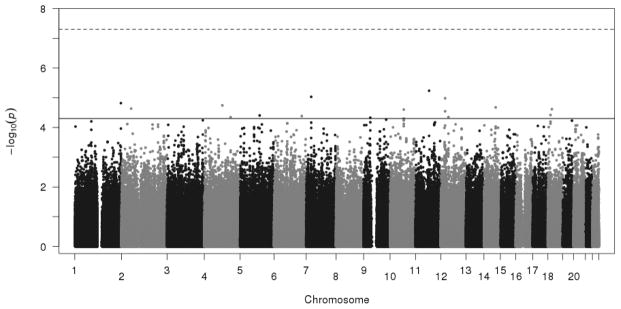
Behavioral disinhibition (BD) is a quantitative measure designed to capture the heritable variation encompassing risky and impulsive behaviors. As a result, BD represents an ideal target for discovering genetic loci that predispose individuals to a wide range of antisocial behaviors and substance misuse that together represent a large cost to society as a whole. Published genome-wide association studies (GWAS) have examined specific phenotypes that fall under the umbrella of BD (e.g. alcohol dependence, conduct disorder); however no GWAS has specifically examined the overall BD construct. We conducted a GWAS of BD using a sample of 1,901 adolescents over-selected for characteristics that define high BD, such as substance and antisocial behavior problems, finding no individual locus that surpassed genome-wide significance. Although no single SNP was significantly associated with BD, restricted maximum likelihood analysis estimated that 49.3 % of the variance in BD within the Caucasian sub-sample was accounted for by the genotyped SNPs (p = 0.06). Gene-based tests identified seven genes associated with BD (p ≤ 2.0 × 10(-6)). Although the current study was unable to identify specific SNPs or pathways with replicable effects on BD, the substantial sample variance that could be explained by all genotyped SNPs suggests that larger studies could successfully identify common variants associated with BD.
Figures
References
MeSH terms
Grants and funding
- R01 DA005147/DA/NIDA NIH HHS/United States
- R37 AA009367/AA/NIAAA NIH HHS/United States
- U01 HG004446/HG/NHGRI NIH HHS/United States
- R01 AA009367/AA/NIAAA NIH HHS/United States
- U01 DA024417/DA/NIDA NIH HHS/United States
- HHSN268200782096C/HG/NHGRI NIH HHS/United States
- R01 DA013423/DA/NIDA NIH HHS/United States
- T32 MH016880/MH/NIMH NIH HHS/United States
- HHSN268200782096C/HL/NHLBI NIH HHS/United States
- R37 DA005147/DA/NIDA NIH HHS/United States
- R25 DA026119/DA/NIDA NIH HHS/United States
- R01 DA035804/DA/NIDA NIH HHS/United States
- U01 HG004438/HG/NHGRI NIH HHS/United States
- R01 DA021905/DA/NIDA NIH HHS/United States
- R01 DA021913/DA/NIDA NIH HHS/United States
- R01 AA011886/AA/NIAAA NIH HHS/United States
- P01 CA089392/CA/NCI NIH HHS/United States
- R01 DA024417/DA/NIDA NIH HHS/United States
- U01 HG004422/HG/NHGRI NIH HHS/United States
- R01 MH066140/MH/NIMH NIH HHS/United States
- R01 DA012845/DA/NIDA NIH HHS/United States
- R01 MH100141/MH/NIMH NIH HHS/United States
- U10 AA008401/AA/NIAAA NIH HHS/United States
- P60 DA011015/DA/NIDA NIH HHS/United States
- R01 DA013240/DA/NIDA NIH HHS/United States
LinkOut - more resources
Full Text Sources
Other Literature Sources
Medical
Molecular Biology Databases
