


Human promoters are intrinsically directional
- PMID: 25639469
- PMCID: PMC4336624
- DOI: 10.1016/j.molcel.2014.12.029
Human promoters are intrinsically directional
Abstract
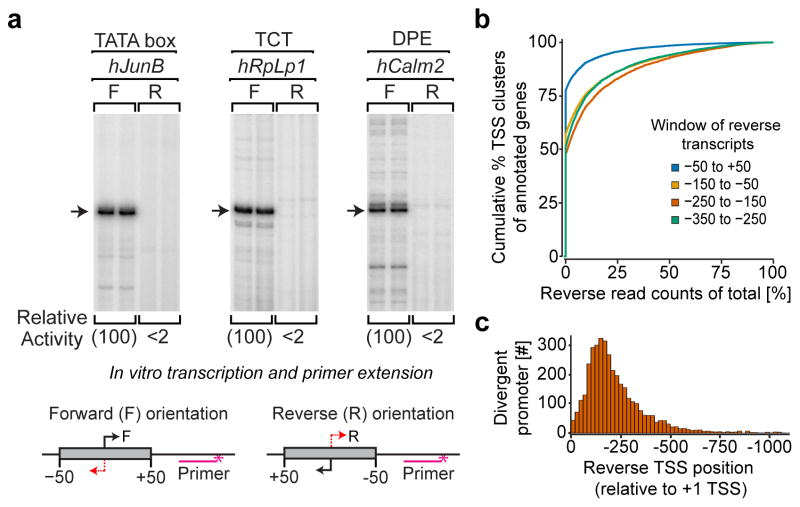
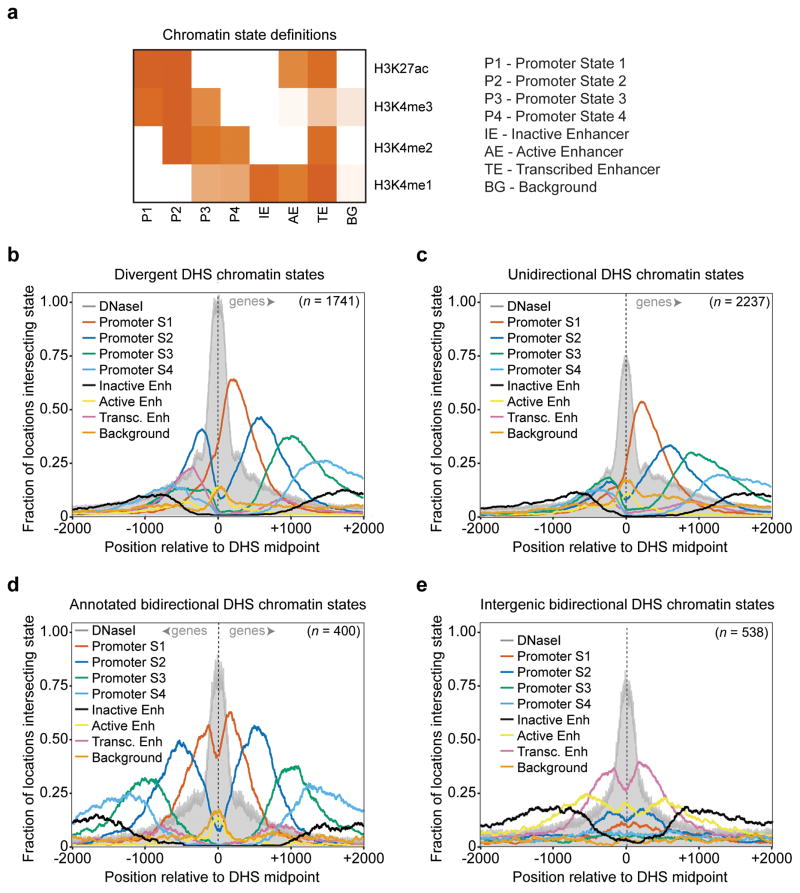
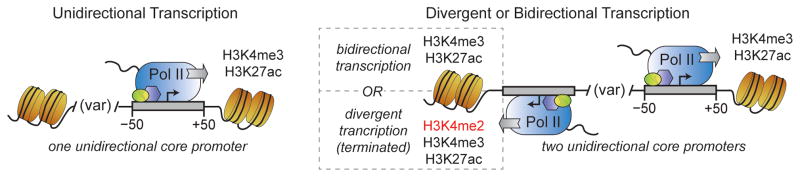
Divergent transcription, in which reverse-oriented transcripts occur upstream of eukaryotic promoters in regions devoid of annotated genes, has been suggested to be a general property of active promoters. Here we show that the human basal RNA polymerase II transcriptional machinery and core promoter are inherently unidirectional and that reverse-oriented transcripts originate from their own cognate reverse-directed core promoters. In vitro transcription analysis and mapping of nascent transcripts in HeLa cells revealed that sequences at reverse start sites are similar to those of their forward counterparts. The use of DNase I accessibility to define proximal promoter borders revealed that about half of promoters are unidirectional and that unidirectional promoters are depleted at their upstream edges of reverse core promoter sequences and their associated chromatin features. Divergent transcription is thus not an inherent property of the transcription process but rather the consequence of the presence of both forward- and reverse-directed core promoters.
Copyright © 2015 Elsevier Inc. All rights reserved.
Figures


Comment in
-
Human Gene Promoters Are Intrinsically Bidirectional.Mol Cell. 2015 Nov 5;60(3):346-7. doi: 10.1016/j.molcel.2015.10.015. Mol Cell. 2015. PMID: 26545074 Free PMC article. No abstract available.
-
Perspectives on Unidirectional versus Divergent Transcription.Mol Cell. 2015 Nov 5;60(3):348-9. doi: 10.1016/j.molcel.2015.10.014. Mol Cell. 2015. PMID: 26545075 Free PMC article. No abstract available.
References
-
- Adachi N, Lieber MR. Bidirectional gene organization: a common architectural feature of the human genome. Cell. 2002;109:807–809. - PubMed
-
- Arigo JT, Eyler DE, Carroll KL, Corden JL. Termination of cryptic unstable transcripts is directed by yeast RNA-binding proteins Nrd1 and Nab3. Molecular Cell. 2006;23:841–851. - PubMed
Publication types
MeSH terms
Substances
Associated data
- Actions
Grants and funding
LinkOut - more resources
Full Text Sources
Other Literature Sources
Molecular Biology Databases
