Review
. 2015 Mar;40(3):130-40.
doi: 10.1016/j.tibs.2015.01.004. Epub 2015 Jan 29.

Famine versus feast: understanding the metabolism of tumors in vivo

Affiliations
Review

Famine versus feast: understanding the metabolism of tumors in vivo

Jared R Mayers et al. Trends Biochem Sci. 2015 Mar.

Abstract

To fuel unregulated proliferation, cancer cells alter metabolism to support macromolecule biosynthesis. Cell culture studies have revealed how different oncogenic mutations and nutrients impact metabolism. Glucose and glutamine are the primary fuels used in vitro; however, recent studies have suggested that utilization of other amino acids as well as lipids and protein can also be important to cancer cells. Early investigations of tumor metabolism are translating these findings to the biology of whole tumors and suggest that additional complexity exists beyond nutrient availability alone in vivo. Whole-body metabolism and tumor heterogeneity also influence the metabolism of tumor cells, and successful targeting of metabolism for cancer therapy will require an understanding of tumor metabolism in vivo.

Keywords: cancer metabolism; cell proliferation; nutrient availability; tumor metabolism.


Figures

Figure 1
Figure 1
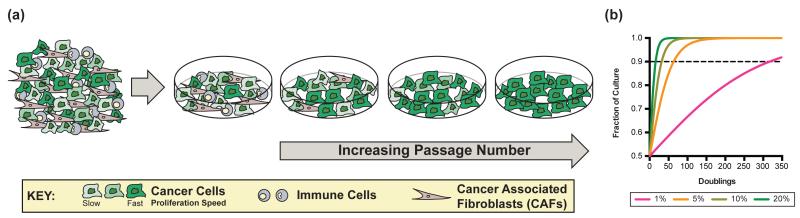
Establishing tumor-derived cell lines in culture selects for the fastest proliferating clones in the population, and non-dividing and less proliferative cells are lost upon serial passaging. This inevitable consequence of cell culture is illustrated graphically in (A), using the example of cell line generation from a tumor. Panel (B) shows a model demonstrating how many cell doublings are required for a clone to take over the culture population if that clone has the proliferation advantage indicated (key; proliferation advantage indicated as % faster than control doubling time). The model assumes competition between two distinct clones plated at equal density with one clone having a fixed advantage that is invariant over time. We further define one clone representing greater than 90% of the cultured population as having taken over the culture. This threshold is reached after 317 doublings with a 1% proliferation advantage, 64 with 5%, 32 with 10%, and only 16 with 20%. Additional details of the model are included as supplemental material.
Figure 2
Figure 2
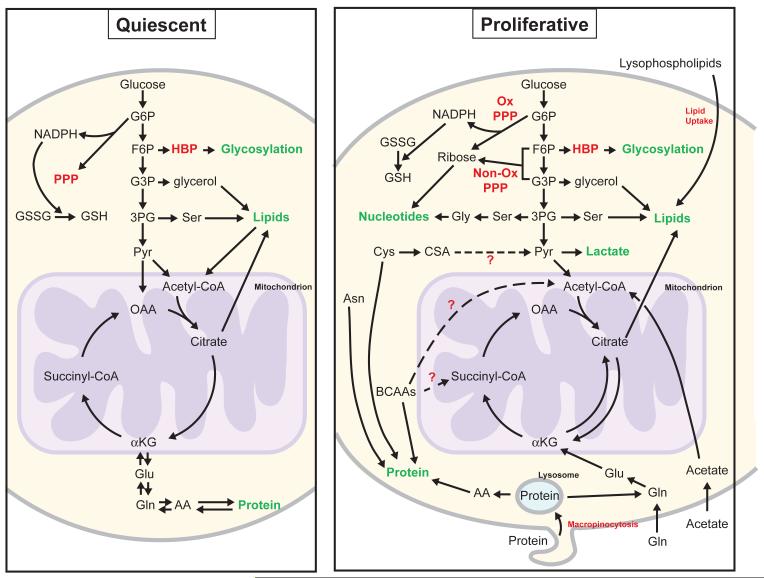
/B> Differences between quiescent and proliferative metabolism. In quiescent metabolism (left), cells balance catabolic and anabolic process such as lipogenesis and β-oxidation, or protein synthesis and degradation. In proliferative metabolism (right), anabolic processes are favored to allow the net production of biomass. Red labels indicate metabolic pathways not shown in detail. Green labels indicate macromolecules (or protein modifications such as glycosylation) that represent the starting points of catabolic pathways and/or the end points of anabolic pathways. Broken arrows represent potential fates of the identified nutrients that have not been extensively investigated. The mitochondrion is represented in purple to illustrate compartmentalized reactions. Abbreviations: AA = amino acids, Asn = Asparagine, αKG = α-ketoglutarate, BCAAs = branched chain amino acids, CSA = cysteine sulfinic acid, Cys = cysteine, F6P = fructose-6-phosphate, Gln = glutamine, Glu = glutamate, Gly = glycine, GSH = reduced glutathione, GSSG = oxidized glutathione, G3P = glyceraldehyde-3-phosphate, G6P = glucose-6-phosphate, HBP = hexosamine biosynthetic pathway, NADPH = reduced nicotinaminde adenine dinucleotide phosphate, OAA = oxaloacetate, ox = oxidative, PPP = pentose phosphate pathway, Pyr = pyruvate, Ser = serine, 3PG = 3-phosphoglycerate.

References

    1. Gaglio D, et al. Oncogenic K-Ras decouples glucose and glutamine metabolism to support cancer cell growth. Molecular Systems Biology. 2011;7:523–523. - PMC - PubMed
    1. Vizan P. K-ras Codon-Specific Mutations Produce Distinctive Metabolic Phenotypes in Human Fibroblasts. Cancer Research. 2005;65:5512–5515. - PubMed
    1. Wise DR, et al. Myc regulates a transcriptional program that stimulates mitochondrial glutaminolysis and leads to glutamine addiction. Proc Natl Acad Sci USA. 2008;105:18782–18787. - PMC - PubMed
    1. Gao P, et al. c-Myc suppression of miR-23a/b enhances mitochondrial glutaminase expression and glutamine metabolism. Nature. 2009;458:762–765. - PMC - PubMed
    1. Wang R, et al. The Transcription Factor Myc Controls Metabolic Reprogramming upon T Lymphocyte Activation. Immunity. 2011;35:871–882. - PMC - PubMed

Publication types