Review
. 2015 Sep;12(5):553-7.
doi: 10.1038/cmi.2014.133. Epub 2015 Feb 2.

The role of all-trans retinoic acid in the biology of Foxp3+ regulatory T cells

Affiliations
Review

The role of all-trans retinoic acid in the biology of Foxp3+ regulatory T cells

Zhong-Min Liu et al. Cell Mol Immunol. 2015 Sep.

Abstract

Regulatory T (Treg) cells are necessary for immune system homeostasis and the prevention of autoimmune diseases. Foxp3 is specifically expressed in Treg cells and plays a key role in their differentiation and function. Foxp3(+) Treg cells are consisted of naturally occurring, thymus-derived Treg (nTreg) and peripheral-induced Treg (iTreg) cells that may have different functional characteristics or synergistic roles. All-trans retinoic acid (atRA), a vitamin A metabolite, regulates a wide range of biological processes, including cell differentiation and proliferation. Recent studies demonstrated that atRA also regulates the differentiation of T helper (Th) cells and Treg cells. Moreover, atRA also sustains nTreg stability under inflammatory conditions. In this review, we summarize the significant progress of our understanding of the role(s) and mechanisms of atRA in Treg biology.


Figures
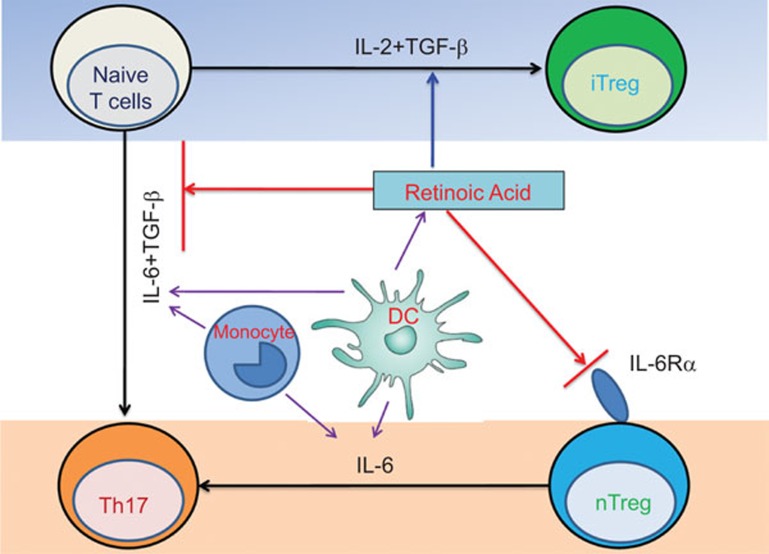
Figure 1
Figure 1
Immunomodulatory effects of atRA on CD4+ T-cell subsets. atRA maintains immune homeostasis by working with TGF-β to promote Treg cell induction from naive T cells, while inhibiting Th17 cell induction in the presence of inflammatory cytokines such as IL-6. In addition, atRA inhibits Th17 differentiation from nTreg cells by reducing their expression of IL-6Rα. atRA, all-trans retinoic acid; TGF, transforming growth factor; Treg, regulatory T.

References

    1. 1Zhou X, Bailey-Bucktrout SL, Jeker LT, Rosenthal W, Bluestone JA. Instability of the transcription factor Foxp3 leads to the generation of pathogenic memory T cells in vivo. Nat Immunol 2009; 10: 1000–1007. - PMC - PubMed
    1. 2Sawa S, Kamimura D, Jin GH, Morikawa H, Kamon H, Nishihara M et al. Autoimmune arthritis associated with mutated interleukin (IL)-6 receptor gp130 is driven by STAT3/IL-7-dependent homeostatic proliferation of CD4+ T cells. J Exp Med 2006; 203: 1459–1470. - PMC - PubMed
    1. 3Lan Q, Fan H, Quesniaux V, Ryffel B, Liu Z, Zheng SG. Induced Foxp3+ regulatory T cells: a potential new weapon to treat autoimmune and inflammatory diseases? J Mol Cell Biol 2012; 4: 22–28. - PMC - PubMed
    1. 4Zhou X, Wang J, Shi W, Brand DD, Liu Z, Fan H, Zheng SG. Isolation of purified and live Foxp3+ regulatory T cells using FACS sorting on scatter plot. J Mol Cell Biol 2010; 2: 164–169. - PMC - PubMed
    1. 5Tang Q, Adams JY, Penaranda C, Melli K, Piaggio E, Evridiki Sgouroudis E et al. Central role of defective interleukin-2 production in the triggering of islet autoimmune destruction. Immunity 2008; 28: 687–697. - PMC - PubMed

Publication types

MeSH terms
