


Generation of highly enriched populations of optic vesicle-like retinal cells from human pluripotent stem cells
- PMID: 25640818
- PMCID: PMC4353653
- DOI: 10.1002/9780470151808.sc01h08s32
Generation of highly enriched populations of optic vesicle-like retinal cells from human pluripotent stem cells
Abstract
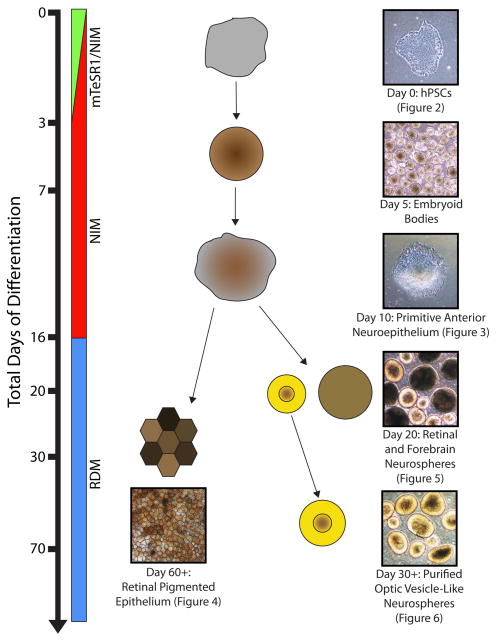
The protocol outlined below is used to differentiate human pluripotent stem cells (hPSCs) into retinal cell types through a process that faithfully recapitulates the stepwise progression observed in vivo. From pluripotency, cells are differentiated to a primitive anterior neural fate, followed by progression into two distinct populations of retinal progenitors and forebrain progenitors, each of which can be manually separated and purified. The hPSC-derived retinal progenitors are found to self-organize into three-dimensional optic vesicle-like structures, with each aggregate possessing the ability to differentiate into all major retinal cell types. The ability to faithfully recapitulate the stepwise in vivo development in a three-dimensional cell culture system allows for the study of mechanisms underlying human retinogenesis. Furthermore, this methodology allows for the study of retinal dysfunction and disease modeling using patient-derived cells, as well as high-throughput pharmacological screening and eventually patient-specific therapies.
Keywords: development; differentiation; human pluripotent stem cells (hPSCs); optic vesicle; retina.
Copyright © 2015 John Wiley & Sons, Inc.
Figures
References
-
- Belecky-Adams T, Tomarev S, Li HS, Ploder L, McInnes RR, Sundin O, Adler R. Pax-6, Prox 1, and Chx10 homeobox gene expression correlates with phenotypic fate of retinal precursor cells. Invest Ophthalmol Vis Sci. 1997;38:1293–1303. - PubMed
Publication types
MeSH terms
Grants and funding
LinkOut - more resources
Full Text Sources
Other Literature Sources
