


Mitochondrial Diseases Part II: Mouse models of OXPHOS deficiencies caused by defects in regulatory factors and other components required for mitochondrial function
- PMID: 25640959
- PMCID: PMC4447541
- DOI: 10.1016/j.mito.2015.01.008
Mitochondrial Diseases Part II: Mouse models of OXPHOS deficiencies caused by defects in regulatory factors and other components required for mitochondrial function
Abstract
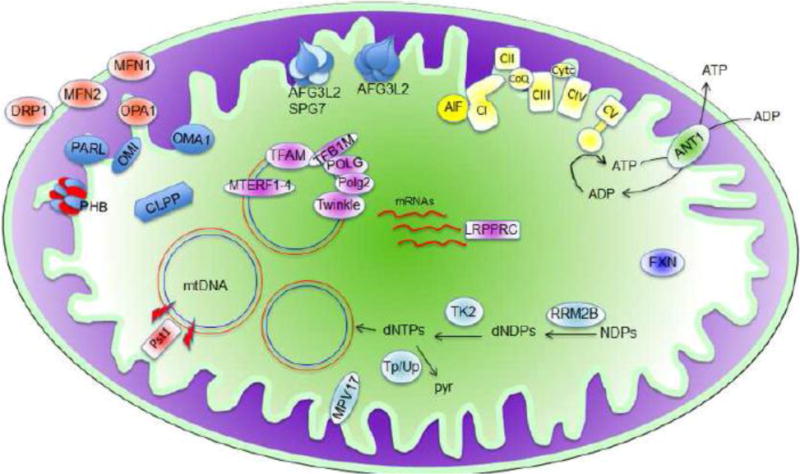
Mitochondrial disorders are defined as defects that affect the oxidative phosphorylation system (OXPHOS). They are characterized by a heterogeneous array of clinical presentations due in part to a wide variety of factors required for proper function of the components of the OXPHOS system. There is no cure for these disorders owing to our poor knowledge of the pathogenic mechanisms of disease. To understand the mechanisms of human disease numerous mouse models have been developed in recent years. Here we summarize the features of several mouse models of mitochondrial diseases directly related to those factors affecting mtDNA maintenance, replication, transcription, translation as well as other proteins that are involved in mitochondrial dynamics and quality control which affect mitochondrial OXPHOS function without being intrinsic components of the system. We discuss how these models have contributed to our understanding of mitochondrial diseases and their pathogenic mechanisms.
Keywords: Mitochondrial DNA; Mitochondrial diseases; Mitochondrial dynamics; Mitochondrial transcription; Mouse models; Quality control.
Copyright © 2015 © Elsevier B.V. and Mitochondria Research Society. Published by Elsevier B.V. All rights reserved.
Conflict of interest statement
Figures
References
-
- Acham-Roschitz B, Plecko B, Lindbichler F, Bittner R, Mache CJ, Sperl W, Mayr JA. A novel mutation of the RRM2B gene in an infant with early fatal encephalomyopathy, central hypomyelination, and tubulopathy. Mol Genet Metab. 2009;98:300–304. - PubMed
-
- Ahlqvist KJ, Hämäläinen RH, Yatsuga S, Uutela M, Terzioglu M, Götz A, Forsström S, Salven P, Angers-Loustau A, Kopra OH, Tyynismaa H, Larsson NG, Wartiovaara K, Prolla T, Trifunovic A, Suomalainen A. Somatic progenitor cell vulnerability to mitochondrial DNA mutagenesis underlies progeroid phenotypes in Polg mutator mice. Cell Metab. 2012;15:100–109. - PubMed
-
- Ahola-Erkkilä S, Carroll CJ, Peltola-Mjösund K, Tulkki V, Mattila I, Seppänen-Laakso T, Oresic M, Tyynismaa H, Suomalainen A. Ketogenic diet slows down mitochondrial myopathy progression in mice. Hum Mol Genet. 2010;19:1974–1984. - PubMed
-
- Al-Mahdawi S, Pinto RM, Ruddle P, Carroll C, Webster Z, Pook M. GAA repeat instability in Friedreich ataxia YAC transgenic mice. Genomics. 2004;84:301–310. - PubMed
Publication types
MeSH terms
Grants and funding
LinkOut - more resources
Full Text Sources
Other Literature Sources
Medical
