. 2015 Feb 2:12:8.
doi: 10.1186/s12977-015-0136-x.

The decline of human endogenous retroviruses: extinction and survival

The decline of human endogenous retroviruses: extinction and survival

Gkikas Magiorkinis et al. Retrovirology. .

Abstract

Background: Endogenous Retroviruses (ERVs) are retroviruses that over the course of evolution have integrated into germline cells and eventually become part of the host genome. They proliferate within the germline of their host, making up ~5% of the human and mouse genome sequences. Several lines of evidence have suggested a decline in the rate of ERV integration into the human genome in recent evolutionary history but this has not been investigated quantitatively or possible causes explored.

Results: By dating the integration of ERV loci in 40 mammal species, we show that the human genome and that of other hominoids (great apes and gibbons) have experienced an approximately four-fold decline in the ERV integration rate over the last 10 million years. A major cause is the recent extinction of one very large ERV lineage (HERV-H), which is responsible for most of the integrations over the last 30 million years. The decline however affects most other ERV lineages. Only about 10% of the decline might be attributed to an accompanying increase in body mass (a trait we have shown recently to be negatively correlated with ERV integration rate). Humans are unusual compared to related species - Old World monkeys, great apes and gibbons - in (a) having not acquired any new ERV lineages during the last 30 million years and (b) the possession of an old ERV lineage that has continued to replicate up until at least the last few hundred thousand years - the potentially medically significant HERVK(HML2).

Conclusions: The human genome shares with the genome of other great apes and gibbons a recent decline in ERV integration that is not typical of other primates and mammals. The human genome differs from that of related species both in maintaining up until at least recently a replicating old ERV lineage and in not having acquired any new lineages. We speculate that the decline in ERV integration in the human genome has been exacerbated by a relatively low burden of horizontally-transmitted retroviruses and subsequent reduced risk of endogenization.


Figures
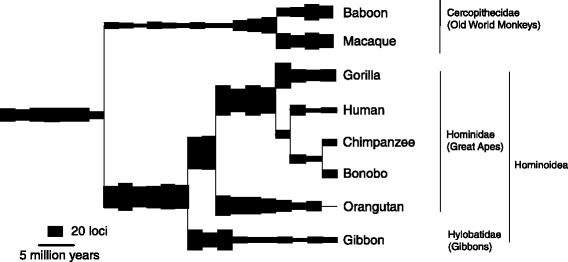
Figure 1
Figure 1
Rate of ERV integration in the sequenced catarrhines. Branch thickness shows the number of loci estimated to have integrated at different times, with each increment corresponding to a period of two million years. Integration dates are estimated by LTR divergence (except in the poorly assembled baboon, where they are estimated using a nearest neighbor analysis). Numbers of loci have been normalized using the human genome as a reference to allow for variation in quality of genome assembly as follows: branch thickness leading to human is calculated from the human genome; other branch thicknesses are adjusted proportional to a comparison between (i) the number of loci that integrated into the human genome and (ii) the number that integrated into the second species’ genome during the time period when the genome was shared. The baboon was similarly normalized using the macaque instead of the human genome. Data for each species are shown as frequency histograms in Additional file 1: Figure S1.
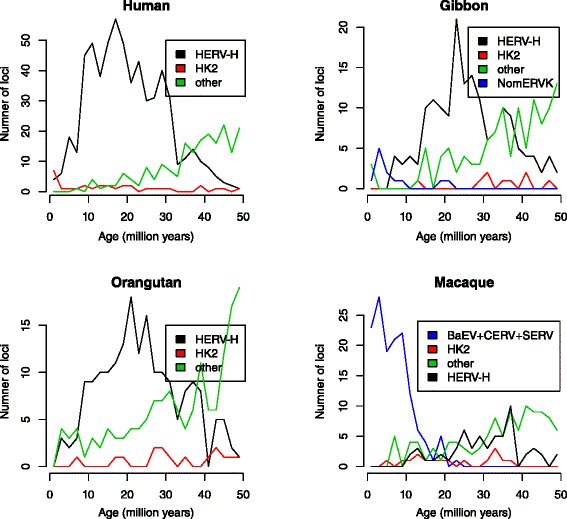
Figure 2
Figure 2
Age and number of ERV integrations in the human and other representative catarrhine genomes. Loci analysed were all full-length and dated using LTR divergence.
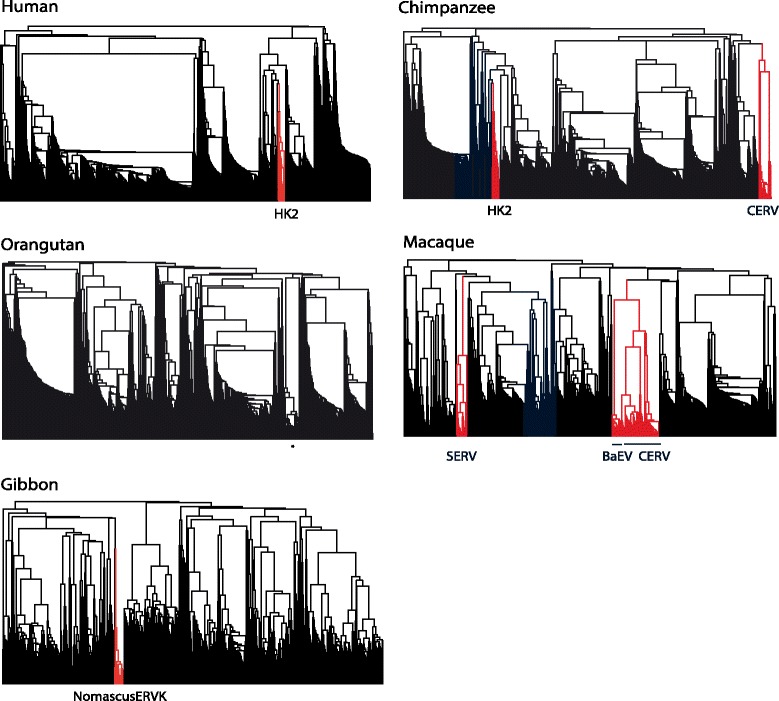
Figure 3
Figure 3
Dendrogram of loci in selected catarrhines. Recently copying families plus HK2 in the human and chimpanzee genomes are shown in red. Families such as BaEV show bursts of copying restricted to near the tree tip. For clarity, we excluded loci that had integrated before the origin of the catarrhines. The asterisk in the orangutan shows a clade of loci detected only in unassembled parts of the X chromosome and chromosome 1. These possibly represent loci within repeat regions that have been copied by the host, or assembly errors.

References

    1. Dewannieux M, Heidmann T. Endogenous retroviruses: acquisition, amplification and taming of genome invaders. Curr Opin Virol. 2013;3:646–56. doi: 10.1016/j.coviro.2013.08.005. - DOI - PubMed
    1. Tristem M. Identification and characterization of novel human endogenous retrovirus families by phylogenetic screening of the Human Genome Mapping Project database. J Virol. 2000;74:3715–30. doi: 10.1128/JVI.74.8.3715-3730.2000. - DOI - PMC - PubMed
    1. Belshaw R, Pereira V, Katzourakis A, Talbot G, Paces J, Burt A, et al. Long-term reinfection of the human genome by endogenous retroviruses. Proc Natl Acad Sci U S A. 2004;101:4894–9. doi: 10.1073/pnas.0307800101. - DOI - PMC - PubMed
    1. Mayer J, Blomberg J, Seal RL. A revised nomenclature for transcribed human endogenous retroviral loci. Mob DNA. 2011;2:7. doi: 10.1186/1759-8753-2-7. - DOI - PMC - PubMed
    1. Lander ES, Linton LM, Birren B, Nusbaum C, Zody MC, Baldwin J, et al. Initial sequencing and analysis of the human genome. Nature. 2001;409:860–921. doi: 10.1038/35057062. - DOI - PubMed

Publication types

LinkOut - more resources