


Changes in the spinal curvature, degree of pain, balance ability, and gait ability according to pregnancy period in pregnant and nonpregnant women
- PMID: 25642091
- PMCID: PMC4305582
- DOI: 10.1589/jpts.27.279
Changes in the spinal curvature, degree of pain, balance ability, and gait ability according to pregnancy period in pregnant and nonpregnant women
Abstract
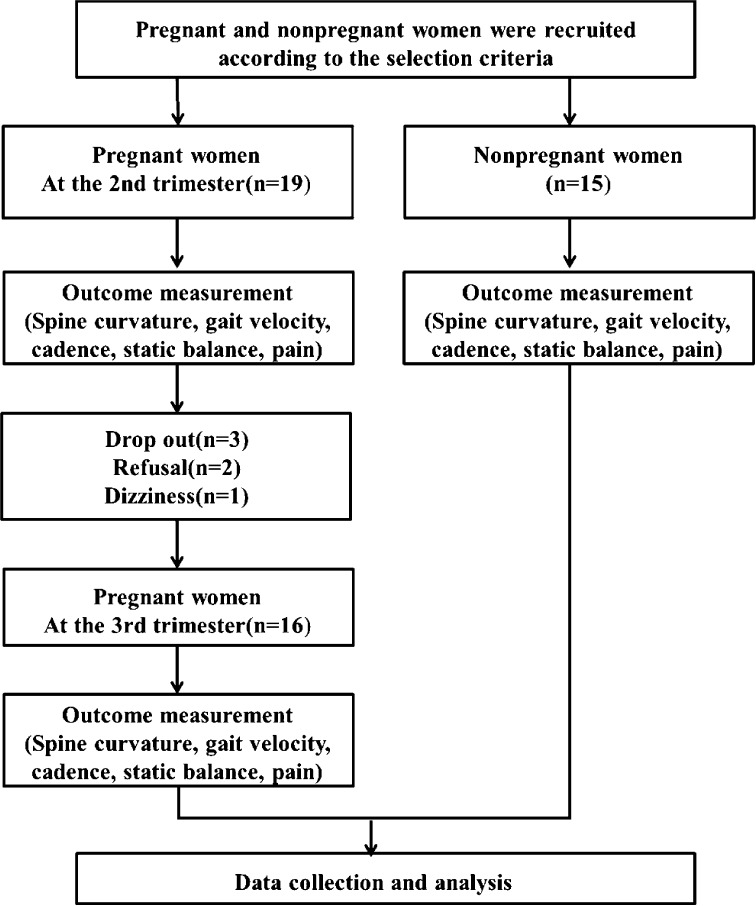
[Purpose] The aim of this study was to investigate the changes in pain intensity, spinal curvature, and balance and gait ability according to the pregnancy period. [Subjects] Nineteen pregnant women and fifteen nonpregnant women were recruited in this study. [Methods] The pain intensity, spinal curvature, gait, and balance of pregnant women were measured according to the pregnant period (2nd and 3rd trimester). The changes in the pregnant women were also compared with those in the nonpregnant women. [Results] The pain intensity and spinal curvature in the third trimester of pregnancy were significantly increased compared with the second trimester. Only the lumbar spine curvature in the third trimester pregnancy was significantly greater in the pregnant women than in non-pregnant women. The gait velocity and cadence in the third trimester of pregnancy showed a significant decrease compared with the second trimester. The gait speed in the second and third trimester of pregnancy showed a significant decrease in the pregnant women compared with nonpregnant women. Balance in the third trimester of pregnancy showed significant improvement compared with the second trimester. The balance of the pregnant women showed a significant decrease compare with that nonpregnant women only on unstable surfaces. [Conclusion] These research findings can be used as basic data for health promotion programs for sound daily activities in pregnant women.
Keywords: Gait; Pregnant women; Spinal curvatures.
References
-
- Hirabayashi Y, Shimizu R, Saitoh K, et al. : Anatomical configuration of the spinal column in the supine position. I. A study using magnetic resonance imaging. Br J Anaesth, 1995, 75: 3–5. - PubMed
-
- Berg G, Hammar M, Möller-Nielsen J, et al. : Low back pain during pregnancy. Obstet Gynecol, 1988, 71: 71–75. - PubMed
-
- Suputtitada A, Wacharapreechanont T, Chaisayan P: Effect of the “sitting pelvic tilt exercise” during the third trimester in primigravidas on back pain. Journal of the Medical Association of Thailand = Chotmaihet thangphaet, 2002, 85 Suppl 1: S170–179. - PubMed
-
- Yu Y, Chung HC, Hemingway L, et al. : Standing body sway in women with and without morning sickness in pregnancy. Gait Posture, 2013, 37: 103–107. - PubMed
LinkOut - more resources
Full Text Sources
Other Literature Sources