


Automatic analysis (aa): efficient neuroimaging workflows and parallel processing using Matlab and XML
- PMID: 25642185
- PMCID: PMC4295539
- DOI: 10.3389/fninf.2014.00090
Automatic analysis (aa): efficient neuroimaging workflows and parallel processing using Matlab and XML
Abstract
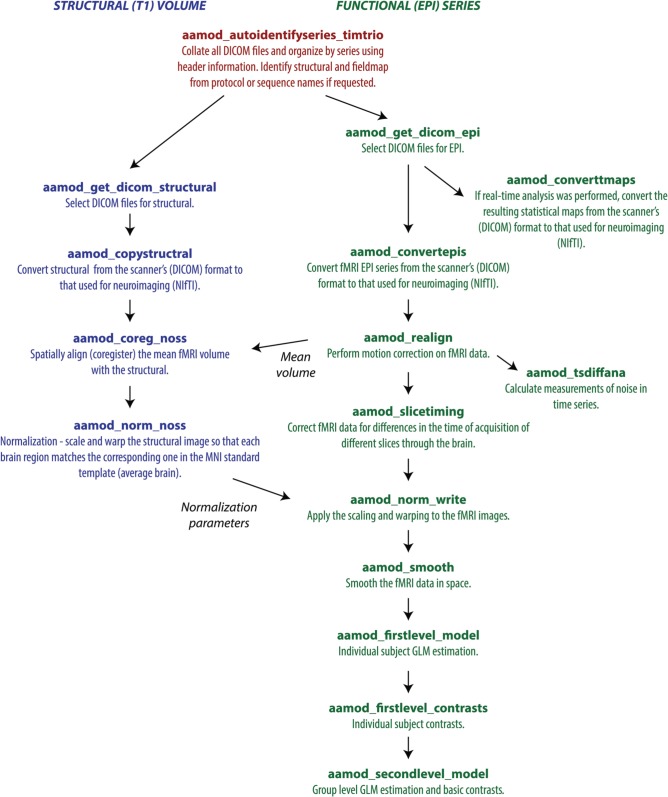
Recent years have seen neuroimaging data sets becoming richer, with larger cohorts of participants, a greater variety of acquisition techniques, and increasingly complex analyses. These advances have made data analysis pipelines complicated to set up and run (increasing the risk of human error) and time consuming to execute (restricting what analyses are attempted). Here we present an open-source framework, automatic analysis (aa), to address these concerns. Human efficiency is increased by making code modular and reusable, and managing its execution with a processing engine that tracks what has been completed and what needs to be (re)done. Analysis is accelerated by optional parallel processing of independent tasks on cluster or cloud computing resources. A pipeline comprises a series of modules that each perform a specific task. The processing engine keeps track of the data, calculating a map of upstream and downstream dependencies for each module. Existing modules are available for many analysis tasks, such as SPM-based fMRI preprocessing, individual and group level statistics, voxel-based morphometry, tractography, and multi-voxel pattern analyses (MVPA). However, aa also allows for full customization, and encourages efficient management of code: new modules may be written with only a small code overhead. aa has been used by more than 50 researchers in hundreds of neuroimaging studies comprising thousands of subjects. It has been found to be robust, fast, and efficient, for simple-single subject studies up to multimodal pipelines on hundreds of subjects. It is attractive to both novice and experienced users. aa can reduce the amount of time neuroimaging laboratories spend performing analyses and reduce errors, expanding the range of scientific questions it is practical to address.
Keywords: diffusion tensor imaging (DTI); diffusion weighted imaging (DWI); functional magnetic resonance imaging (fMRI); multi-voxel pattern analysis (MVPA); neuroimaging; pipeline; software.
Figures
References
Grants and funding
LinkOut - more resources
Full Text Sources
Other Literature Sources
