


Radiosynthesis and in Vivo Evaluation of Two PET Radioligands for Imaging α-Synuclein
- PMID: 25642331
- PMCID: PMC4310556
- DOI: 10.3390/app4010066
Radiosynthesis and in Vivo Evaluation of Two PET Radioligands for Imaging α-Synuclein
Abstract
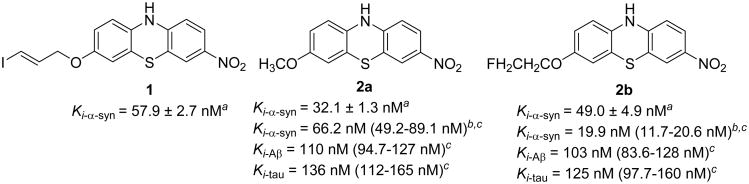
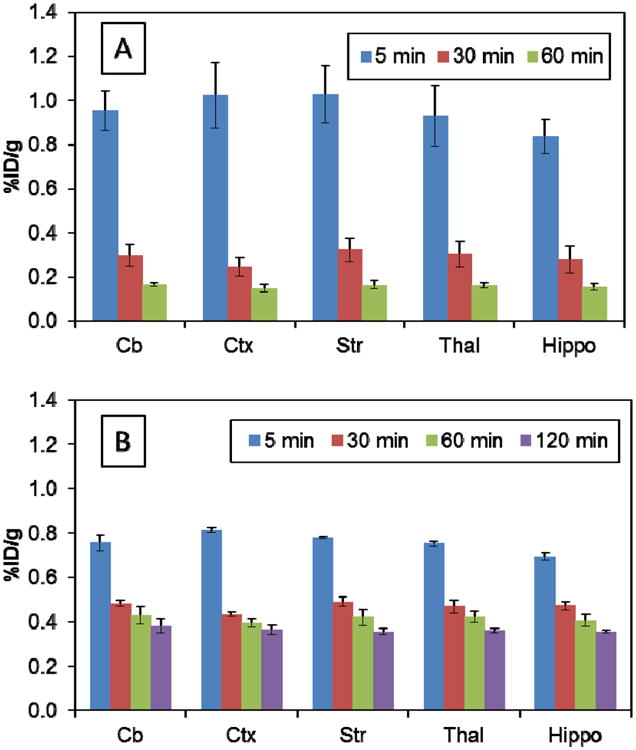
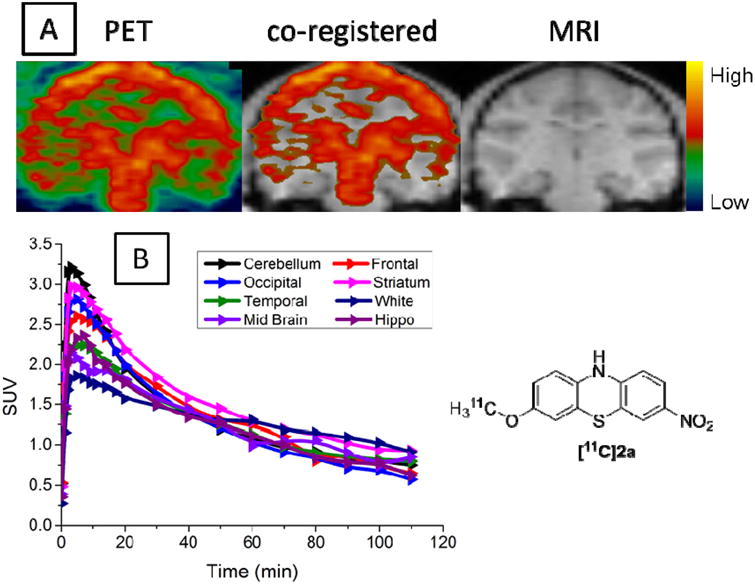
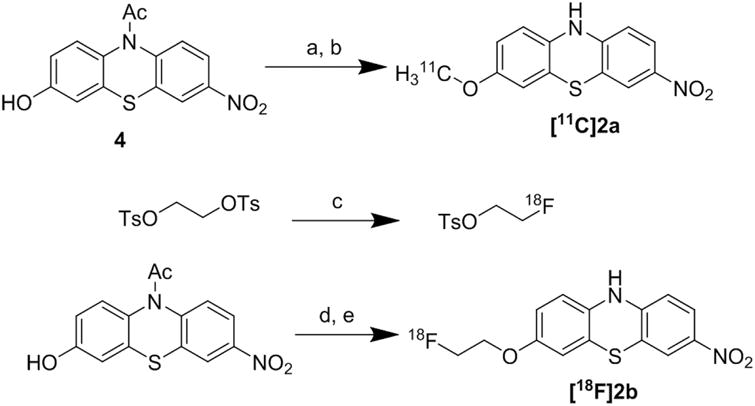
Two α-synuclein ligands, 3-methoxy-7-nitro-10H-phenothiazine (2a, Ki = 32.1 ± 1.3 nM) and 3-(2-fluoroethoxy)-7-nitro-10H-phenothiazine (2b, Ki = 49.0 ± 4.9 nM), were radiolabeled as potential PET imaging agents by respectively introducing 11C and 18F. The syntheses of [11C]2a and [18F]2b were accomplished in a good yield with high specific activity. Ex vivo biodistribution studies in rats revealed that both [11C]2a and [18F]2b crossed the blood-brain barrier (BBB) and demonstrated good brain uptake 5 min post-injection. MicroPET imaging of [11C]2a in a non-human primate (NHP) confirmed that the tracer was able to cross the BBB with rapid washout kinetics from brain regions of a healthy macaque. The initial studies suggested that further structural optimization of [11C]2a and [18F]2b is necessary in order to identify a highly specific positron emission tomography (PET) radioligand for in vivo imaging of α-synuclein aggregation in the central nervous system (CNS).
Keywords: Lewy bodies; PET; Parkinson's disease; phenothiazine; radiosynthesis; α-synuclein.
Conflict of interest statement
Figures

References
-
- Hely MA, Reid WGJ, Adena MA, Halliday GM, Morris JGL. The sydney multicenter study of parkinson's disease: The inevitability of dementia at 20 years. Mov Disord. 2008;23:837–844. - PubMed
-
- Hurtig HI, Trojanowski JQ, Galvin J, Ewbank D, Schmidt ML, Lee VMY, Clark CM, Glosser G, Stern MB, Gollomp SM, et al. Alpha-synuclein cortical lewy bodies correlate with dementia in Parkinson's disease. Neurology. 2000;54:1916–1921. - PubMed
-
- Jankovic J. Parkinson's disease: Clinical features and diagnosis. J Neurol Neurosurg Psychiatry. 2008;79:368–376. - PubMed
-
- Cheng F, Vivacqua G, Yu S. The role of alpha-synuclein in neurotransmission and synaptic plasticity. J Chem Neuroanat. 2011;42:242–248. - PubMed
-
- George JM, Jin H, Woods WS, Clayton DF. Characterization of a novel protein regulated during the critical period for song learning in the zebra finch. Neuron. 1995;15:361–372. - PubMed
Grants and funding
LinkOut - more resources
Full Text Sources
Other Literature Sources