


Biophysical Characterization of Human Protamine-1 as a Responsive CEST MR Contrast Agent
- PMID: 25642384
- PMCID: PMC4307908
- DOI: 10.1021/mz500681y
Biophysical Characterization of Human Protamine-1 as a Responsive CEST MR Contrast Agent
Abstract
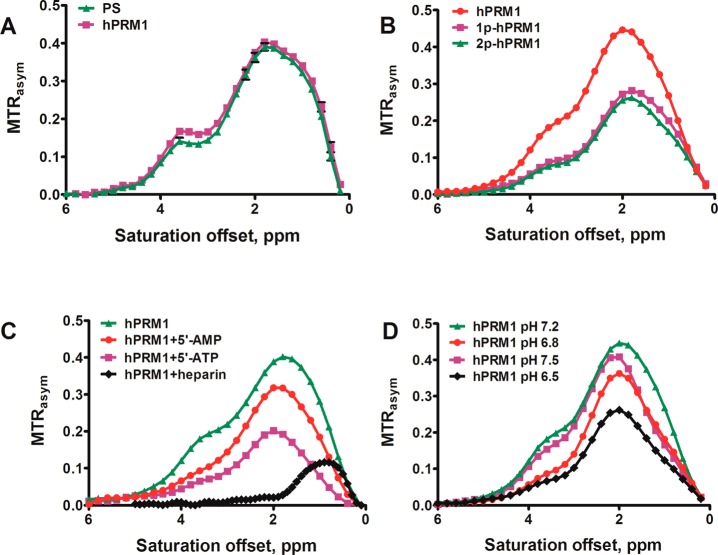
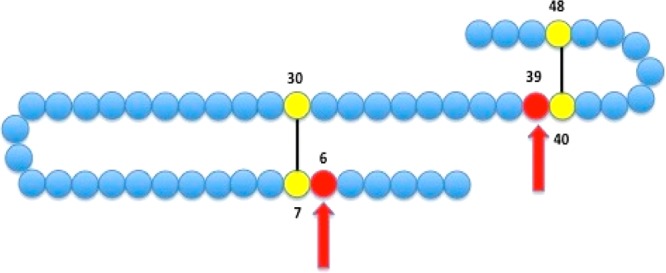
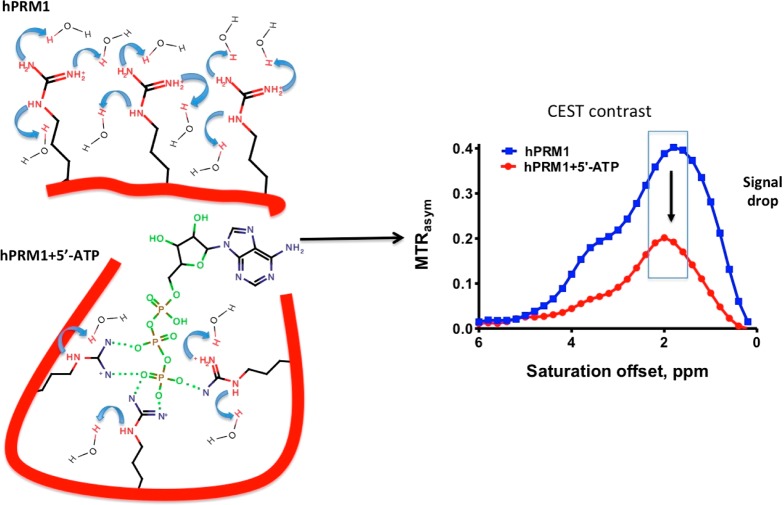
The protamines are a low-molecular-weight, arginine-rich family of nuclear proteins that protect chromosomal DNA in germ cells by packing it densely using electrostatic interactions. Human protamine-1 (hPRM1) has been developed as a magnetic resonance imaging (MRI) chemical exchange saturation transfer (CEST) reporter gene, based on a sequence that is approximately 50% arginine, which has a side chain with rapidly exchanging protons. In this study, we have synthesized hPRM1 and determined how its CEST MRI contrast varies as a function of pH, phosphorylation state, and upon noncovalent interaction with nucleic acids and heparin (as antagonist). CEST contrast was found to be highly sensitive to phosphorylation on serine residues, intra- and intermolecular disulfide bridge formation, and the binding of negatively charged nucleotides and heparin. In addition, the nucleotide binding constants (Keq) for the protamines were determined through plotting the molar concentration of heparin versus CEST contrast and compared between hPRM1 and salmon protamine. Taken together, these findings are important for explaining the CEST contrast of existing arginine-rich probes as well as serving as a guideline for designing new genetic or synthetic probes.
Figures
References
-
- Frank J. A.; Miller B. R.; Arbab A. S.; Zywicke H. A.; Jordan E. K.; Lewis B. K.; Bryant L. H.; Bulte J. W. M. Radiology 2003, 2282480–487. - PubMed
-
- Evgenov N. V.; Medarova Z.; Dai G. P.; Bonner-Weir S.; Moore A. Nat. Med. 2006, 121144–148. - PubMed
-
- Heyn C.; Ronald J. A.; Mackenzie L. T.; MacDonald I. C.; Chambers A. F.; Rutt B. K.; Foster P. J. Magn. Reson. Med. 2006, 55123–29. - PubMed
Grants and funding
LinkOut - more resources
Full Text Sources
Other Literature Sources
Molecular Biology Databases
