


Review
doi: 10.1172/JCI76302.
Epub 2015 Feb 2.
Intestinal lipid-derived signals that sense dietary fat
- PMID: 25642767
- PMCID: PMC4362267
- DOI: 10.1172/JCI76302
Item in Clipboard
Review
Intestinal lipid-derived signals that sense dietary fat
J Clin Invest.
.
Abstract
Fat is a vital macronutrient, and its intake is closely monitored by an array of molecular sensors distributed throughout the alimentary canal. In the mouth, dietary fat constituents such as mono- and diunsaturated fatty acids give rise to taste signals that stimulate food intake, in part by enhancing the production of lipid-derived endocannabinoid messengers in the gut. As fat-containing chyme enters the small intestine, it causes the formation of anorexic lipid mediators, such as oleoylethanolamide, which promote satiety. These anatomically and functionally distinct responses may contribute to the homeostatic control and, possibly, the pathological dysregulation of food intake.
Figures
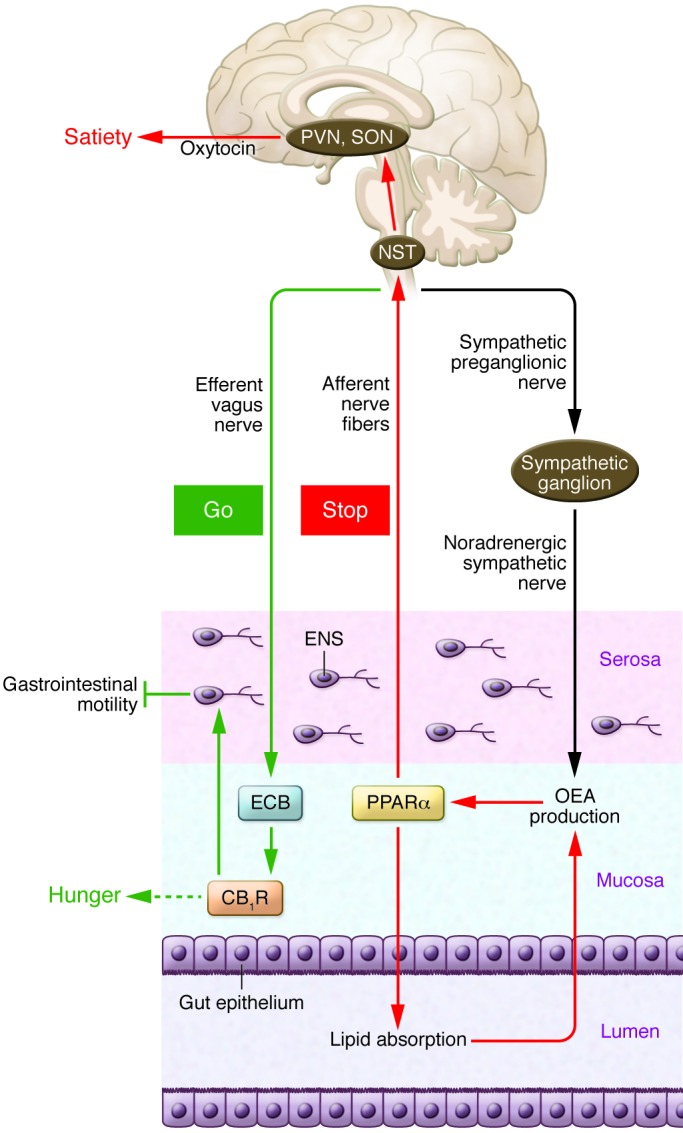
According to this model, oral exposure to fat stimulates endocannabinoid (ECB) mobilization in the jejunum and activation of local CB1 receptors (CB1Rs). This signaling event, which requires the efferent vagus nerve, may act as a “go” signal that promotes further eating (83, 84). While the precise mechanism underlying this orexigenic response is unknown, the presence of CB1R in cells of the stomach that secrete ghrelin (88) and in enteroendocrine I cells that release cholecystokinin (89) suggests a possible involvement of these peptide hormones. Gut CB1Rs also control gastrointestinal motility (86, 87, 90, 91) and mucosal inflammation (23). When fat-containing chyme reaches the upper intestine, it initiates the production of several lipid-derived mediators, including OEA, a process that depends on sympathetic activation of β2 adrenoreceptors (37, 120). OEA stimulation of PPARα may act as a “stop” signal for feeding by recruiting afferent sensory fibers, possibly of the vagal nerve (26, 28, 113). The signal is transferred to the NST in the brainstem, from which neurotransmission continues to magnocellular oxytocin-secreting neurons in the paraventricular (PVN) and supraoptic nucleus (SON) of the hypothalamus (28, 116), as well as to histaminergic neurons of the tuberomammillary nucleus (118). ENS, enteric nervous system.
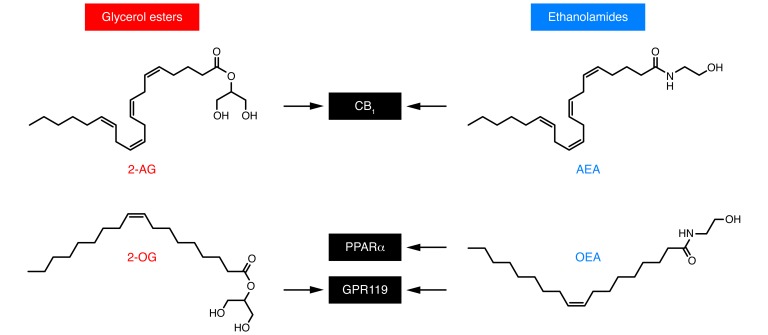
Left: fatty acyl glycerol esters 2-AG and 2-OG. Right: fatty acyl ethanolamides anandamide (AEA) and OEA. OEA and 2-OG may contribute in complementary ways to the postingestive control of satiety. 2-OG may act as a local regulator of GLP1 release through its ability to activate GPR119 on the apical surface of enteroendocrine L cells of the ileum. It is likely to reach millimolar concentrations in the lumen of the upper gut during fat digestion. OEA is produced by duodenal and jejunal enterocytes and modifies meal patterns in a manner similar to a satiety signal, increasing the time between meals. This activity is dependent on OEA binding of PPARα. OEA also engages GPR119 to drive secretion of GLP1 (27). Anandamide and 2-AG are high-affinity agonists for the GPCR cannabinoid receptors CB1 and CB2. Activation of CB1 increases food intake, enhances reward aspects of eating, and promotes energy conservation (4).
References
-
- Leonard WR, Snodgrass JJ, Robertson ML. Evolutionary perspectives on fat ingestion and metabolism in humans. In: Montmayeur JP, le Coutre J, eds. Fat Detection: Taste, Texture, and Post Ingestive Effects. Boca Raton, Florida, USA: CRC Press; 2010:Chapter 1.
-
- Muskiet FAJ. Pathophysiology and evolutionary aspects of dietary fats and long-chain polyunsaturated fatty acids across the life cycle. In: Montmayeur JP, le Coutre J, eds. Fat Detection: Taste, Texture, and Post Ingestive Effects. Boca Raton, Florida, USA: CRC Press; 2010:Chapter 2. - PubMed
