Latent class profiles of internalizing and externalizing psychosocial health indicators are differentially associated with sexual transmission risk: Findings from the CFAR network of integrated clinical systems (CNICS) cohort study of HIV-infected men engaged in primary care in the United States
- PMID: 25642839
- PMCID: PMC4522398
- DOI: 10.1037/hea0000189
Latent class profiles of internalizing and externalizing psychosocial health indicators are differentially associated with sexual transmission risk: Findings from the CFAR network of integrated clinical systems (CNICS) cohort study of HIV-infected men engaged in primary care in the United States
Abstract
Objective: To examine whether latent class indicators of negative affect and substance use emerged as distinct psychosocial risk profiles among HIV-infected men, and if these latent classes were associated with high-risk sexual behaviors that may transmit HIV.
Methods: Data were from HIV-infected men who reported having anal intercourse in the past 6 months and received routine clinical care at 4 U.S. sites in the Centers for AIDS Research Network of Integrated Clinical Systems cohort (n = 1,210). Latent class membership was estimated using binary indicators for anxiety, depression, alcohol and/or drug use during sex, and polydrug use. Generalized estimating equations modeled whether latent class membership was associated with HIV sexual transmission risk in the past 6 months.
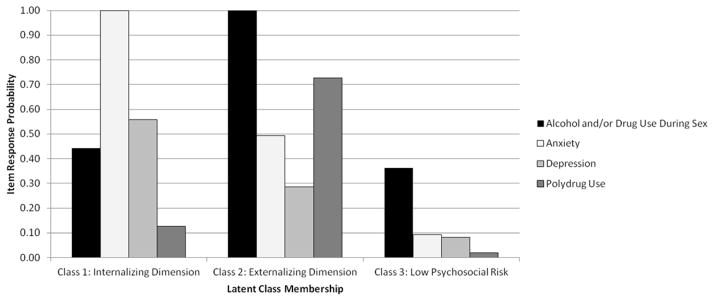
Results: Three latent classes of psychosocial indicators emerged: (a) internalizing (15.3%; high probability of anxiety and major depression); (b) externalizing (17.8%; high probability of alcohol and/or drug use during sex and polydrug use); (c) low psychosocial distress (67.0%; low probability of all psychosocial factors examined). Internalizing and externalizing latent class membership were associated with HIV sexual transmission risk, compared to low psychosocial class membership; externalizing class membership was also associated with higher sexual transmission risk compared to internalizing class membership.
Conclusions: Distinct patterns of psychosocial health characterize this sexually active HIV-infected male patient population and are strongly associated with HIV sexual transmission risk. Public Health intervention efforts targeting HIV sexual risk transmission may benefit from considering symptom clusters that share internalizing or externalizing properties.
(c) 2015 APA, all rights reserved).
Figures
References
-
- Allison PD. Fixed Effects Regression Methods for Longitudinal Data: Using SAS. SAS Institute; 2005.
Publication types
MeSH terms
Grants and funding
- U01AR057954/AR/NIAMS NIH HHS/United States
- U01 AR057954/AR/NIAMS NIH HHS/United States
- R01 MH084759/MH/NIMH NIH HHS/United States
- K24 MH094214/MH/NIMH NIH HHS/United States
- R24 AI067039/AI/NIAID NIH HHS/United States
- R34 DA031028/DA/NIDA NIH HHS/United States
- P30 AI027757/AI/NIAID NIH HHS/United States
- R34DA031028/DA/NIDA NIH HHS/United States
- R24AI067039/AI/NIAID NIH HHS/United States
- U01 AA020793/AA/NIAAA NIH HHS/United States
- K24MH094214/MH/NIMH NIH HHS/United States
- P30 AI050410/AI/NIAID NIH HHS/United States
LinkOut - more resources
Full Text Sources
Other Literature Sources
Medical
Miscellaneous