Phenotype-Genotype Correlations and Estimated Carrier Frequencies of Primary Hyperoxaluria
- PMID: 25644115
- PMCID: PMC4587693
- DOI: 10.1681/ASN.2014070698
Phenotype-Genotype Correlations and Estimated Carrier Frequencies of Primary Hyperoxaluria
Abstract
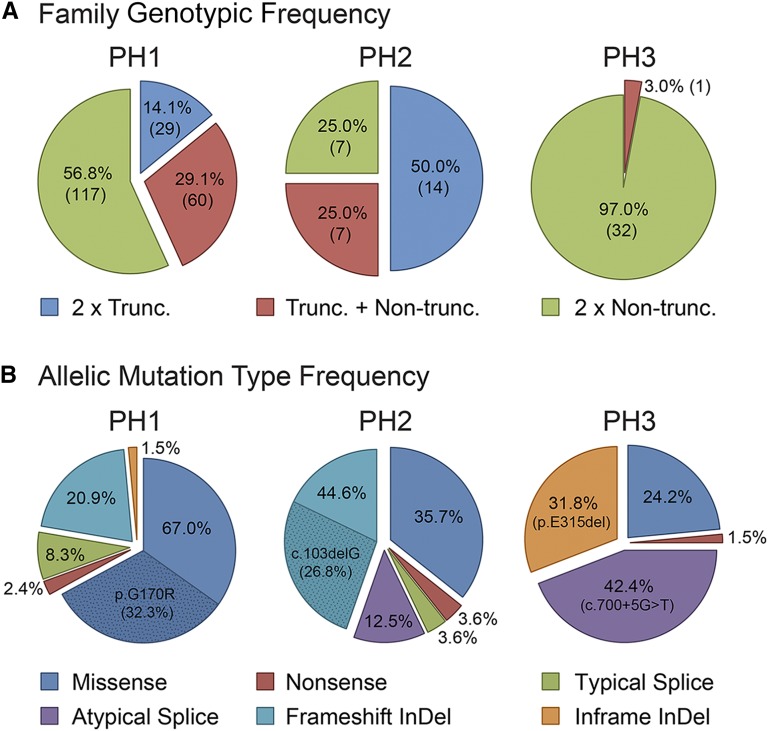
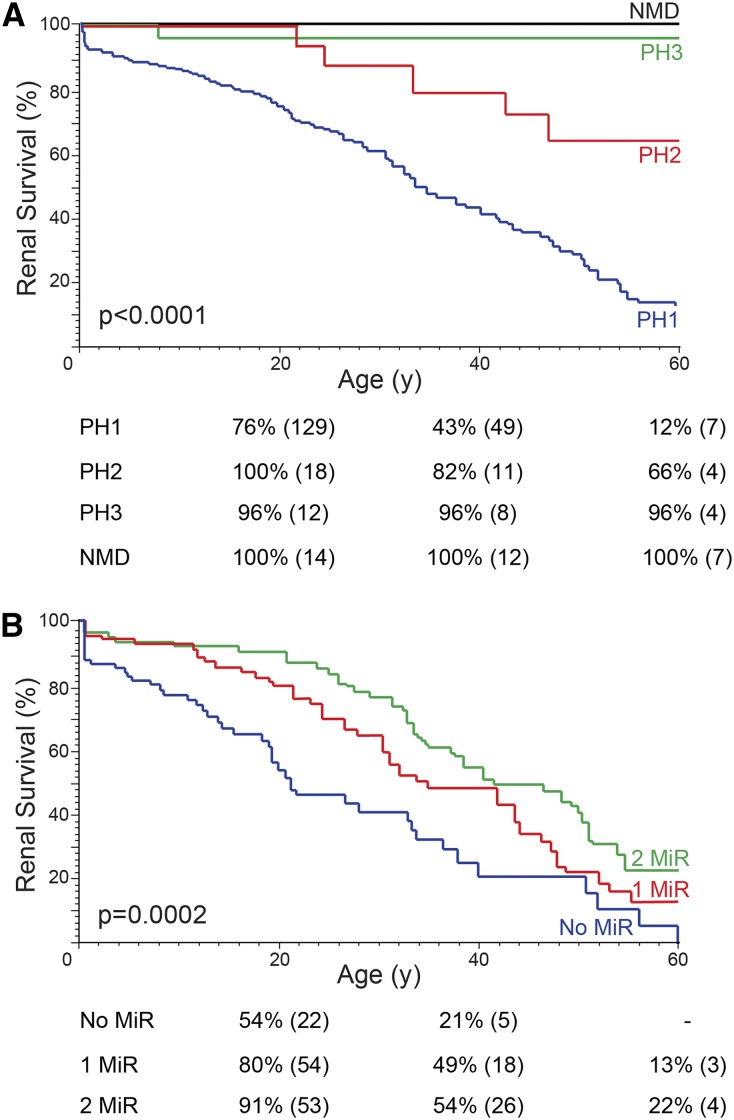
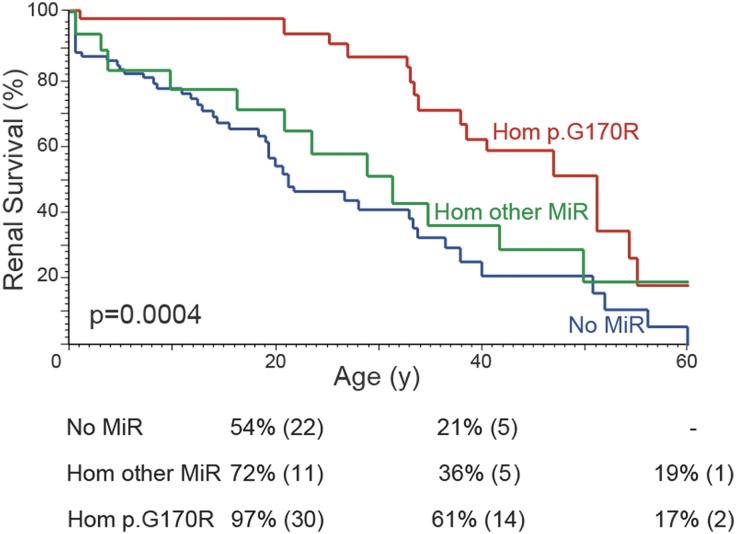
Primary hyperoxaluria (PH) is a rare autosomal recessive disease characterized by oxalate accumulation in the kidneys and other organs. Three loci have been identified: AGXT (PH1), GRHPR (PH2), and HOGA1 (PH3). Here, we compared genotype to phenotype in 355 patients in the Rare Kidney Stone Consortium PH registry and calculated prevalence using publicly available whole-exome data. PH1 (68.4% of families) was the most severe PH type, whereas PH3 (11.0% of families) showed the slowest decline in renal function but the earliest symptoms. A group of patients with disease progression similar to that of PH3, but for whom no mutation was detected (11.3% of families), suggested further genetic heterogeneity. We confirmed that the AGXT p.G170R mistargeting allele resulted in a milder PH1 phenotype; however, other potential AGXT mistargeting alleles caused more severe (fully penetrant) disease. We identified the first PH3 patient with ESRD; a homozygote for two linked, novel missense mutations. Population analysis suggested that PH is an order of magnitude more common than determined from clinical cohorts (prevalence, approximately 1:58,000; carrier frequency, approximately 1:70). We estimated PH to be approximately three times less prevalent among African Americans than among European Americans because of a limited number of common European origin alleles. PH3 was predicted to be as prevalent as PH1 and twice as common as PH2, indicating that PH3 (and PH2) cases are underdiagnosed and/or incompletely penetrant. These results highlight a role for molecular analyses in PH diagnostics and prognostics and suggest that wider analysis of the idiopathic stone-forming population may be beneficial.
Keywords: genetic renal disease; kidney stones; molecular genetics.
Copyright © 2015 by the American Society of Nephrology.
Figures

References
-
- Hoppe B: An update on primary hyperoxaluria. Nat Rev Nephrol 8: 467–475, 2012 - PubMed
-
- Cochat P, Rumsby G: Primary hyperoxaluria. N Engl J Med 369: 649–658, 2013 - PubMed
-
- Lieske JC, Monico CG, Holmes WS, Bergstralh EJ, Slezak JM, Rohlinger AL, Olson JB, Milliner DS: International registry for primary hyperoxaluria. Am J Nephrol 25: 290–296, 2005 - PubMed
-
- Rumsby G: Primary hyperoxaluria type 2. In: GeneReviews(R), edited by Pagon RA, Adam MP, Bird TD, Dolan CR, Fong CT, Smith RJH, Stephens K, Seattle, WA, University of Washington, 1993, Updated 2011
-
- Coulter-Mackie MB, White CT, Hurley RM, Chew BH, Lange D: Primary hyperoxaluria type 1. In: GeneReviews(R), edited by Pagon RA, Adam MP, Bird TD, Dolan CR, Fong CT, Smith RJH, Stephens K, Seattle, WA, University of Washington, 1993, Updated 2011
Publication types
MeSH terms
Grants and funding
LinkOut - more resources
Full Text Sources
Other Literature Sources
Medical