


Mortality among individuals accessing pharmacological treatment for opioid dependence in California, 2006-10
- PMID: 25644938
- PMCID: PMC4452110
- DOI: 10.1111/add.12863
Mortality among individuals accessing pharmacological treatment for opioid dependence in California, 2006-10
Abstract
Aims: To estimate mortality rates among treated opioid-dependent individuals by cause and in relation to the general population, and to estimate the instantaneous effects of opioid detoxification and maintenance treatment (MMT) on the hazard of all-cause and cause-specific mortality.
Design: Population-based treatment cohort study.
Setting: Linked mortality data on all individuals first enrolled in publicly funded pharmacological treatment for opioid dependence in California, USA from 2006 to 2010.
Participants: A total of 32 322 individuals, among whom there were 1031 deaths (3.2%) over a median follow-up of 2.6 years (interquartile range = 1.4-3.7).
Measurements: The primary outcome was mortality, indicated by time to death, crude mortality rates (CMR) and standardized mortality ratios (SMR).
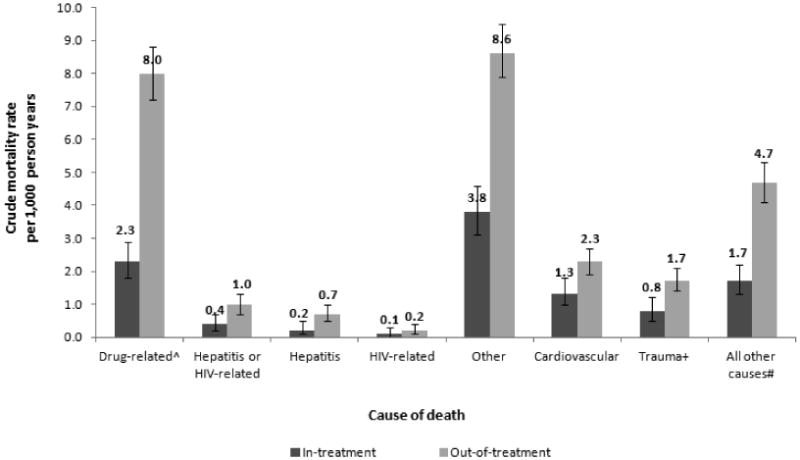
Findings: Individuals being treated for opioid dependence had a more than fourfold increase of mortality risk compared with the general population [SMR = 4.5, 95% confidence interval (CI) = 4.2, 4.8]. Mortality risk was higher (1) when individuals were out-of-treatment (SMR = 6.1, 95% CI = 5.7, 6.5) than in-treatment (SMR = 1.8, 95% CI = 1.6, 2.1) and (2) during detoxification (SMR = 2.4, 95% CI = 1.5, 3.8) than during MMT (SMR = 1.8, 95% CI = 1.5, 2.1), especially in the 2 weeks post-treatment entry (SMR = 5.5, 95% CI = 2.7, 9.8 versus SMR = 2.5, 95% CI = 1.7, 4.9). Detoxification and MMT both independently reduced the instantaneous hazard of all-cause and drug-related mortality. MMT preceded by detoxification was associated with lower all-cause and other cause-specific mortality than MMT alone.
Conclusions: In people with opiate dependence, detoxification and methadone maintenance treatment both independently reduce the instantaneous hazard of all-cause and drug-related mortality.
Keywords: Administrative data; detoxification and maintenance treatment; longitudinal design; mortality; opioid dependence.
© 2015 Society for the Study of Addiction.
Figures
Comment in
-
Coherent long-term treatment approaches-superior in the treatment of opioid dependence.Addiction. 2015 Jun;110(6):1006-7. doi: 10.1111/add.12922. Addiction. 2015. PMID: 25963874 No abstract available.
References
-
- Darke S, Mills KL, Ross J, Teesson M. Rates and correlates of mortality amongst heroin users: Findings from the Australian Treatment Outcome Study (ATOS), 2001–2009. Drug & Alcohol Dependence. 2011;15:190–195. - PubMed
-
- Degenhardt L, Bucello C, Mathers B, Briegleb C, Ali H, Hickman M, McLaren J. Mortality among regular or dependent users of heroin and other opioids: a systematic review and meta-analysis of cohort studies. Addiction. 2011;106:32–51. - PubMed
-
- Hser YI, Evans E, Grella C, Ling W, Anglin D. Long-term course of opioid addiction. Harvard Review of Psychiatry. Forthcoming. - PubMed
-
- Degenhardt L, Larney S, Randall D, Burns L, Hall W. Causes of death in a cohort treated for opioid dependence between 1985 and 2005. Addiction. 2014;109:90–99. - PubMed
-
- Amato L, Davoli M, Perucci CA, Ferri M, Faggiano F, Mattick RP. An overview of systematic reviews of the effectiveness of opiate maintenance therapies: Available evidence to inform clinical practice and research. Journal of Substance Abuse Treatment. 2005;28:321–329. - PubMed
Publication types
MeSH terms
Substances
Grants and funding
LinkOut - more resources
Full Text Sources
Other Literature Sources
Medical
