. 2015 Apr;59(4):2242-55.
doi: 10.1128/AAC.04231-14. Epub 2015 Feb 2.

Experimental resistance to drug combinations in Leishmania donovani: metabolic and phenotypic adaptations

Affiliations

Experimental resistance to drug combinations in Leishmania donovani: metabolic and phenotypic adaptations

Maya Berg et al. Antimicrob Agents Chemother. 2015 Apr.

Abstract

Together with vector control, chemotherapy is an essential tool for the control of visceral leishmaniasis (VL), but its efficacy is jeopardized by growing resistance and treatment failure against first-line drugs. To delay the emergence of resistance, the use of drug combinations of existing antileishmanial agents has been tested systematically in clinical trials for the treatment of visceral leishmaniasis (VL). In vitro, Leishmania donovani promastigotes are able to develop experimental resistance to several combinations of different antileishmanial drugs after 10 weeks of drug pressure. Using an untargeted liquid chromatography-mass spectrometry (LC-MS) metabolomics approach, we identified metabolic changes in lines that were experimentally resistant to drug combinations and their respective single-resistant lines. This highlighted both collective metabolic changes (found in all combination therapy-resistant [CTR] lines) and specific ones (found in certain CTR lines). We demonstrated that single-resistant and CTR parasite cell lines show distinct metabolic adaptations, which all converge on the same defensive mechanisms that were experimentally validated: protection against drug-induced and external oxidative stress and changes in membrane fluidity. The membrane fluidity changes were accompanied by changes in drug uptake only in the lines that were resistant against drug combinations with antimonials, and surprisingly, drug accumulation was higher in these lines. Together, these results highlight the importance and the central role of protection against oxidative stress in the different resistant lines. Ultimately, these phenotypic changes might interfere with the mode of action of all drugs that are currently used for the treatment of VL and should be taken into account in drug development.


Figures

FIG 1
FIG 1
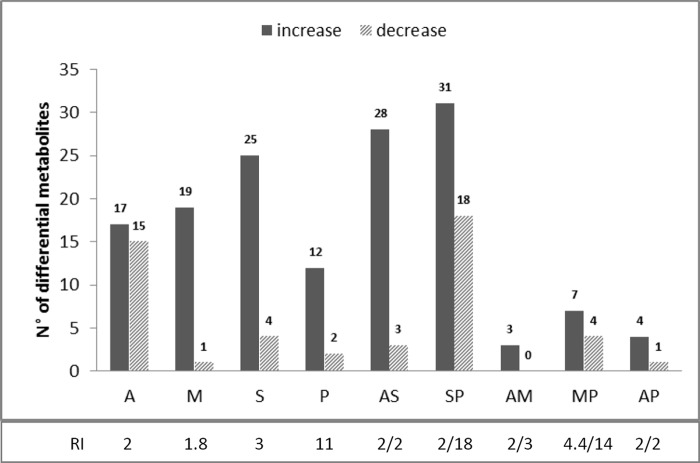
Number of differential metabolites in single-R and CTR L. donovani lines compared to those in the WTM line. The resistance index (RI) against AmB, MIL, SbIII, and PMM, respectively, is mentioned for each single-R line (A, M, S, and P) and CTR line (RI/RI) (AS, SP, AM, MP, and AP) (adapted from García-Hernández et al. [28]). Differential metabolites (Δmb) are either increased or decreased (fold change, <0.5 or >2 and P < 0.05 and P < q).
FIG 2
FIG 2
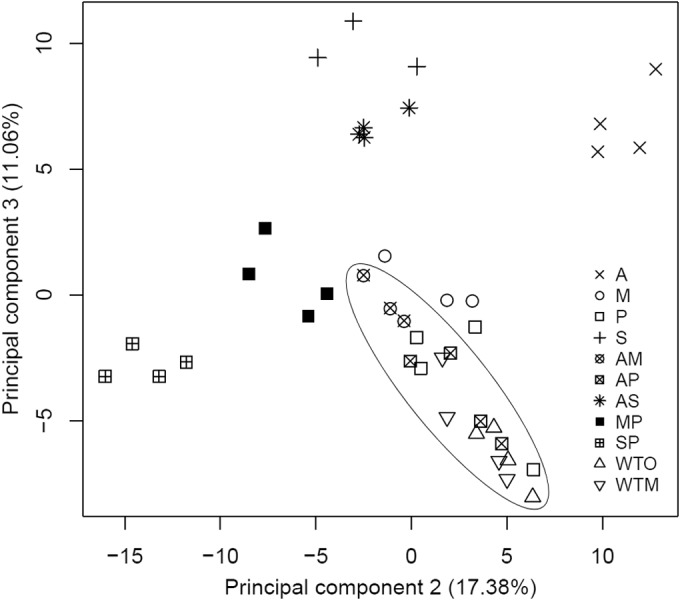
Principal component analysis distinguishes single-R and CTR L. donovani promastigote lines. This analysis was based on the quantitative measurements of all 257 putatively identified compounds. In this study, three biological replicates were removed due to signal intensity drift: M_BR1, S_BR2, and AM_BR3. Separate PCA plots for each CTR and their respective single-R lines can be found in Fig. S2 in the supplemental material.
FIG 3
FIG 3
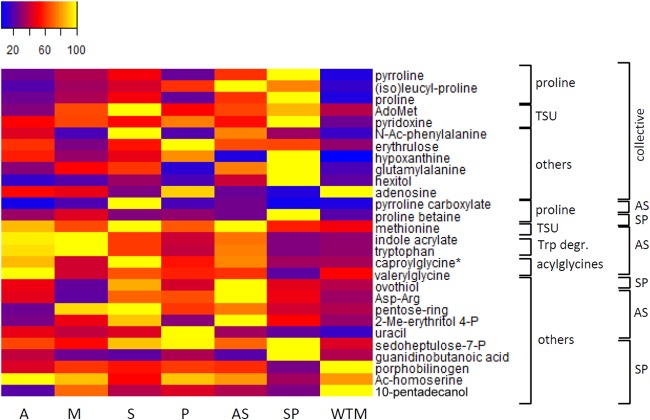
Metabolic profiles of differential metabolites belonging to the proline biosynthesis pathway, transsulfuration pathway (TSU), tryptophan degradation (Trp degr.), acylglycines, and others in heatmap format. The samples are presented along the bottom. Averages were taken for the intensities of the biological replicates per line, and the intensities were rescaled between 0 (blue) and 100 (yellow). On the right, a first classification is made for the metabolites based on the metabolic pathway to which they belong. A second classification is made based on whether they are shared between the AS and SP line (CTR-collective) or are specific for one CTR line (AS or SP). The asterisk indicates that another isomer was detected for this metabolite (see Table S4 in the supplemental material for more details). AdoMet, S-adenosylmethionine; N-Ac-phenylalanine, N-acetylphenylalanine; 2-Me-erythritol-4-P, 2-methyl-erythritol-4-phosphate; sedoheptulose-7-P, sedopheptulose-7-phosphate. AdoMet was found to be increased significantly in both AS and SP lines but not by 2-fold in AS (fold change, 1.78). Tryptophan (Trp) was found to be increased by 2.58-fold in the AS line, with a P value of 0.0146 but with P > q.
FIG 4
FIG 4
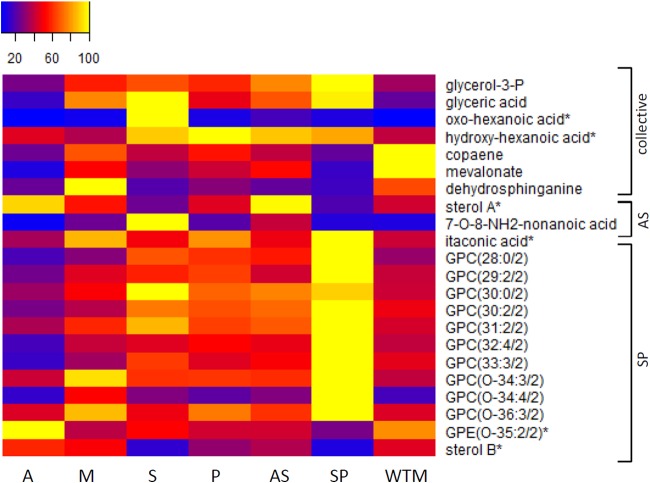
Metabolic profiles of differential metabolites belonging to the lipid metabolism in heatmap format. The samples are presented along the bottom. Averages were taken for the intensities of the biological replicates per line, and the intensities were rescaled between 0 (blue) and 100 (yellow). On the right, a classification is made based on whether they are shared between the AS and SP line (CTR collective) or specific for one CTR line (AS or SP). An asterisk indicates that another isomer was detected for this metabolite (see Table S4 in the supplemental material for more details). The abbreviations for glycerophosphocholines (GPCs) and glycerophosphoethanolamines (GPEs) should be interpreted as follows: GPL(x:y/z), where x represents the number of carbons in the fatty acid side chain(s), y represents the number of double bonds, and z represents the number of side chains. Glycerol-3-P, glycerol-3-phosphate; sterol A, a secosteroid with a monoisotopic mass of 398.318484 Da; sterol B, a secosteroid with a monoisotopic mass of 412.333833 Da (an ergostatetraene-diol and its isomers). Mevalonate was found to be decreased significantly in both AS and SP lines but not by 0.5-fold in AS (fold change, 0.53; P < 0.05).
FIG 5
FIG 5
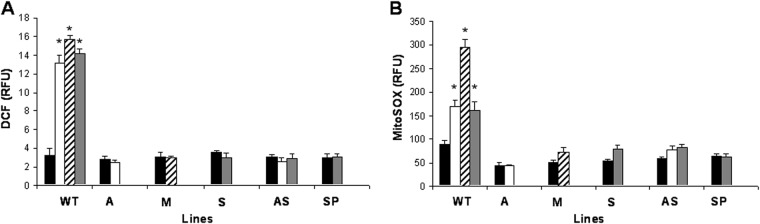
Drug-induced ROS generation in L. donovani lines. The L. donovani lines control (WTM), A, M, S, AS, and SP were left untreated (black columns) or exposed to 0.1 μM AmB (white columns), 10 μM MIL (diagonal line columns), or 100 μM SbIII (gray columns) for 48 h. The parasites were incubated with 40 nM H2DCFDA for 30 min at 28°C (A) or 5 μM MitoSOX for 2 h at 28°C (B). The fluorescence intensity was determined by flow cytometry analysis and expressed as relative fluorescence units (RFU). The data are the means ± standard deviation (SD) values from three independent experiments. Significant differences versus the control were determined by Student's t test (*, P < 0.001).
FIG 6
FIG 6
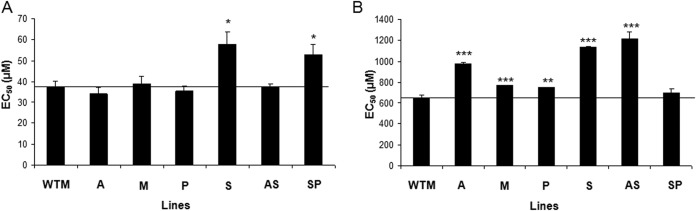
Drug susceptibility profile to menadione and H2O2 in L. donovani lines. Promastigote forms of L. donovani lines (WTM and resistant lines A, M, P, S, AS, and SP) were grown as described in Materials and Methods for 72 h at 28°C in the presence of increasing concentrations of menadione (A) or H2O2 (B). Cell viability was determined using an MTT-based assay. The data are the mean EC50 ± SD from three independent experiments. Significant differences versus the WTM were determined using Student's t test (*, P < 0.01; **, P < 0.005; ***, P < 0.001). The black line indicates the threshold at which the levels of EC50 have been modified versus WTM.

References

    1. Alvar J, Velez ID, Bern C, Herrero M, Desjeux P, Cano J, Jannin J, den Boer M, WHO Leishmaniasis Control Team . 2012. Leishmaniasis worldwide and global estimates of its incidence. PLoS One 7:e35671. doi: 10.1371/journal.pone.0035671. - DOI - PMC - PubMed
    1. Sundar S. 2001. Drug resistance in Indian visceral leishmaniasis. Trop Med Int Health 6:849–854. doi: 10.1046/j.1365-3156.2001.00778.x. - DOI - PubMed
    1. Sundar S, More DK, Singh MK, Singh VP, Sharma S, Makharia A, Kumar PC, Murray HW. 2000. Failure of pentavalent antimony in visceral leishmaniasis in India: report from the center of the Indian epidemic. Clin Infect Dis 31:1104–1107. doi: 10.1086/318121. - DOI - PubMed
    1. Ashutosh, Sundar S, Goyal N. 2007. Molecular mechanisms of antimony resistance in Leishmania. J Med Microbiol 56:143–153. doi: 10.1099/jmm.0.46841-0. - DOI - PubMed
    1. Mookerjee Basu J, Mookerjee A, Sen P, Bhaumik S, Sen P, Banerjee S, Naskar K, Choudhuri SK, Saha B, Raha S, Roy S. 2006. Sodium antimony gluconate induces generation of reactive oxygen species and nitric oxide via phosphoinositide 3-kinase and mitogen-activated protein kinase activation in Leishmania donovani-infected macrophages. Antimicrob Agents Chemother 50:1788–1797. doi: 10.1128/AAC.50.5.1788-1797.2006. - DOI - PMC - PubMed

Publication types

MeSH terms

LinkOut - more resources