


Difference between 24-h diet recall and urine excretion for assessing population sodium and potassium intake in adults aged 18-39 y
- PMID: 25646336
- PMCID: PMC4307208
- DOI: 10.3945/ajcn.113.081604
Difference between 24-h diet recall and urine excretion for assessing population sodium and potassium intake in adults aged 18-39 y
Abstract
Background: Limited data are available on the accuracy of 24-h dietary recalls used to monitor US sodium and potassium intakes.
Objective: We examined the difference in usual sodium and potassium intakes estimated from 24-h dietary recalls and urine collections.
Design: We used data from a cross-sectional study in 402 participants aged 18-39 y (∼50% African American) in the Washington, DC, metropolitan area in 2011. We estimated means and percentiles of usual intakes of daily dietary sodium (dNa) and potassium (dK) and 24-h urine excretion of sodium (uNa) and potassium (uK). We examined Spearman's correlations and differences between estimates from dietary and urine measures. Multiple linear regressions were used to evaluate the factors associated with the difference between dietary and urine measures.
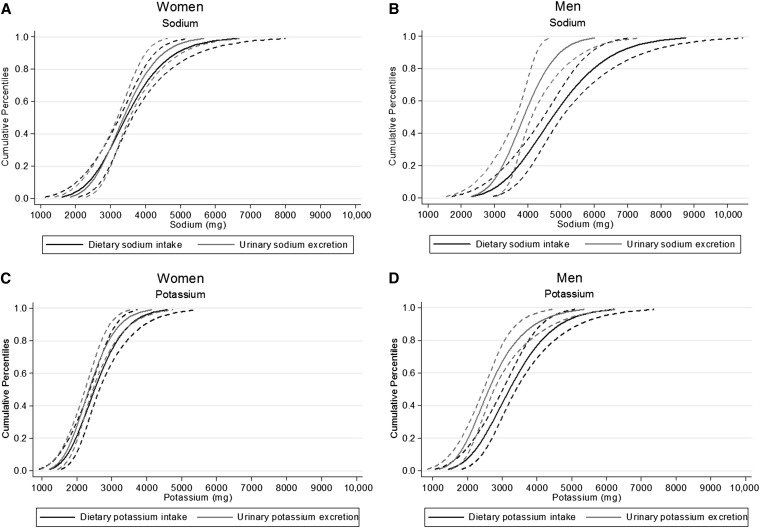
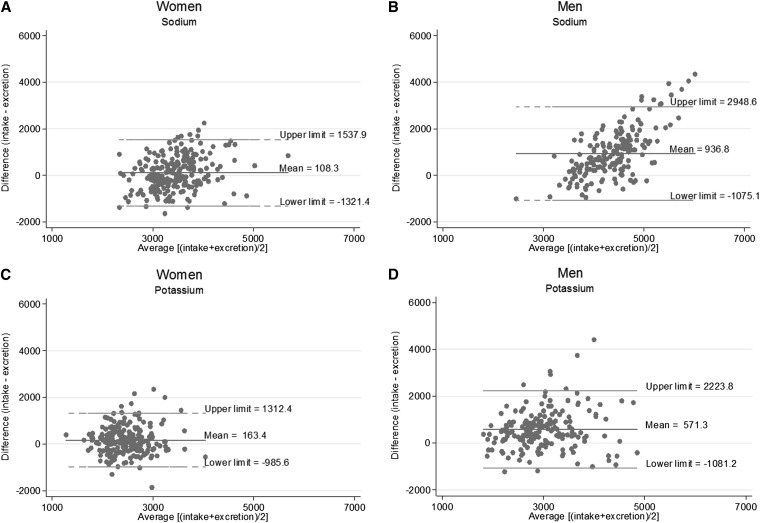
Results: Mean differences between diet and urine estimates were higher in men [dNa - uNa (95% CI) = 936.8 (787.1, 1086.5) mg/d and dK - uK = 571.3 (448.3, 694.3) mg/d] than in women [dNa - uNa (95% CI) = 108.3 (11.1, 205.4) mg/d and dK - uK = 163.4 (85.3, 241.5 mg/d)]. Percentile distributions of diet and urine estimates for sodium and potassium differed for men. Spearman's correlations between measures were 0.16 for men and 0.25 for women for sodium and 0.39 for men and 0.29 for women for potassium. Urinary creatinine, total caloric intake, and percentages of nutrient intake from mixed dishes were independently and consistently associated with the differences between diet and urine estimates of sodium and potassium intake. For men, body mass index was also associated. Race was associated with differences in estimates of potassium intake.
Conclusions: Low correlations and differences between dietary and urinary sodium or potassium may be due to measurement error in one or both estimates. Future analyses using these methods to assess sodium and potassium intake in relation to health outcomes may consider stratifying by factors associated with the differences in estimates from these methods. This trial was registered at clinicaltrials.gov as NCT01631240.
Keywords: biomarker; diet; sodium; urine; validation study.
© 2015 American Society for Nutrition.
Figures
References
-
- Polonia J, Maldonado J, Ramos R, Bertoquini S, Duro M, Almeida C, Ferreira J, Barbosa L, Silva JA, Martins L. Estimation of salt intake by urinary sodium excretion in a Portuguese adult population and its relationship to arterial stiffness. Rev Port Cardiol 2006;25(9):801–17. - PubMed
-
- Kwok TC, Chan TY, Woo J. Relationship of urinary sodium/potassium excretion and calcium intake to blood pressure and prevalence of hypertension among older Chinese vegetarians. Eur J Clin Nutr 2003;57:299–304. - PubMed
-
- Blackwood AM, Sagnella GA, Cook DG, Cappuccio FP. Urinary calcium excretion, sodium intake and blood pressure in a multi-ethnic population: results of the Wandsworth Heart and Stroke Study. J Hum Hypertens 2001;15:229–37. - PubMed
-
- Liu L, Ikeda K, Yamori Y. Twenty-four hour urinary sodium and 3-methylhistidine excretion in relation to blood pressure in Chinese: results from the China-Japan cooperative research for the WHO-CARDIAC study. Hypertens Res 2000;23(2):151–7. - PubMed
-
- Institute of Medicine. Dietary Reference Intakes for water, potassium, sodium, chloride, and sulfate. Washington, DC: The National Academies Press; 2005.
Publication types
MeSH terms
Substances
Associated data
LinkOut - more resources
Full Text Sources
Other Literature Sources
Medical
