


Plasma butyrylcholinesterase regulates ghrelin to control aggression
- PMID: 25646463
- PMCID: PMC4343161
- DOI: 10.1073/pnas.1421536112
Plasma butyrylcholinesterase regulates ghrelin to control aggression
Erratum in
-
Correction for Chen et al., Plasma butyrylcholinesterase regulates ghrelin to control aggression.Proc Natl Acad Sci U S A. 2015 Mar 24;112(12):E1510. doi: 10.1073/pnas.1503913112. Epub 2015 Mar 3. Proc Natl Acad Sci U S A. 2015. PMID: 25737546 Free PMC article. No abstract available.
Abstract
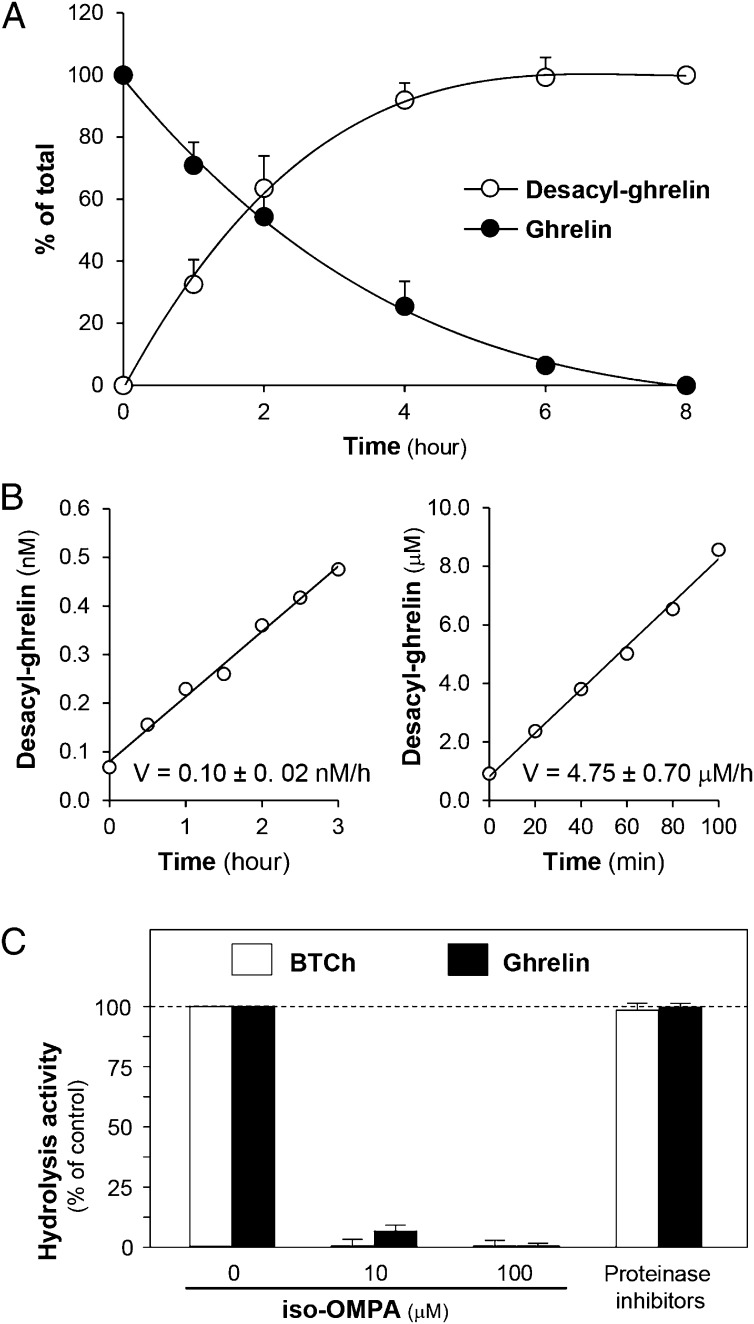
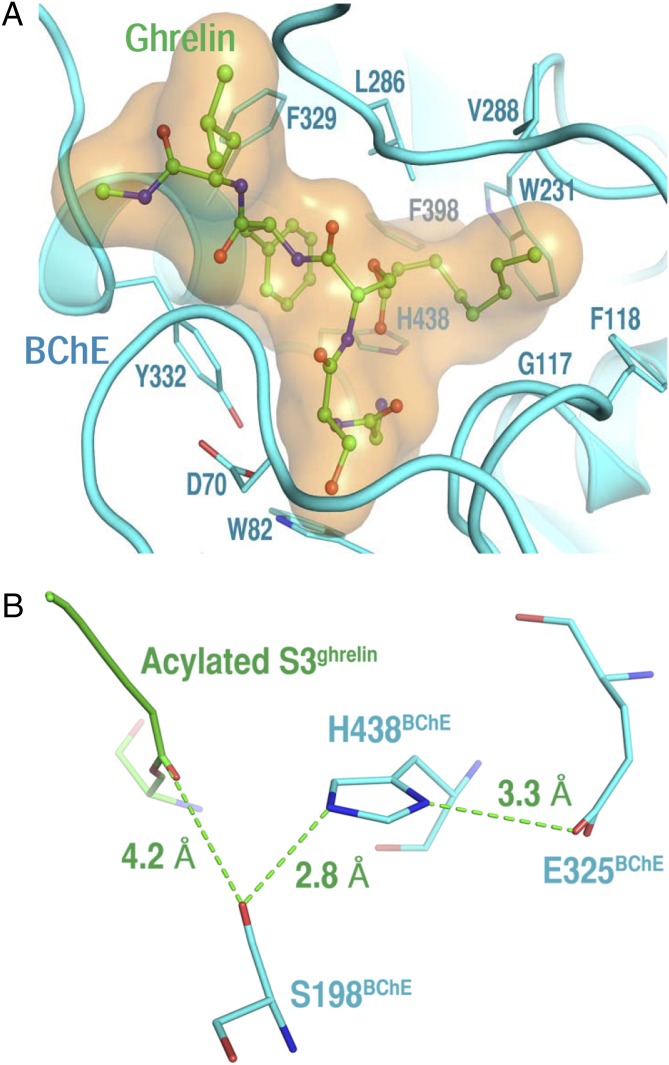
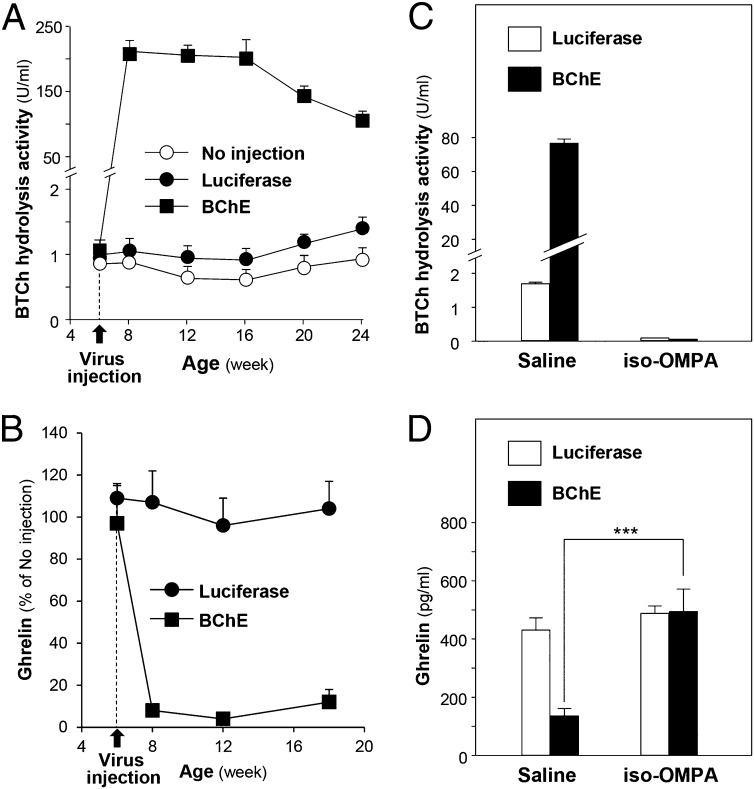
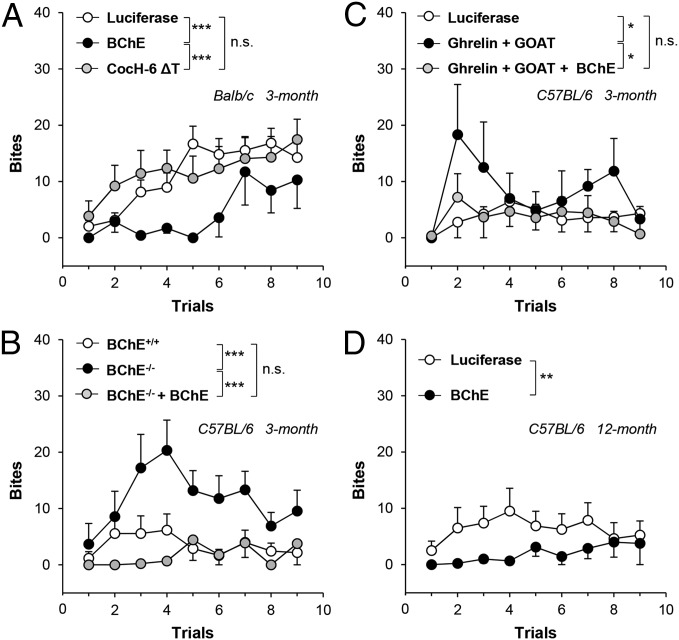
Ongoing mouse studies of a proposed therapy for cocaine abuse based on viral gene transfer of butyrylcholinesterase (BChE) mutated for accelerated cocaine hydrolysis have yielded surprising effects on aggression. Further investigation has linked these effects to a reduction in circulating ghrelin, driven by BChE at levels ∼ 100-fold above normal. Tests with human BChE showed ready ghrelin hydrolysis at physiologic concentrations, and multiple low-mass molecular dynamics simulations revealed that ghrelin's first five residues fit sterically and electrostatically into BChE's active site. Consistent with in vitro results, male BALB/c mice with high plasma BChE after gene transfer exhibited sharply reduced plasma ghrelin. Unexpectedly, such animals fought less, both spontaneously and in a resident/intruder provocation model. One mutant BChE was found to be deficient in ghrelin hydrolysis. BALB/c mice transduced with this variant retained normal plasma ghrelin levels and did not differ from untreated controls in the aggression model. In contrast, C57BL/6 mice with BChE gene deletion exhibited increased ghrelin and fought more readily than wild-type animals. Collectively, these findings indicate that BChE-catalyzed ghrelin hydrolysis influences mouse aggression and social stress, with potential implications for humans.
Keywords: BChE; aggression; ghrelin; mice; viral vector.
Conflict of interest statement
The authors declare no conflict of interest.
Figures
References
-
- Silver A. The Biology of Cholinesterases. North-Holland; Oxford: 1974.
-
- Kojima M, Kangawa K. Ghrelin: Structure and function. Physiol Rev. 2005;85(2):495–522. - PubMed
-
- De Vriese C, et al. Ghrelin degradation by serum and tissue homogenates: Identification of the cleavage sites. Endocrinology. 2004;145(11):4997–5005. - PubMed
Publication types
MeSH terms
Substances
Grants and funding
LinkOut - more resources
Full Text Sources
Other Literature Sources
Molecular Biology Databases
Miscellaneous
