


Risk of Ovarian Cancer Relapse score: a prognostic algorithm to predict relapse following treatment for advanced ovarian cancer
- PMID: 25647256
- PMCID: PMC4340599
- DOI: 10.1097/IGC.0000000000000361
Risk of Ovarian Cancer Relapse score: a prognostic algorithm to predict relapse following treatment for advanced ovarian cancer
Abstract
Objective: The aim of this study was to construct a prognostic index that predicts risk of relapse in women who have completed first-line treatment for ovarian cancer (OC).
Methods: A database of OC cases from 2000 to 2010 was interrogated for International Federation of Gynecology and Obstetrics stage, grade and histological subtype of cancer, preoperative and posttreatment CA-125 level, presence or absence of residual disease after cytoreductive surgery and on postchemotherapy computed tomography scan, and time to progression and death. The strongest predictors of relapse were included into an algorithm, the Risk of Ovarian Cancer Relapse (ROVAR) score.
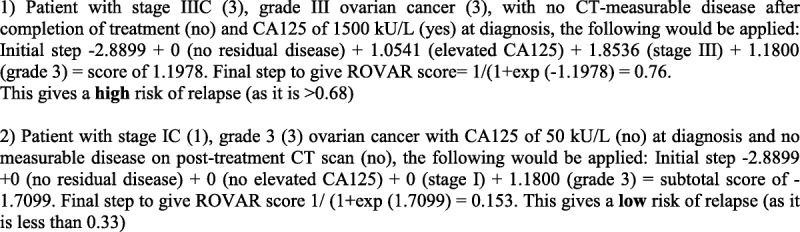
Results: Three hundred fifty-four cases of OC were analyzed to generate the ROVAR score. Factors selected were preoperative serum CA-125, International Federation of Gynecology and Obstetrics stage and grade of cancer, and presence of residual disease at posttreatment computed tomography scan. In the validation data set, the ROVAR score had a sensitivity and specificity of 94% and 61%, respectively. The concordance index for the validation data set was 0.91 (95% confidence interval, 0.85-0.96). The score allows patient stratification into low (<0.33), intermediate (0.34-0.67), and high (>0.67) probability of relapse.
Conclusions: The ROVAR score stratifies patients according to their risk of relapse following first-line treatment for OC. This can broadly facilitate the appropriate tailoring of posttreatment care and support.
References
-
- Office for National Statistics [on request], June 2012. http://www.ons.gov.uk/ons/rel/vsob1/cancer-statistics-registrations–engl.... Accessed May 1, 2014.
-
- Siegel R, Naishadham D, Jemal A. Cancer statistics. Ca Cancer J Clin. 2013; 63: 11– 30. - PubMed
-
- on behalf of the ESMO Guidelines Working Group. Newly diagnosed and relapsed epithelial ovarian carcinoma: ESMO Clinical Practice Guidelines for diagnosis, treatment and follow-up. Ann Oncol. 2013; 24 (suppl 6): vi24– vi32. - PubMed
-
- Gynecologic Oncology Group. Phase III trial of carboplatin and paclitaxel compared with cisplatin and paclitaxel in patients with optimally resected stage III ovarian cancer: a Gynecologic Oncology Group study. J Clin Oncol. 2003; 21: 3194– 3200. - PubMed
Publication types
MeSH terms
Substances
LinkOut - more resources
Full Text Sources
Medical
Research Materials
Miscellaneous
