


Preventing Obesity in the Military Community (POMC): the development of a clinical trials research network
- PMID: 25648176
- PMCID: PMC4344661
- DOI: 10.3390/ijerph120201174
Preventing Obesity in the Military Community (POMC): the development of a clinical trials research network
Abstract
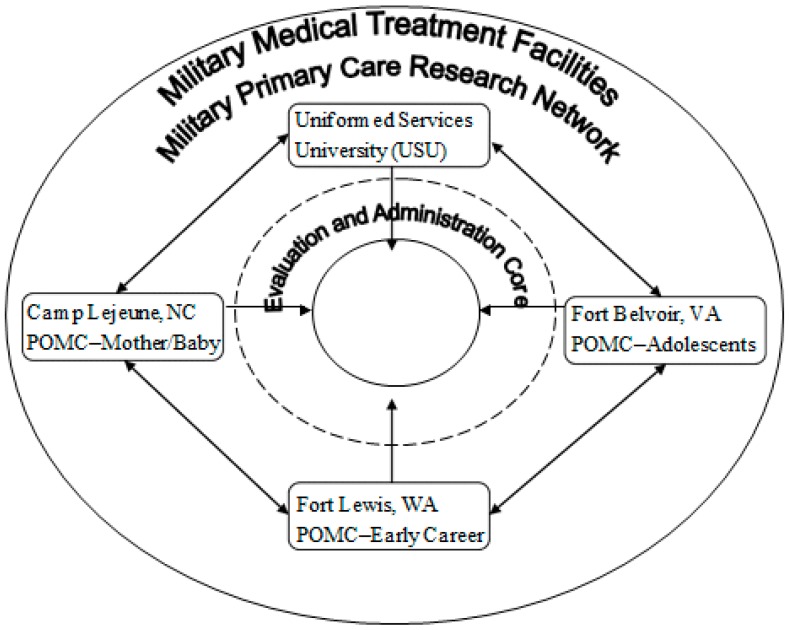
Obesity impacts the U.S. military by affecting the health and readiness of active duty service members and their families. Preventing Obesity in Military Communities (POMC) is a comprehensive research program within Patient Centered Medical Homes (PCMHs) in three Military Training Facilities. This paper describes three pilot randomized controlled trials that target critical high risk periods for unhealthy weight gain from birth to young adulthood: (1) pregnancy and early infancy (POMC-Mother-Baby), (2) adolescence (POMC-Adolescent), and (3) the first tour of duty after boot camp (POMC-Early Career). Each study employs a two-group randomized treatment or prevention program with follow up. POMC offers a unique opportunity to bring together research and clinical expertise in obesity prevention to develop state-of-the-art programs within PCMHs in Military Training Facilities. This research builds on existing infrastructure that is expected to have immediate clinical benefits to DoD and far-reaching potential for ongoing collaborative work. POMC may offer an economical approach for widespread obesity prevention, from conception to young adulthood, in the U.S. military as well as in civilian communities.
References
-
- Barlas F.M., Higgins W.B., Pflieger J.C., Diecker K. 2011 Department of Defense Health Related Behaviors Survey of Active Duty Military Personnel. ICF International; Fairfax, VA, USA: 2013.
-
- Registry M.B. Military Brat Survey Results. [(accessed on 19 October 2014)]. Available online: http://www.militarybrat.com/surveyresults2b.cfm.
Publication types
MeSH terms
Grants and funding
LinkOut - more resources
Full Text Sources
Other Literature Sources
Medical
Miscellaneous
