


Duration of Colonization and Determinants of Earlier Clearance of Colonization With Methicillin-Resistant Staphylococcus aureus
- PMID: 25648237
- PMCID: PMC4490328
- DOI: 10.1093/cid/civ075
Duration of Colonization and Determinants of Earlier Clearance of Colonization With Methicillin-Resistant Staphylococcus aureus
Abstract
Background: The duration of colonization and factors associated with clearance of methicillin-resistant Staphylococcus aureus (MRSA) after community-onset MRSA skin and soft-tissue infection (SSTI) remain unclear.
Methods: We conducted a prospective cohort study of patients with acute MRSA SSTI presenting to 5 adult and pediatric academic hospitals from 1 January 2010 through 31 December 2012. Index patients and household members performed self-sampling for MRSA colonization every 2 weeks for 6 months. Clearance of colonization was defined as negative MRSA surveillance cultures during 2 consecutive sampling periods. A Cox proportional hazards regression model was developed to identify determinants of clearance of colonization.
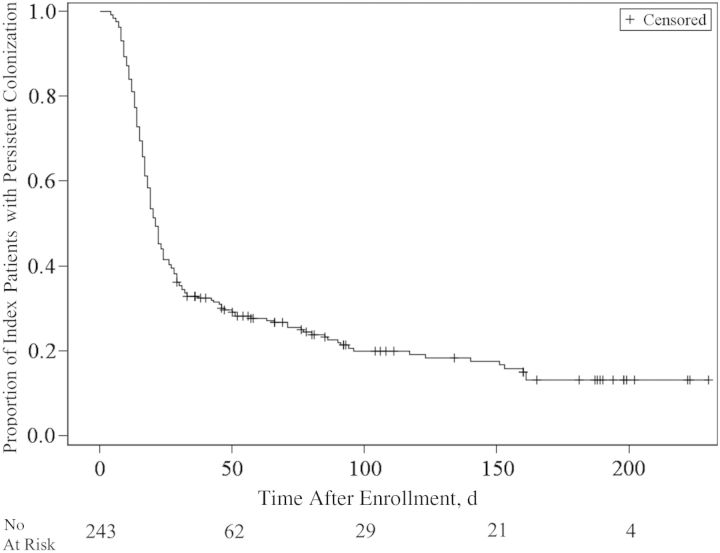
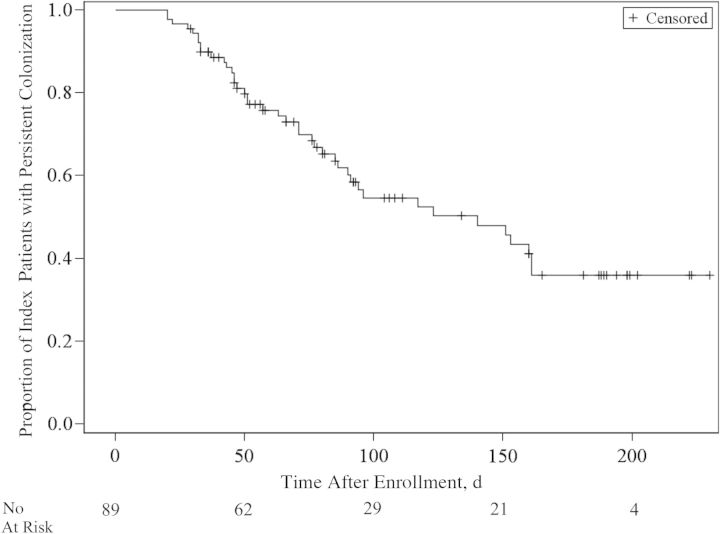
Results: Two hundred forty-three index patients were included. The median duration of MRSA colonization after SSTI diagnosis was 21 days (95% confidence interval [CI], 19-24), and 19.8% never cleared colonization. Treatment of the SSTI with clindamycin was associated with earlier clearance (hazard ratio [HR], 1.72; 95% CI, 1.28-2.30; P < .001). Older age (HR, 0.99; 95% CI, .98-1.00; P = .01) was associated with longer duration of colonization. There was a borderline significant association between increased number of household members colonized with MRSA and later clearance of colonization in the index patient (HR, 0.85; 95% CI, .71-1.01; P = .06).
Conclusions: With a systematic, regular sampling protocol, duration of MRSA colonization was noted to be shorter than previously reported, although 19.8% of patients remained colonized at 6 months. The association between clindamycin and shorter duration of colonization after MRSA SSTI suggests a possible role for the antibiotic selected for treatment of MRSA infection.
Keywords: MRSA colonization; MRSA decolonization; MRSA skin and soft-tissue infection; methicillin-resistant Staphylococcus aureus (MRSA).
© The Author 2015. Published by Oxford University Press on behalf of the Infectious Diseases Society of America. All rights reserved. For Permissions, please e-mail: journals.permissions@oup.com.
Figures

Comment in
-
Editorial Commentary: Duration of Colonization With Methicillin-Resistant Staphylococcus aureus: A Question With Many Answers.Clin Infect Dis. 2015 May 15;60(10):1497-9. doi: 10.1093/cid/civ082. Epub 2015 Feb 3. Clin Infect Dis. 2015. PMID: 25648241 Free PMC article. No abstract available.
References
-
- Pfaller MA, Jones RN, Doern GV, Kugler K. Bacterial pathogens isolated from patients with bloodstream infection: frequencies of occurrence and antimicrobial susceptibility patterns from the SENTRY antimicrobial surveillance program (United States and Canada, 1997). Antimicrob Agents Chemother 1998; 42:1762–70. - PMC - PubMed
-
- Zetola N, Francis JS, Nuermberger EL, Bishai WR. Community-acquired meticillin-resistant Staphylococcus aureus: an emerging threat. Lancet Infect Dis 2005; 5:275–86. - PubMed
-
- Salgado CD, Farr BM, Calfee DP. Community-acquired methicillin-resistant Staphylococcus aureus: a meta-analysis of prevalence and risk factors. Clin Infect Dis 2003; 36:131–9. - PubMed
Publication types
MeSH terms
Substances
Grants and funding
LinkOut - more resources
Full Text Sources
Other Literature Sources
Medical
