


Inconsistency in reporting abstention and heavy drinking frequency: associations with sex and socioeconomic status, and potential impacts
- PMID: 25648932
- PMCID: PMC4481535
- DOI: 10.1093/alcalc/agu106
Inconsistency in reporting abstention and heavy drinking frequency: associations with sex and socioeconomic status, and potential impacts
Abstract
Aims: To describe inconsistencies in reporting past-year drinking status and heavy drinking occasions (HDOs) on single questions from two different instruments, and to identify associated characteristics and impacts.
Methods: We compared computer-presented Alcohol Use Disorder Identification Test-Consumption (AUDIT-C) with categorical response options, and mental health interview (MHI) with open-ended consumption questions, completed on the same day. Participants were 464 men and 459 women aged 38 (91.7% of surviving birth cohort members). Differences in dichotomous single-item measures of abstention and HDO frequency, associations of inconsistent reporting with sex, socioeconomic status (SES) and survey order, and impacts of instrument choice on associations of alcohol with sex and SES were examined.
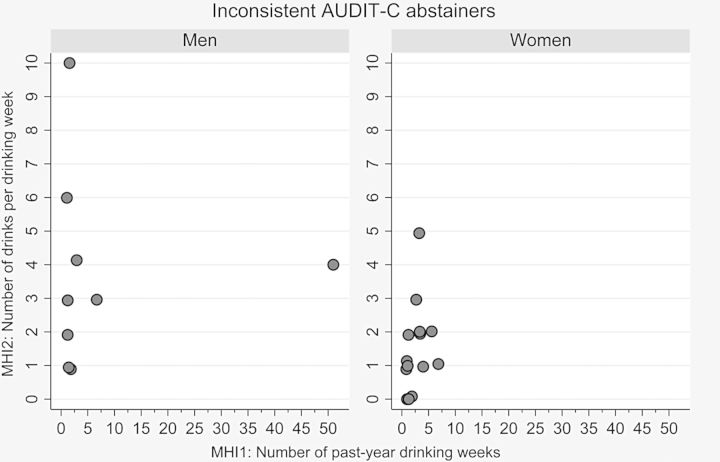
Results: The AUDIT-C drinking frequency question estimated higher past-year abstention prevalence (AUDIT = 7.6%, MHI = 5.4%), with one-third of AUDIT-C abstainers being MHI drinkers. Only AUDIT-C produced significant sex differences in abstainer prevalence. Inconsistencies in HDO classifications were bidirectional, but with fewer HDOs reported on the MHI than AUDIT-C question. Lower SES was associated with inconsistency in abstention and weekly+ HDOs. Abstention and higher HDO frequency were associated with lower SES overall, but sex-specific associations differed by instrument.
Conclusions: In this context, data collection method affected findings, with inconsistencies in abstention reports having most impact. Future studies should: (a) confirm self-reported abstention; (b) consider piloting data collection methods in target populations; (c) expect impacts of sex and SES on measurements and analyses.
© The Author 2015. Medical Council on Alcohol and Oxford University Press. All rights reserved.
Figures
References
-
- Altman D. (1991) Practical Statistics for Medical Research. London: Chapman & Hall.
-
- American Psychiatric Association. (2000) Diagnostic and Statistical Manual of Mental Disorders, DSM-IV-TR (text rev.). Washington, DC: American Psychiatric Association.
-
- Astudillo M, Connor J, Roiblatt RE, et al. (2013) Influence from friends to drink more or drink less: a cross-national comparison. Addict Behav 38:2675–82. - PubMed
-
- Australian Institute of Health and Welfare. (2011) 2010 National Drug Strategy Household Survey Report. Drug Statistics Series no. 25. Cat no. PHE 145 Canberra: AIHW.
-
- Bradley KA, DeBenedetti AF, Volk RJ, et al. (2007) AUDIT-C as a brief screen for alcohol misuse in primary care. Alcohol Clin Exp Res 31:1208–17. - PubMed
Publication types
MeSH terms
Grants and funding
LinkOut - more resources
Full Text Sources
Other Literature Sources
Medical
Miscellaneous
