AKI in hospitalized children: comparing the pRIFLE, AKIN, and KDIGO definitions
- PMID: 25649155
- PMCID: PMC4386245
- DOI: 10.2215/CJN.01900214
AKI in hospitalized children: comparing the pRIFLE, AKIN, and KDIGO definitions
Abstract
Background and objectives: Although several standardized definitions for AKI have been developed, no consensus exists regarding which to use in children. This study applied the Pediatric RIFLE (pRIFLE), AKI Network (AKIN), and Kidney Disease Improving Global Outcomes (KDIGO) criteria to an anonymized cohort of hospitalizations extracted from the electronic medical record to compare AKI incidence and outcomes in intensive care unit (ICU) and non-ICU pediatric populations.
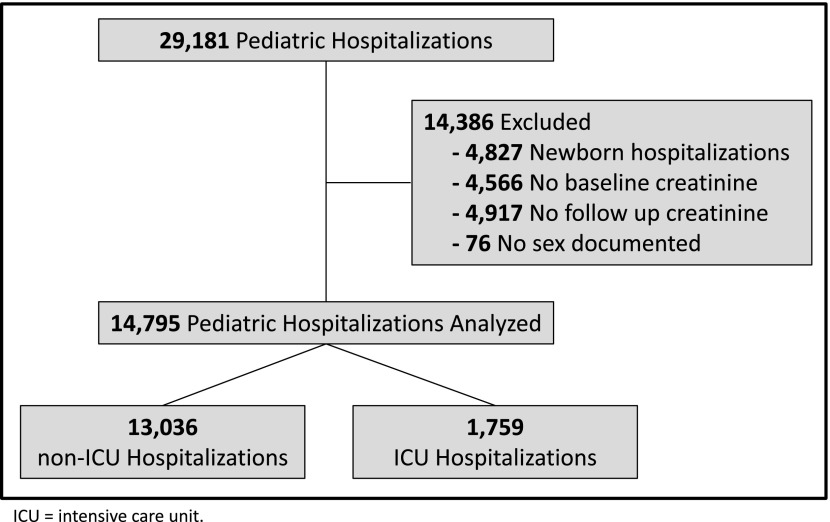
Design, setting, participants, & measurements: Observational, electronic medical record-enabled study of 14,795 hospitalizations at the Lucile Packard Children's Hospital between 2006 and 2010. AKI and AKI severity stage were defined by the pRIFLE, AKIN, and KDIGO definitions according to creatinine change criteria; urine output criteria were not used. The incidences of AKI and each AKI stage were calculated for each classification system. All-cause, in-hospital mortality and total hospital length of stay (LOS) were compared at each subsequent AKI stage by Fisher exact and Kolmogorov-Smirnov tests, respectively.
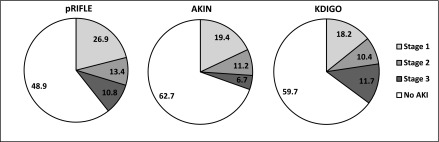
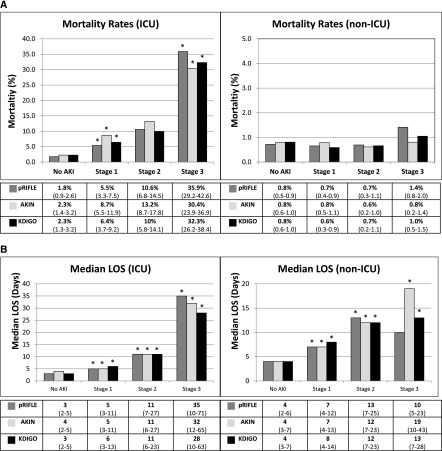
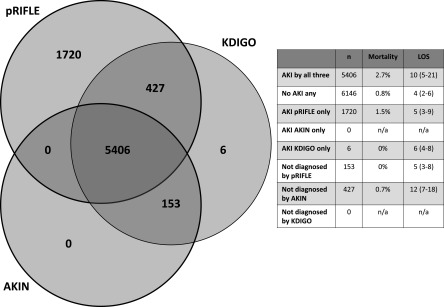
Results: AKI incidences across the cohort according to pRIFLE, AKIN, and KDIGO were 51.1%, 37.3%, and 40.3%. Mortality was higher among patients with AKI across all definitions (pRIFLE, 2.3%; AKIN, 2.7%; KDIGO, 2.5%; P<0.001 versus no AKI [0.8%-1.0%]). Within the ICU, pRIFLE, AKIN, and KDIGO demonstrated progressively higher mortality at each AKI severity stage; AKI was not associated with mortality outside the ICU by any definition. Both in and outside the ICU, AKI was associated with significantly higher LOS at each AKI severity stage across all three definitions (P<0.001). Definitions resulted in differences in diagnosis and staging of AKI; staging agreement ranged from 76.7% to 92.5%.
Conclusions: Application of the three definitions led to differences in AKI incidence and staging. AKI was associated with greater mortality and LOS in the ICU and greater LOS outside the ICU. All three definitions demonstrated excellent interstage discrimination. While each definition offers advantages, these results underscore the need to adopt a single, universal AKI definition.
Keywords: acute renal failure; children; kidney failure; mortality.
Copyright © 2015 by the American Society of Nephrology.
Figures
References
-
- Bellomo R, Ronco C, Kellum JA, Mehta RL, Palevsky P, Acute Dialysis Quality Initiative workgroup : Acute renal failure - definition, outcome measures, animal models, fluid therapy and information technology needs: The Second International Consensus Conference of the Acute Dialysis Quality Initiative (ADQI) Group. Crit Care 8: R204–R212, 2004 - PMC - PubMed
-
- Akcan-Arikan A, Zappitelli M, Loftis LL, Washburn KK, Jefferson LS, Goldstein SL: Modified RIFLE criteria in critically ill children with acute kidney injury. Kidney Int 71: 1028–1035, 2007 - PubMed
-
- KDIGO AKI Work Group : KDIGO clinical practice guideline for acute kidney injury. Kidney Int Suppl 2: 1–138, 2012
-
- Lafrance JP, Levin A: Defining AKI: Closer to getting the math right. Nephrol Dial Transplant 28: 1340–1342, 2013 - PubMed
Publication types
MeSH terms
Substances
LinkOut - more resources
Full Text Sources
Other Literature Sources