


Cost-effectiveness and affordability of community mobilisation through women's groups and quality improvement in health facilities (MaiKhanda trial) in Malawi
- PMID: 25649323
- PMCID: PMC4299571
- DOI: 10.1186/s12962-014-0028-2
Cost-effectiveness and affordability of community mobilisation through women's groups and quality improvement in health facilities (MaiKhanda trial) in Malawi
Abstract
Background: Understanding the cost-effectiveness and affordability of interventions to reduce maternal and newborn deaths is critical to persuading policymakers and donors to implement at scale. The effectiveness of community mobilisation through women's groups and health facility quality improvement, both aiming to reduce maternal and neonatal mortality, was assessed by a cluster randomised controlled trial conducted in rural Malawi in 2008-2010. In this paper, we calculate intervention cost-effectiveness and model the affordability of the interventions at scale.
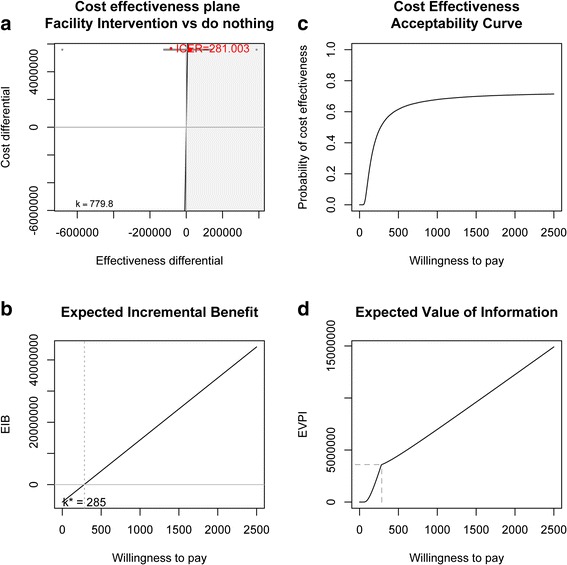
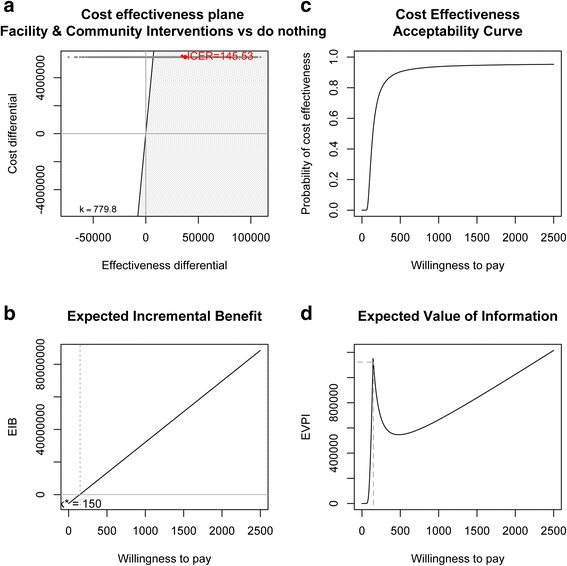
Methods: Bayesian methods are used to estimate the incremental cost-effectiveness of the community and facility interventions on their own (CI, FI), and together (FICI), compared to current practice in rural Malawi. Effects are estimated with Monte Carlo simulation using the combined full probability distributions of intervention effects on stillbirths, neonatal deaths and maternal deaths. Cost data was collected prospectively from a provider perspective using an ingredients approach and disaggregated at the intervention (not cluster or individual) level. Expected Incremental Benefit, Cost-effectiveness Acceptability Curves and Expected Value of Information (EVI) were calculated using a threshold of $780 per disability-adjusted life-year (DALY) averted, the per capita gross domestic product of Malawi in 2013 international $.
Results: The incremental cost-effectiveness of CI, FI, and combined FICI was $79, $281, and $146 per DALY averted respectively, compared to current practice. FI is dominated by CI and FICI. Taking into account uncertainty, both CI and combined FICI are highly likely to be cost effective (probability 98% and 93%, EVI $210,423 and $598,177 respectively). Combined FICI is incrementally cost effective compared to either intervention individually (probability 60%, ICER $292, EIB $9,334,580 compared to CI). Future scenarios also found FICI to be the optimal decision. Scaling-up to the whole of Malawi, CI is of greatest value for money, potentially averting 13.0% of remaining annual DALYs from stillbirths, neonatal and maternal deaths for the equivalent of 6.8% of current annual expenditure on maternal and neonatal health in Malawi.
Conclusions: Community mobilisation through women's groups is a highly cost-effective and affordable strategy to reduce maternal and neonatal mortality in Malawi. Combining community mobilisation with health facility quality improvement is more effective, more costly, but also highly cost-effective and potentially affordable in this context.
Keywords: Affordability; Community mobilisation; Cost-effectiveness; Future scenarios; MaiKhanda; Malawi; Quality improvement; Scale-up; Women’s groups.
Figures


References
-
- National Statistical Office (NSO), ICF Macro . Malawi Demographic and Health Survey 2010. Zomba, Malawi, and Calverton, Maryland, USA: NSO and ICF Macro; 2011.
-
- The Partnership for Maternal Newborn & Child Health . A Global Review of the Key Interventions Related to Reproductive, Maternal, Newborn and Child Health (RMNCH) Geneva, Switzerland: PMNCH; 2011.
-
- WHO, UNICEF . Countdown to 2015, Maternal, Newborn and Child Survival: Building a Brighter Future for Women and Children, The 2012 Report. 2012.
-
- Colbourn T, Nambiar B, Bondo A, Makwenda C, Tsetekani E, Makonda-Ridley A, et al. Effects of quality improvement in health facilities and community mobilisation through women’s groups on maternal, neonatal and perinatal mortality in three districts of Malawi: MaiKhanda, a cluster randomised controlled effectiveness trial. Int Health. 2013;5:180–95. doi: 10.1093/inthealth/iht011. - DOI - PMC - PubMed
Grants and funding
LinkOut - more resources
Full Text Sources
Other Literature Sources
