


The effect of a decaffeinated green tea extract formula on fat oxidation, body composition and exercise performance
- PMID: 25650043
- PMCID: PMC4307170
- DOI: 10.1186/s12970-014-0062-7
The effect of a decaffeinated green tea extract formula on fat oxidation, body composition and exercise performance
Abstract
Background: The cardio-metabolic and antioxidant health benefits of caffeinated green tea (GT) relate to its catechin polyphenol content. Less is known about decaffeinated extracts, particularly in combination with exercise. The aim of this study was therefore to determine whether a decaffeinated green tea extract (dGTE) positively influenced fat oxidation, body composition and exercise performance in recreationally active participants.
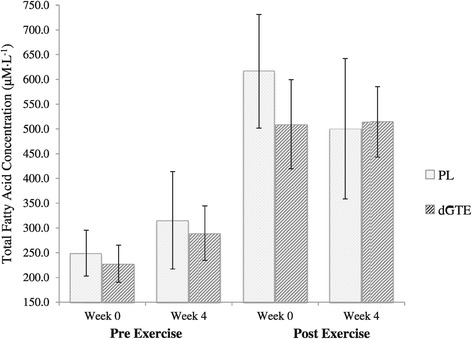
Methods: Fourteen, recreationally active males participated in a double-blind, placebo-controlled, parallel design intervention (mean ± SE; age = 21.4 ± 0.3 yrs; weight = 76.37 ± 1.73 kg; body fat = 16.84 ± 0.97%, peak oxygen consumption [[Formula: see text]] = 3.00 ± 0.10 L·min(-1)). Participants were randomly assigned capsulated dGTE (571 mg·d(-1); n = 7) or placebo (PL; n = 7) for 4 weeks. Following body composition and resting cardiovascular measures, participants cycled for 1 hour at 50% [Formula: see text], followed by a 40 minute performance trial at week 0, 2 and 4. Fat and carbohydrate oxidation was assessed via indirect calorimetry. Pre-post exercise blood samples were collected for determination of total fatty acids (TFA). Distance covered (km) and average power output (W) were assessed as exercise performance criteria.
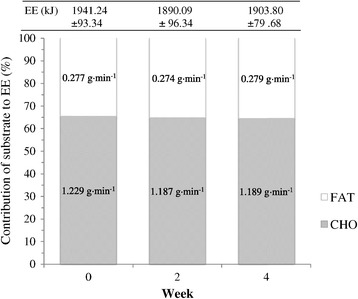
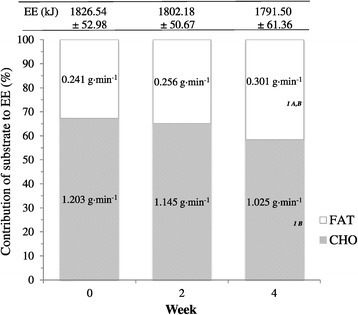
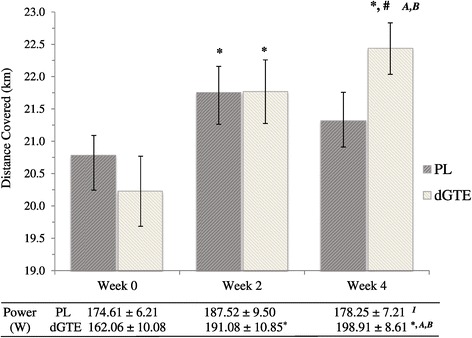
Results: Total fat oxidation rates increased by 24.9% from 0.241 ± 0.025 to 0.301 ± 0.009 g·min(-1) with dGTE (P = 0.05; ηp(2) = 0.45) by week 4, whereas substrate utilisation was unaltered with PL. Body fat significantly decreased with dGTE by 1.63 ± 0.16% in contrast to PL over the intervention period (P < 0.001; ηp(2) = 0.84). No significant changes for FFA or blood pressure between groups were observed. dGTE resulted in a 10.9% improvement in performance distance covered from 20.23 ± 0.54 km to 22.43 ± 0.40 km by week 4 (P < 0.001; ηp(2) = 0.85).
Conclusions: A 4 week dGTE intervention favourably enhanced substrate utilisation and subsequent performance indices, but did not alter TFA concentrations in comparison to PL. The results support the use of catechin polyphenols from dGTE in combination with exercise training in recreationally active volunteers.
Keywords: Body composition; Exercise performance; Fat oxidation; Green tea.
Figures
References
-
- Dulloo AG, Duret C, Rohrer D, Girardier L, Mensi N, Fathi M, et al. Efficacy of a green tea extract rich in catechin polyphenols and caffeine in increasing 24-h energy expenditure and fat oxidation in humans. Am J Clin Nutr. 1999;70:1040–50. - PubMed
-
- Venables MC, Hulston CJ, Cox HR, Jeukendrup AE. Green tea extract ingestion, fat oxidation, and glucose tolerance in healthy humans. Am J Clin Nutr. 2008;87:778–84. - PubMed
-
- Mukhtar H, Ahmad N. Tea polyphenols: prevention of cancer and optimizing health. Am J Clin Nutr. 2000;71(6):1698S–702. - PubMed
LinkOut - more resources
Full Text Sources
Other Literature Sources
Medical
Miscellaneous
