


Compensatory biliary and urinary excretion of gadobenate ion after administration of gadobenate dimeglumine (MultiHance(®)) in cases of impaired hepatic or renal function: a mechanism that may aid in the prevention of nephrogenic systemic fibrosis?
- PMID: 25651409
- PMCID: PMC4651256
- DOI: 10.1259/bjr.20140526
Compensatory biliary and urinary excretion of gadobenate ion after administration of gadobenate dimeglumine (MultiHance(®)) in cases of impaired hepatic or renal function: a mechanism that may aid in the prevention of nephrogenic systemic fibrosis?
Abstract
Objective: To determine whether increased elimination of gadobenate ion via the hepatobiliary pathway might compensate for reduced/absent elimination via the urinary pathway in the event of compromised renal function, as a possible protective mechanism against nephrogenic systemic fibrosis (NSF).
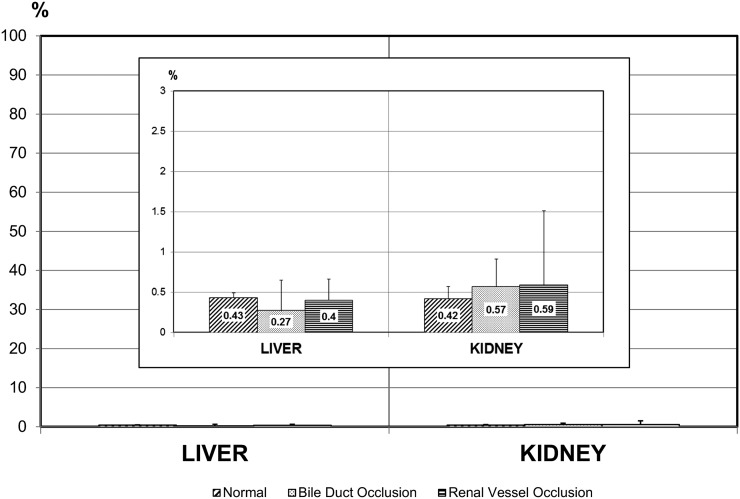
Methods: 15 male Crl:CD(®) R(SD)Br rats (Charles River Italia, Como, Italy) randomized to three treatment groups: (1) animals with occluded bile ducts, (2) animals with occluded renal vessels and (3) control animals, each received 0.25 mmol kg(-1) of bodyweight of gadobenate dimeglumine (MultiHance(®); Bracco Imaging SpA, Milan, Italy). Urine and bile were collected from 0-30, 30-60, 60-120, 120-240 and 240-480 min after gadobenate dimeglumine administration prior to exsanguination. Determinations of gadobenate ion in blood, bile and urine were performed by high-performance liquid chromatography. Gadolinium (Gd(3+)) levels in excised liver and kidneys were determined by X-ray fluorescence.
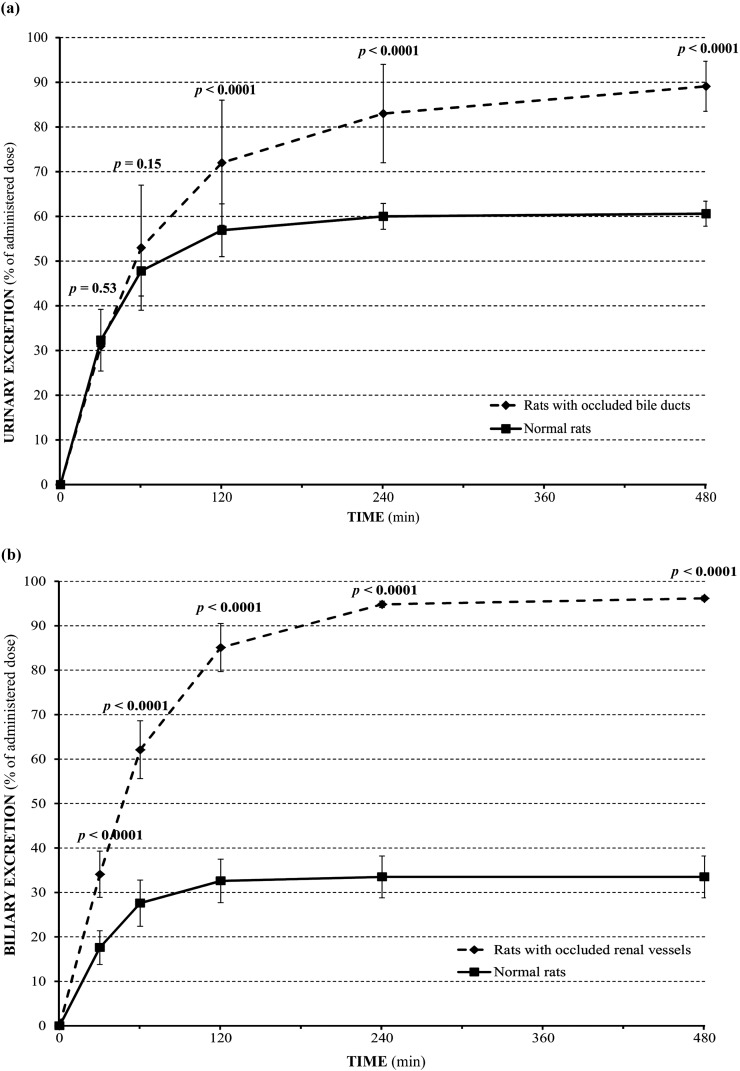
Results: The recovery of gadobenate ion in the urine of rats with bile duct occlusion was significantly higher than that in the urine of normal rats (89.1 ± 4.2% vs 60.6 ± 2.8%; p < 0.0001). Conversely, mean recovery in the bile of rats with renal vessel occlusion was significantly higher than that in the bile of normal rats (96.16 ± 0.55% vs 33.5 ± 4.7%; p < 0.0001). Gadobenate ion was not quantifiable in any group 8 h post-injection.
Conclusion: Compensatory elimination may be an effective means to overcome compromised renal or hepatobiliary elimination.
Advances in knowledge: The absence of NSF in at-risk patients administered with gadobenate dimeglumine may in part reflect greater Gd(3+) elimination via the hepatobiliary route.
Figures
References
-
- Cowper SE, Su LD, Bhawan J, Robin HS, LeBoit PE. Nephrogenic fibrosing dermopathy. Am J Dermatopathol 2001; 23: 383–93. - PubMed
-
- Cowper SE, Robin HS, Steinberg SM, Su LD, Gupta S, LeBoit PE. Scleromyxoedema-like cutaneous diseases in renal-dialysis patients. Lancet 2000; 356: 1000–1. - PubMed
-
- Grobner T. Gadolinium—a specific trigger for the development of nephrogenic fibrosing dermopathy and nephrogenic systemic fibrosis? Nephrol Dial Transplant 2006; 21: 1104–8. Erratum in: Nephrol Dial Transplant 2006; 21: 1745. - PubMed
-
- Spinazzi A. MRI contrast agents and nephrogenic systemic fibrosis. In: Shellock FG, Crues JV, eds. MRI bioeffects, safety, and patient management. Los Angeles, CA: Biomedical Research Publishing Group; 2014. pp. 256–81.
Publication types
MeSH terms
Substances
LinkOut - more resources
Full Text Sources
Other Literature Sources
