. 2015 Feb 5:15:8.
doi: 10.1186/s12906-015-0524-8.

Exploring the anti-diabetic potential of Australian Aboriginal and Indian Ayurvedic plant extracts using cell-based assays

Affiliations

Exploring the anti-diabetic potential of Australian Aboriginal and Indian Ayurvedic plant extracts using cell-based assays

Vandana Gulati et al. BMC Complement Altern Med. .

Abstract

Background: Plant-derived compounds have been used clinically to treat type 2 diabetes for many years as they also exert additional beneficial effects on various other disorders. The aim of the present study was to investigate the possible mechanism of anti-diabetic activity of twelve (seven Australian Aboriginal and five Indian Ayurvedic) plant extracts.

Methods: The ethanolic plant extracts were investigated for glucose uptake and adipogenesis in murine 3T3-L1 adipocytes. Cytotoxicity studies were also carried out against two cancerous cell lines, HeLa and A549, to investigate the potential anti-cancer activities of the extracts.

Results: Of the seven Australian Aboriginal plant extracts tested, only Acacia kempeana and Santalum spicatum stimulated glucose uptake in adipocytes. Among the five Indian Ayurvedic plant extracts, only Curculigo orchioides enhanced glucose uptake. With respect to adipogenesis, the Australian plants Acacia tetragonophylla, Beyeria leshnaultii and Euphorbia drumondii and the Indian plants Pterocarpus marsupium, Andrographis paniculata and Curculigo orchioides reduced lipid accumulation in differentiated adipocytes. Extracts of Acacia kempeana and Acacia tetragonophylla showed potent and specific activity against HeLa cells.

Conclusions: The findings suggest that the plant extracts exert their anti-diabetic properties by different mechanisms, including the stimulation of glucose uptake in adipocytes, inhibition of adipogenesis or both. Apart from their anti-diabetic activities, some of the extracts have potential for the development of chemotherapeutic agents for the treatment of cervical cancer.


Figures
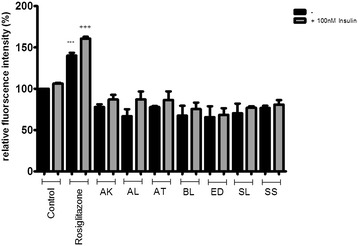
Figure 1
Figure 1
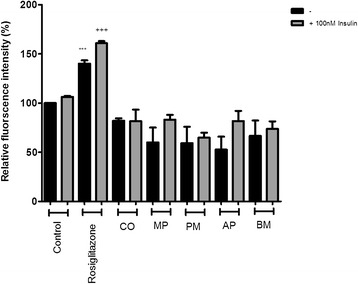
Effect of Australian Aboriginal plant extracts at 10 μg/ml on basal and insulin-stimulated glucose uptake in 3T3-L1 adipocytes. Cells were treated with individual extracts for 24 hours followed by incubation for 60 min in serum and glucose-free medium containing 80 μM 2-NBDG. Ethanol was used as a negative control, while rosiglitazone and insulin were used as positive controls. Cells received insulin only during 2-NBDG uptake. After incubation, fluorescence activity remaining in the cells was measured by a fluorescence microplate reader. Fluorescence activity in the absence of 2-NBDG was subtracted from all values. Data shown are mean ± SD of at least three independent experiments performed in triplicates. Significance against ethanol control (=100%): ***p < 0.001. Significance against ethanol + 100 nM insulin control: +++ p < 0.001.
Figure 2
Figure 2
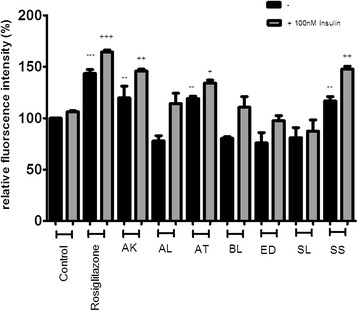
Effect of Indian Ayurvedic plant extracts at 10 μg/ml on basal and insulin-stimulated glucose uptake in 3T3-L1 adipocytes. Cells were treated with the individual extract for 24 hours followed by incubation for 60 min in serum and glucose-free medium containing 80 μM 2-NBDG. Ethanol was used as a negative control, while rosiglitazone and insulin were used as positive controls. Cells received insulin only during 2-NBDG uptake. After incubation, fluorescence activity remaining in the cells was measured by a fluorescence microplate reader. Fluorescence activity in the absence of 2-NBDG was subtracted from all values. Data shown are mean ± SD of at least three independent experiments performed in triplicates. Significance against ethanol control (=100%): ***p < 0.001. Significance against ethanol + 100 nM insulin control: +++ p < 0.001.
Figure 3
Figure 3
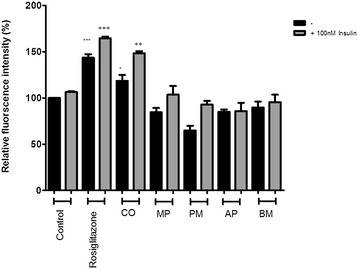
Effect of Australian Aboriginal plant extracts at 100 μg/ml on basal and insulin-stimulated glucose uptake in 3T3-L1 adipocytes. Cells were treated with individual extracts for 24 hours followed by incubation for 60 min in serum and glucose-free medium containing 80 μM 2-NBDG. Ethanol was used as a negative control, while rosiglitazone and insulin were used as positive controls. Cells received insulin only during 2-NBDG uptake. After incubation, fluorescence activity remaining in the cells was measured by a fluorescence microplate reader. Fluorescence activity in the absence of 2-NBDG was subtracted from all values. Data shown are mean ± SD of at least three independent experiments performed in triplicates. Significance against ethanol control (=100%): **p < 0.01, ***p < 0.001. Significance against ethanol + 100 nM insulin control: + p < 0.05, ++ p < 0.01, +++ p < 0.001.
Figure 4
Figure 4
Effect of Indian Ayurvedic plant extracts at 100 μg/ml on basal and insulin-stimulated glucose uptake in 3T3-L1 adipocytes. Cells were treated with the individual extract for 24 hours followed by incubation for 60 min in serum and glucose-free medium containing 80 μM 2-NBDG. Ethanol was used as a negative control, while rosiglitazone and insulin were used as positive controls. Cells received insulin only during 2-NBDG uptake. After incubation, fluorescence activity remaining in the cells was measured by a fluorescence microplate reader. Fluorescence activity in the absence of 2-NBDG was subtracted from all values. Data shown are mean ± SD of at least three independent experiments performed in triplicates. Significance against ethanol control (=100%): *p < 0.05, **p < 0.01, ***p < 0.001. Significance against ethanol + 100 nM insulin control: ++ p < 0.01, +++ p < 0.001.
Figure 5
Figure 5
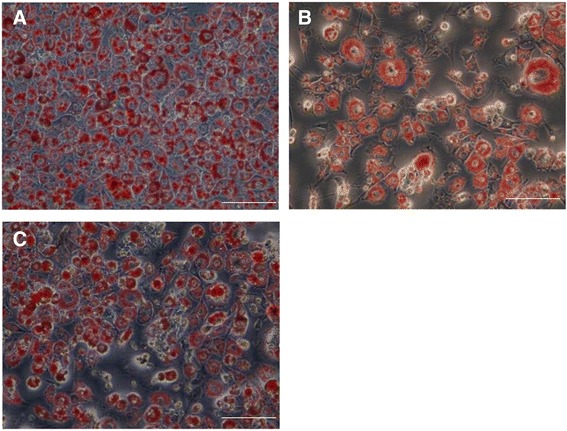
Effect of AT (B) and CO (C) extracts on fat droplet formation in 3T3-L1 cells as compared to control (A). Pre-adipocytes were differentiated with 100 μg/mL of AT and CO extracts treatment for 8 days after 72 hours of exposure, then stained with Oil Red O dye and examined using a light microscope. Scale bar is 50 μm.
Figure 6
Figure 6
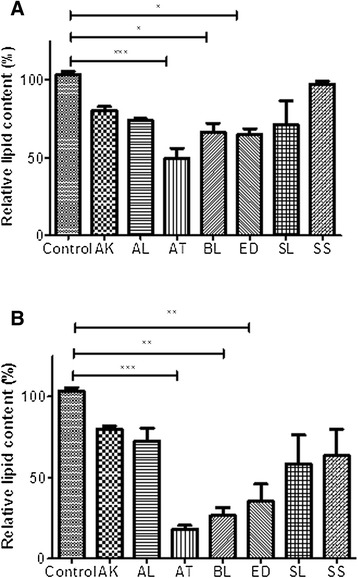
Effect of Australian Aboriginal plant extracts on Oil Red O staining in cultured 3T3-L1 adipocytes. (A) Effect of 10 μg/ml extracts and (B) Effect of 100 μg/ml extracts on fat droplet formation in 3T3-L1 cells. Values are expressed as mean ± standard deviation of at least three independent experiments. Values are mean ± SE (n = 3), significance against control (without plant extract) (=100%): ***p < 0.001 and *p < 0.05.
Figure 7
Figure 7
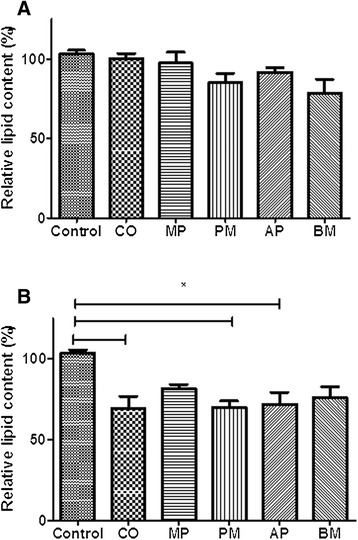
Effect of Indian Ayurvedic plant extracts on Oil Red O staining in cultured 3T3-L1 adipocytes. (A) Effect of 10 μg/ml extracts and (B) Effect of 100 μg/ml extracts on fat droplet formation in 3T3-L1 cells. Values are expressed as mean ± standard deviation of at least three independent experiments. Values are mean ± SE (n = 3), significance against control (without plant extracts) (=100%): * p < 0.05.

References

    1. Baldea LAN, Martineau LC, Benhaddou-Andaloussi A, Arnason JT, Levy E, Haddad PS. Inhibition of intestinal glucose absorption by anti-diabetic medicinal plants derived from the James Bay Cree traditional pharmacopeia. J Ethnopharmacol. 2010;132(2):473–82. doi: 10.1016/j.jep.2010.07.055. - DOI - PubMed
    1. Klein G, Kim J, Himmeldirk K, Cao Y, Chen X. Antidiabetes and anti-obesity activity of Lagerstroemia speciosa. Evidence Based Complementary and Alternative Medicine. 2007;4(4):401–8. doi: 10.1093/ecam/nem013. - DOI - PMC - PubMed
    1. Heller S. Weight gain during insulin therapy in patients with type 2 diabetes mellitus. Diabetes Res Clin Pract. 2004;65(0):S23–7. doi: 10.1016/j.diabres.2004.07.005. - DOI - PubMed
    1. Chan CH, Ngoh GC, Yusoff R. A brief review on anti diabetic plants: Global distribution, active ingredients, extraction techniques and acting mechanisms. Pharmacognosy Reviews. 2012;6(11):22. doi: 10.4103/0973-7847.95854. - DOI - PMC - PubMed
    1. Tom Yates MJD, Schwarz PEH, Khunti K. Diabetes prevention: a call to action. Indian J Med Res. 2011;134(November):579–82. doi: 10.4103/0971-5916.90979. - DOI - PMC - PubMed

MeSH terms